Market access is no longer a default right. It is a privilege earned through data verification. The European Union has erected two new borders—not on land, but in data. Together, they form the architecture of Carbon & Digital Borders:
- Carbon Borders (CBAM) audit the Molecule—your embedded emissions
- Digital Borders (DPP) audit the Electron—your data continuity
Welcome to the age of Audited Tradability. If you cannot digitize your carbon, you cannot monetize your product.
[ Explore the Compliance Matrix ↓ ]
I. Defining Audited Tradability
What Is Audited Tradability?
Audited Tradability is the capacity of an asset to cross regulatory borders by proving both its physical integrity (carbon) and digital integrity (data).
| The Old World | The New World |
|---|---|
| Free Trade | Audited Trade |
| If you make it, you sell it | If you prove it, you sell it |
| Market access by default | Market access by verification |
The EU has built two gates. Pass both or stay out.
| Gate | Mechanism | What It Audits | The Question |
|---|---|---|---|
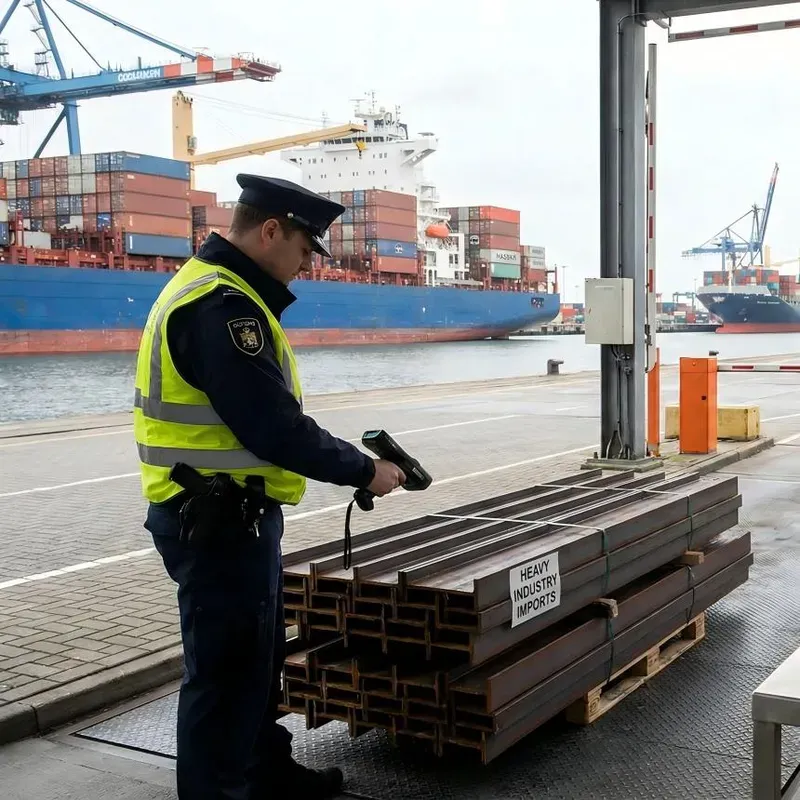
| Gate 1 | CBAM | The Molecule | How much carbon is embedded in your product? |
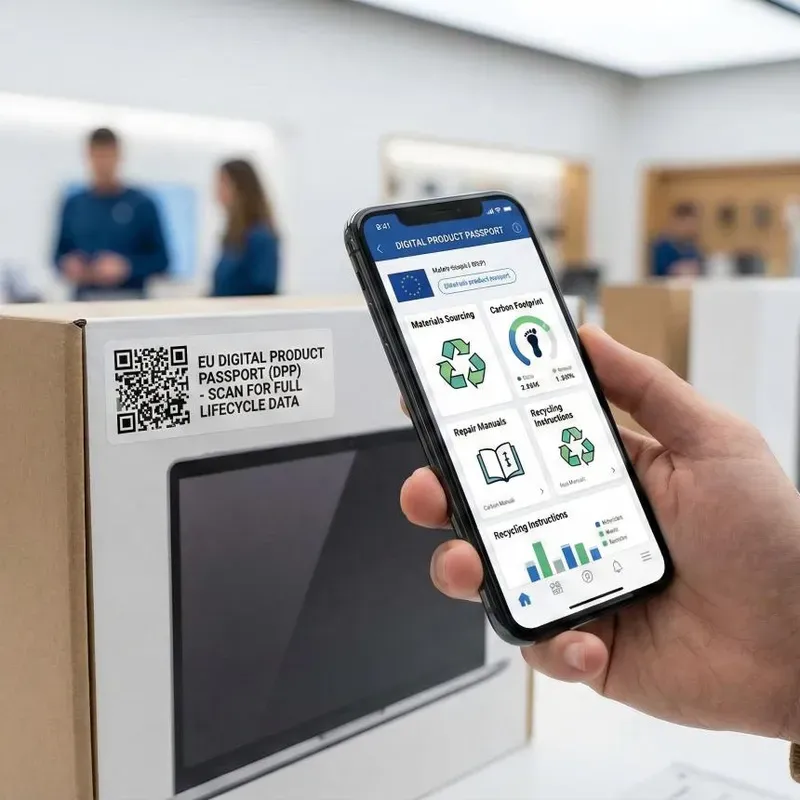
| Gate 2 | DPP | The Electron | Can your product's data chain be traced end-to-end? |
II. The Systemic Logic
Why One System?
The siloed approach—CBAM handled here, DPP handled there—misses the structural linkage between them.
A cybernetic view:
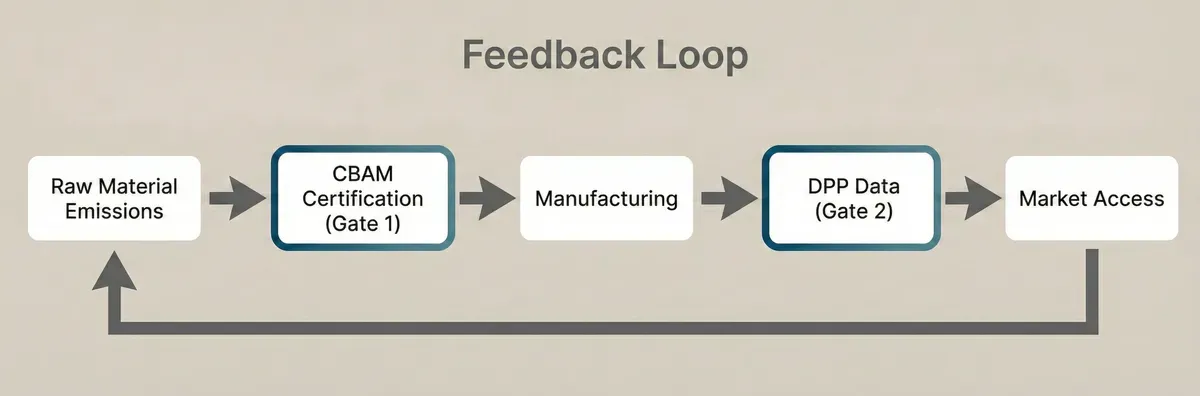
- Input Control (CBAM): If upstream suppliers: steel mills, aluminum smelters, lack verified carbon data...
- Output Control (DPP): ...then downstream products, batteries, vehicles, fail their passport audit.
DPP carries the carbon footprint data that CBAM needs to calculate. Without verified DPP data, exporters face punitive default values under CBAM. The two mechanisms are not parallel—they are sequential and interdependent. You cannot fix the Passport without fixing the Furnace.
III. The Compliance Matrix
Select Your Structural Bottleneck
1) Diagnostic Layer
| CBAM Diagnostics | Status | DPP Diagnostics | Status |
|---|---|---|---|
| 📊 The €90 Billion Blind Spot | 🟢 | 📋 The DPP Compliance Gap | Q2 2026 |
| Why nearly €90 billion in global trade needs a new framework | Structural challenges in Digital Product Passport adoption | ||
| 📉 Blind Spot 1: Implicit Carbon Costs | 🟢 | 🔐 Data Sovereignty Paradox | Q2 2026 |
| Why implicit carbon costs deserve recognition under Article 9 | The tension between transparency and data control | ||
| 🏭 Blind Spot 2: Clean Production Paradox | 🟢 | 🧮 The Cost of Traceability | Q2 2026 |
| When low carbon intensity meets zero deduction | SME compliance burden and the digital divide | ||
| 🌍 Blind Spot 3: Missing CBDR | 🟢 | ⚖️ Interoperability Crisis | Q2 2026 |
| Where is the principle of development differentiation? | Standard fragmentation across jurisdictions | ||
| 🔧 Blind Spot 4: Design Flaws | 🟢 | ||
| Design principles for future carbon border mechanisms |
2) Industry Layer
| CBAM Industries | Status | DPP Industries | Status |
|---|---|---|---|
| 🛡️ Iron & Steel | Coming | 🔋 Battery Passport | Coming |
| Blast furnace vs. EAF, the scrap gap | Critical minerals, carbon footprint, recyclability | ||
| ⚡ Aluminum & Electricity | Coming | 👕 Textiles & Fashion | Coming |
| Indirect emission traps and grid factors | Traceability from cotton field to retail shelf | ||
| 🏗️ Cement & Fertilizers | Coming | 📱 Consumer Electronics | Coming |
| Process emissions and chemical vectors | Right-to-repair and e-waste directives | ||
| 💧 Hydrogen | Coming | 🧱 Construction Materials | Coming |
| The green hydrogen certification gap | Material passports for green buildings | ||
| 🔗 Blockchain Infrastructure | Coming | ||
| From oracle problem to immutable verification |
IV. Regional Impact
Tradability Exposure by Region
Audited Tradability hits different economies differently.
🇨🇳 🇮🇳 🇹🇷 🇧🇷 🇿🇦 🇻🇳 🇰🇷 🇺🇦 🇷🇺 🇪🇬
Country-level Tradability risk assessments coming soon.
[ Subscribe for First Access → ]
V. From Tradability to Bankability
Why Audited Tradability Determines Financing
The death spiral:
No Compliance → No Market Access → Stranded Assets → No Financing
In 2026, financial institutions will not back assets that lack Audited Tradability. Data is the new collateral.
VI. Theoretical Foundation
The Framework Behind the Framework. Terawatt Times integrates Cybernetics, Science & Technology Studies, and International Trade Law to build the analytical architecture for Audited Tradability.
6.1 Climate Governance Architecture & CBAM Translation Series
VII. Action
[ Assess Your Audited Tradability → ]
[ Subscribe to Tradability Monitor → ]
Terawatt Times Institute
Decoding the energy transition through structural science. We advocate for frameworks that balance commercial bankability with climate justice.
Powered by Structural Science