What is a Terawatt? What is a Terawatt Times?
Welcome to THEORY: An Evolving Idea Lab
Editor's Note:
As Editor-in-Chief, I am excited to introduce you to the most unique and dynamic space in our publication.
We understand that the Terawatt-scale climate and energy transition is not happening in a static world. We are at the dawn of the age of Artificial Intelligence (AI), a massive shift that is fundamentally reshaping our cognitive processes, resource allocation, and even our power structures. Against this backdrop of radical transformation, the old theories we have long taken for granted are no longer sufficient.
To successfully navigate this historic transition, we cannot rely on fragmented insights. We must construct a new, coherent intellectual architecture.
This is the core mission of the THEORY section at Terawatt Times. Our positioning and values are clear: in an era defined by uncertainty and conflict, we are committed to providing innovative frameworks that cut through the fog and bridge divides, forging an actionable consensus for the transition ahead.
However, we believe that such consensus cannot be built on loose opinions. It requires a foundation of shared, irrefutable logic. Therefore, we have organized our evolving idea lab not as a random collection of articles, but as a rigorous logical stack—moving from Axioms to Theorems, to Architectures, and finally to Protocols. You will find our work structured into four distinct layers:
- The Metatheories and Fundamentals: Before we discuss energy, we must define the axioms of the age we live in. Here, frameworks like Cognitive Protocol Theory explore the first principles of intelligence, meaning, and thermodynamic work. This is our Philosophy.
- The Boundaries and Limitations: We respect the hard constraints of the physical world. Concepts like the Terawatt Square Law define the thermodynamic limits of civilizational scaling. These are not forecasts; they are the immutable laws within which we must operate. This is our Science.
- The Mechanisms and Architectures: We apply these laws to design the systems of the future. From Structural Impossibility to Cybernetic Governance frameworks (like TCAF), these are the structural blueprints designed to manage global risk. This is our Engineering.
- Interoperability and Operationalization: Finally, we must make these systems work together. In a fragmented world, we design the middleware, syntax, and indexes, such as 3T progress Index, the MERIT™ Rating System, that allow diverse economic and digital systems to coordinate. We translate abstract principles into measurable data and functional protocols. This is our Infrastructure.
This structured methodology is what fundamentally differentiates us. Our lab is not an abstract exercise; it is execution-oriented. We believe that true theory must be verifiable, falsifiable, and actionable.
The THEORY section is a living organism. As we move forward, you will see new concepts emerge within this architecture, transcending the traditional boundaries of physics, society, and governance. We invite you to follow this section's growth—to witness, reflect, and co-create with us the necessary blueprint for our time.
1.The Metatheories and Fundamentals
Carbon-Silicon Isomorphism Theory Series
Cognitive Protocol Theory
Defining Meaning Transmission
Influence Energetics
A Paradigm Shift from Communication to Thermodynamic Work
2.The Boundaries and Limitations
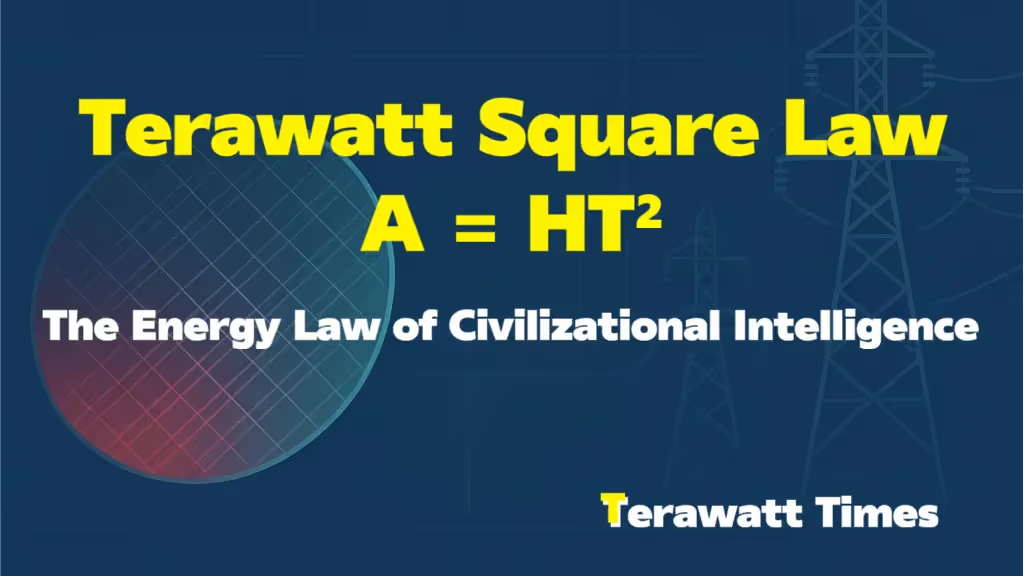
Terawatt Square Law A = HT²
The Energy Law of Civilizational Intelligence

True MAGA
The Second Constitutional Convention of the 2030s
3.The Mechanisms and Architectures
3.1 Clean Energy Market Architecture & Mechanism Design Series
Structural Impossibility
The Risk-Regime Architecture of Clean Energy Markets
The Irreversibility Trap
Why Clean Energy Ventures Fail After the System Succeeds
The Bankability Machine
How Clean Energy Companies Cross the Valley of Death Or Don’t
Beyond LCOE
The MERIT™ Rating System for Energy Asset Valuation
3.2 Climate Governance Architecture & CBAM Translation Series
A First Principles Framework for Climate Governance
Core Functions from Cybernetic Theory
Mirror Images in Climate Governance
The CBAM-CDM Pattern and Translation as Enhancement
Recalibrating Carbon Borders
CBAM's Failure Cascade and the Case for Translation-Enhanced Reform
Modular CBAM
Epistemological Pluralism in Carbon Accounting
3.3 Energy Transition Epistemic Architecture & Knowledge Translation Series
Stranded Minds
The Knowledge Crisis Hiding Inside the Energy Transition
Lost in Translation
Why CCS Projects Misread the Underground
Designing Epistemic Interfaces for Net‑Zero Infrastructure
4.The Interoperability and Operationalization:
4.1 Index and Metrics
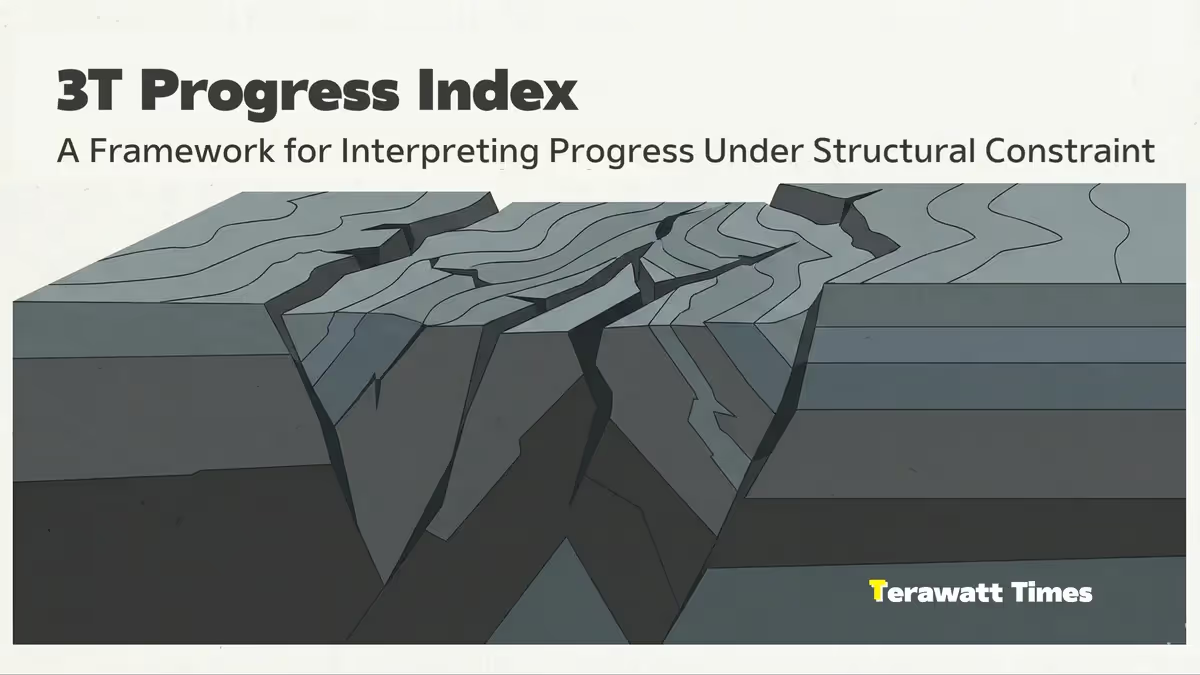
3T Progress Index:
A Framework for Interpreting Progress Under Structural Constraint