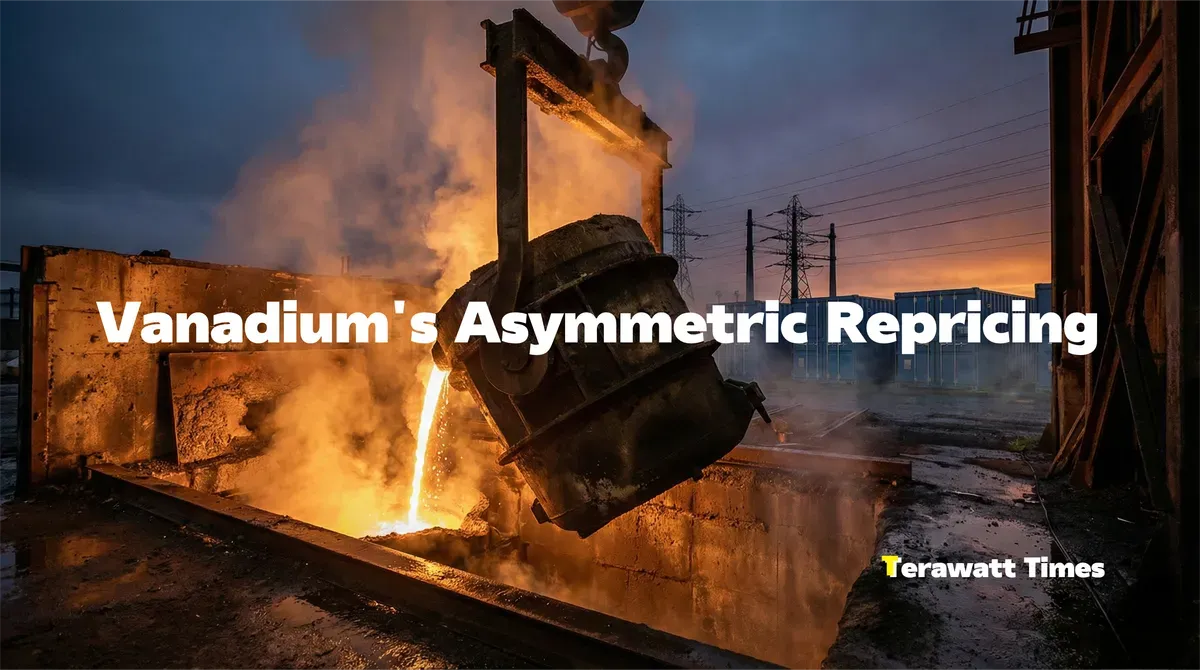
Vanadium's Asymmetric Repricing: The Case for a Supply-Driven Super-Cycle
Vanadium faces a violent repricing inflection analogous to lithium’s 2014 boom, but more durable. With 70% of supply locked as a steel by-product incapable of expanding, and demand surging from VRFB storage, EU CBAM, and nuclear fusion, the market presents an unpriced, asymmetric risk-reward.
Abstract
Vanadium occupies a singular position among critical metals in the global energy transition. With approximately 60 to 72 percent of global output locked to steel smelting as an involuntary by-product [1][2], its supply curve is structurally incapable of responding to its own price signal. This paper argues that vanadium is approaching a repricing inflection analogous to lithium's transformation between 2014 and 2022, yet one that will prove more violent and more durable owing to three compounding rigidities: (i) the physical impossibility of expanding by-product supply independently of crude steel throughput; (ii) the ongoing destruction of Western primary producers at the cycle trough; and (iii) the absence of any futures market or transparent price-discovery mechanism. The analysis draws on a 15-year price-cycle reconstruction, a granular replay of the 2018 Chinese rebar-standard crisis, a structural comparison matrix between vanadium and lithium across eleven dimensions, and a first-principles demand model for vanadium in nuclear fusion reactor materials. The findings establish that global vanadium supply faces an absolute hard constraint as steel output plateaus, while demand from vanadium redox flow batteries (VRFBs) and the EU Carbon Border Adjustment Mechanism (CBAM) are simultaneously tightening the market from both flanks. The resulting supply-demand configuration presents a textbook case of asymmetric risk-reward that remains largely unpriced by financial markets.
1. Introduction: A Metal Caught Between Two Eras
For most of the twentieth century, vanadium served a quiet but essential role inside the global steel industry. Added in trace quantities as a micro-alloying agent, it refines the grain structure of carbon steel, improving yield strength, weldability, and seismic resilience in high-rise construction [3]. Even today, more than 90 percent of the roughly 104,000 tonnes of vanadium produced each year ends up dissolved in structural steel [1][4].¹
¹ A note on production statistics. All tonnage figures in this paper refer to contained vanadium metal unless otherwise stated. The U.S. Geological Survey (USGS) reported global vanadium mine production at approximately 104,000 tonnes (metal content) for 2024 [10]. Vanitec, whose methodology captures additional secondary recovery pathways not included in the USGS mine-production series, reports a higher figure in the range of 120,000 to 128,000 tonnes [2]. The difference reflects statistical boundary definitions, not a factual dispute; both sources agree on the macro trajectory of output. Where this paper cites ranges (e.g., "104,000 to 128,000 tonnes"), it is acknowledging this methodological spread. Vanadium pentoxide (V₂O₅), the principal commercial intermediate, contains approximately 56 percent vanadium by mass; readers encountering V₂O₅ tonnages elsewhere should apply this conversion factor. The market is small, opaque, and almost entirely invisible to generalist investors.
That invisibility is beginning to crack. Vanadium redox flow batteries, a long-duration storage technology capable of discharging at rated power for four to twelve hours with virtually no capacity degradation over a 25-year lifetime, have moved from laboratory curiosity to gigawatt-scale deployment pipeline [5]. China's National Energy Administration approved more than 8 GWh of VRFB projects in its 2023 storage allocation round alone [6]. Meanwhile, the EU Carbon Border Adjustment Mechanism, which entered its definitive phase in 2026, is embedding upstream carbon intensity into the landed cost of every tonne of imported steel, creating a measurable price wedge between high-carbon Chinese vanadium and lower-carbon African or recycled sources [7]. And at the frontier of materials science, the V-4Cr-4Ti alloy has emerged as one of three leading candidates for the first-wall and blanket structures of commercial fusion reactors, a potential demand shock measured not in thousands but in hundreds of thousands of tonnes [8].
Each of these forces alone would be consequential. Together, they converge on a supply base that is, by the laws of metallurgical physics, unable to expand. The purpose of this paper is to build that convergence argument from primary data, quantify the structural constraints, and demonstrate why the current vanadium price embeds a deeply asymmetric risk profile that mainstream commodity analysis has yet to internalise.
Remaining content is for paid members only.
Please subscribe to any paid plan to unlock this article and more content.
Subscribe NowAuthors

Alex is the founder of the Terawatt Times Institute, developing cognitive-structural frameworks for AI, energy transitions, and societal change. His work examines how emerging technologies reshape political behavior and civilizational stability.

U.S. energy strategist focused on the intersection of clean power, AI grid forecasting, and market economics. Ethan K. Marlow analyzes infrastructure stress points and the race toward 2050 decarbonization scenarios at the Terawatt Times Institute.