Executive Summary
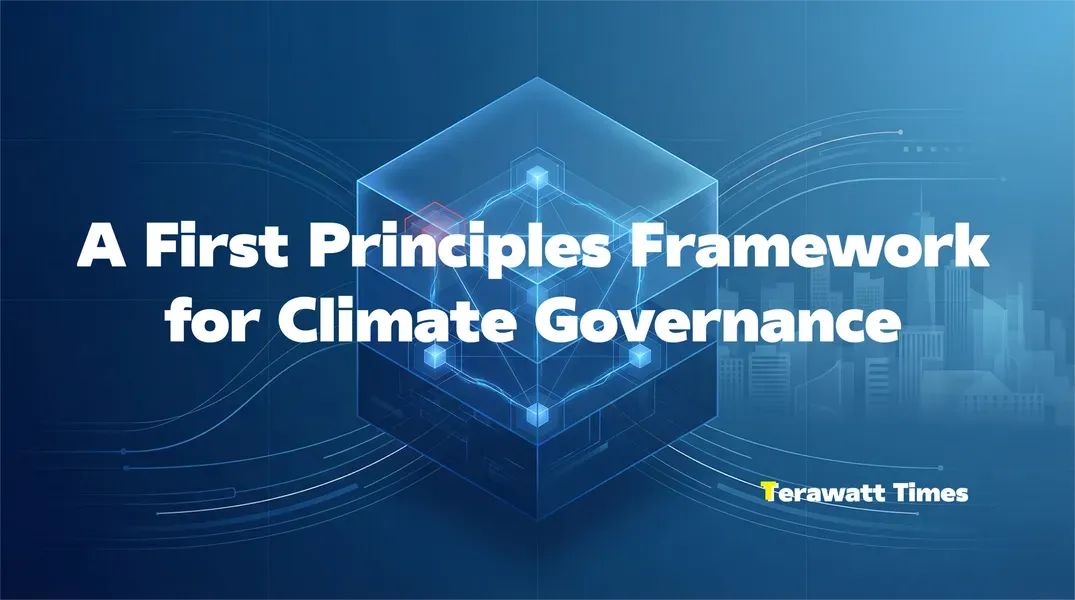
Global climate governance suffers from what recent scholarship identifies as "theoretical fragmentation"—a proliferation of descriptive frameworks that fail to provide normative guidance for system design. We address this gap by developing the Theoretical Climate Action Framework (TCAF), which derives six necessary governance questions from cybernetic first principles. Drawing on Ashby's Law of Requisite Variety and Beer's Viable System Model, we demonstrate through logical necessity tests that any governance system capable of maintaining viability must address: (1) boundary definition and perception, (2) autonomy and supervision balance, (3) inter-unit coordination, (4) environmental intelligence, (5) normative policy coherence, and (6) reflexive learning. We establish these six questions as a theoretically robust and functionally necessary set—each is indispensable, and together they provide sufficient diagnostic coverage for system survival. Applied recursively across three scales (micro, meso, macro), this generates an 18-question diagnostic matrix. We distinguish trust and integrity as transversal mechanisms rather than additional questions, operating across all 18 cells through capacity-building, transparency, and institutional design. Empirical validation demonstrates that observed failures map precisely onto specific question deficits: the Kyoto Protocol's 38% to 11% coverage collapse exemplifies Q5 failure, voluntary carbon markets' 80-90% ineffectiveness rate reflects Q6 failure, and methodological fragmentation across standards represents Q3 failure. Conversely, the Montreal Protocol's success demonstrates how addressing all six questions enables effective governance. This axiomatic approach moves climate governance scholarship from inductive description toward deductive prescription, providing theoretical foundations for evaluating and designing robust multi-scale institutions.
Keywords: climate governance, cybernetics, viable systems, institutional design, axiomatic method, theoretical integration
1. Introduction
1.1 The Triple Crisis of Global Climate Governance
The inadequacy of current climate governance manifests across three interdependent dimensions. At the physical level, converging assessments project warming trajectories fundamentally overshooting the Paris Agreement's 1.5°C target. Climate Action Tracker's 2024 assessment indicates 2.7°C warming under current policies, while the IEA World Energy Outlook 2024 projects 2.4°C, and UNEP's 2024 Emissions Gap Report estimates 2.6°C by 2100. The implementation gap between current policies and the 1.5°C pathway stands at 22-27 GtCO₂e annually according to UNEP 2024. Existing and planned fossil fuel infrastructure commits approximately 850 GtCO₂ to future emissions—far exceeding the remaining carbon budget of 420-500 GtCO₂ estimated by IPCC AR6. The required emissions reduction rate has escalated from 7.6% per year (if starting in 2020) to approximately 9-15% per year if action is delayed to 2030, reaching politically implausible levels.
At the institutional level, international cooperation reveals systematic regression. The Kyoto Protocol's coverage collapsed from 41 countries representing 38% of global emissions in its first commitment period (2008-2012) to merely 34 countries covering 11% in its second period (2013-2020). Within ostensibly functional systems, integrity has eroded dramatically. Rigorous assessment of REDD+ and renewable energy offset projects found that approximately 80-90% of carbon credits delivered no real emission cuts (West et al., 2020; Guardian/SourceMaterial investigation, 2023). The Kariba REDD+ project alone involved 15.2 million improperly issued credits, with 10.3 million already retired by companies to meet climate commitments.
At the theoretical level, comprehensive reviews across multiple domains identify "theoretical fragmentation" as the field's central pathology. Studies of climate risk and corporate innovation document scholarship "characterized by theoretical fragmentation and empirical inconsistency" (Hahn et al., 2024). Research on grassroots climate movements shows that despite increased attention to power dynamics, "theoretical fragmentation persists," reproducing epistemological biases (Patterson et al., 2023). Urban environmental governance scholarship explicitly states that "theoretical fragmentation prevents the development of integrated frameworks that address social, economic, and environmental priorities collectively" (Bulkeley et al., 2024). These three crises—physical, institutional, and theoretical—are mutually reinforcing. Theoretical fragmentation produces inconsistent policy designs, which generate institutional failures, which worsen physical outcomes.
1.2 The Problem of Theoretical Fragmentation
Current climate governance scholarship resembles a "theoretical Babel"—multiple communities speaking distinct conceptual languages with limited capacity for meaningful synthesis. Three dominant approaches have emerged, each capturing important aspects while remaining incomplete.
Polycentric climate governance (PCG), building on Ostrom's work, emphasizes multiple autonomous decision centers. However, the 2024 special issue on "Empirical Realities of Polycentric Climate Governance" delivered sobering assessments. Tobin et al. (2024) found that "empirical testing of whether polycentricity actually assists climate mitigation remains extremely limited." Kellner et al. (2024) demonstrated that PCG systematically neglects power structures, particularly "design power." Morrison et al. (2024) identified the core deficit: without "overarching rules," polycentric systems risk devolving into ineffective fragmentation.
The regime complex approach accepts institutional multiplicity as inevitable (Keohane & Victor, 2011). These descriptive taxonomies excel at explaining variation but offer limited guidance for designing better systems. As Agon (2024) demonstrated through comparison with COVID-19 responses, traditional international law exhibits profound rigidity when confronting cross-sectoral crises.
Experimentalist governance proposes learning-oriented processes (Sabel & Zeitlin, 2017). While productively emphasizing adaptive capacity, critics note it lacks normative force and structural specification. Jordan et al. (2018) found that polycentric systems often degrade into chaotic patchworks without cumulative learning.
The fundamental limitation common to all three approaches is their inductive character—deriving frameworks from observing existing systems rather than deducing what any viable system must possess. Lederer, Walker, and Winden (2025) articulated this deficit precisely: "Polycentric governance provides an ethical foundation (autonomy), experimentalist governance provides a learning mechanism (trial and error), but they both lack a structural skeleton to guarantee the system's long-term survival. Without an appropriate cybernetic architecture, polycentricity easily degenerates into anarchy."
1.3 Our Contribution: From Fragmentation to First Principles
This paper develops TCAF through axiomatic derivation from cybernetic principles. We ground our approach in Ashby's Law of Requisite Variety and von Bertalanffy's conception of open systems requiring boundaries. From these axioms, we derive six necessary questions: boundary definition and perception (Q1), autonomy balanced with supervision (Q2), coordination and oscillation damping (Q3), adaptation through intelligence (Q4), policy coherence and identity (Q5), and reflexive learning (Q6).
Our central claim is that these six questions constitute a theoretically necessary and functionally sufficient set. We establish this through redundancy tests showing that no question can be eliminated without loss of distinct function, and necessity tests demonstrating that each addresses a unique failure mode. The framework's power lies in its recursive structure: governance operates simultaneously across at least three scales (micro, meso, macro), generating an 18-question diagnostic matrix. We distinguish trust and integrity as transversal mechanisms operating across all questions through three pillars—capacity building, transparency, and institutional design.
Our approach represents a methodological shift from inductive description to deductive design, joining a tradition in social science of using axiomatic methods to reveal necessary structures. Kenneth Arrow derived fundamental limits on collective decision-making from axioms, not from surveying voting systems. Alexander Hamilton designed the American federal system through "a priori deduction from assumed first principles." Our application aims to provide not merely explanation of existing failures but a blueprint for constructing viable systems.
Empirical validation comes from demonstrating that observed failures map onto specific question deficits. The Kyoto collapse exemplifies Q5 failure (normative identity dissolution). The VCM's 80-90% ineffectiveness demonstrates Q6 failure (absence of reflexive mechanisms). The five-fold EU-China carbon price differential reflects Q3 failure (lack of coordination mechanisms). Conversely, the Montreal Protocol's success in phasing out ozone-depleting substances demonstrates how addressing all six questions enables effective global governance.
Research Trajectory. This paper establishes theoretical foundations. Subsequent research will apply TCAF to evaluate specific governance systems, develop empirically-validated diagnostic tools, and extend the framework across diverse institutional contexts. The immediate agenda includes systematic evaluation of the EU's Carbon Border Adjustment Mechanism using the 18-question matrix, comparative analysis across multiple governance systems to validate the framework's explanatory power, and development of operational assessment protocols calibrated through case studies.
1.4 Roadmap
Section 2 establishes theoretical foundations, presenting cybernetic axioms and defending axiomatic reasoning in social science. Section 3 systematically derives each of the six necessary questions from first principles. Section 4 demonstrates the functional necessity and sufficiency of our six-question set through logical tests. Section 5 extends the framework to multiple scales, presenting the 18-question matrix. Section 6 addresses trust and integrity as transversal mechanisms. Section 7 discusses theoretical contributions and scope boundaries. Section 8 concludes by identifying how this theoretical foundation enables future empirical research.
Remaining content is for members only.
Please become a free member to unlock this article and more content.
Subscribe NowAuthor

Alex is the founder of the Terawatt Times Institute, developing cognitive-structural frameworks for AI, energy transitions, and societal change. His work examines how emerging technologies reshape political behavior and civilizational stability.