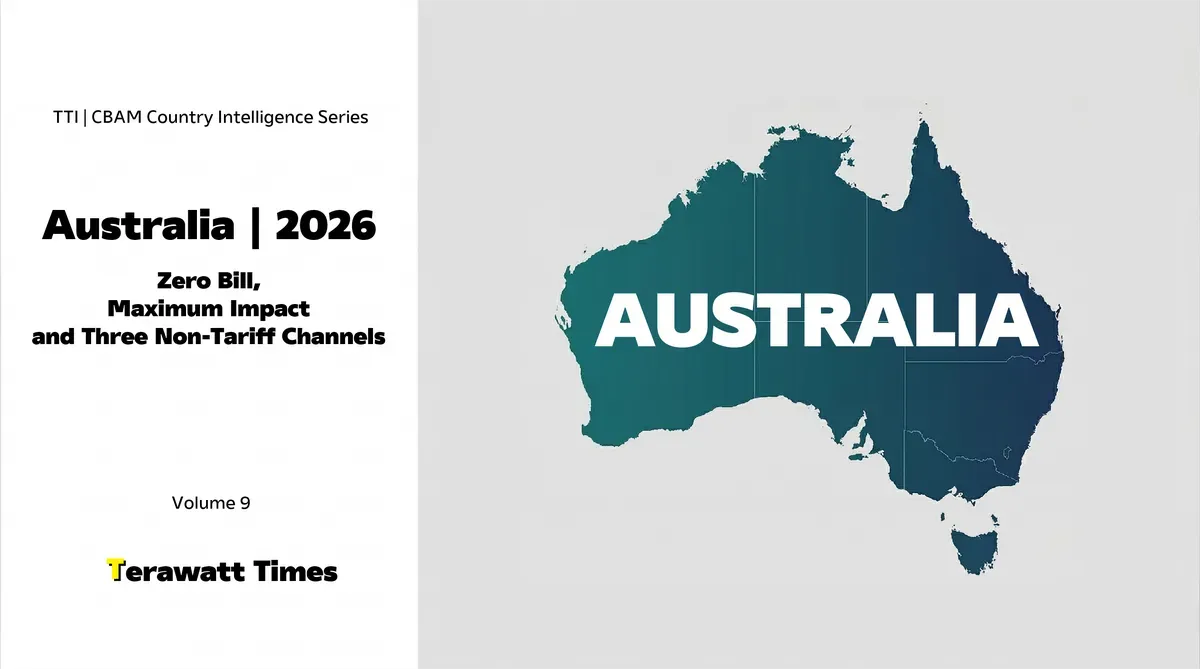
CBAM Country Intelligence Australia 2026: Zero Bill, Maximum Impact and Three Non-Tariff Channels
Despite a negligible €2.3M direct CBAM bill, Australia faces imminent heavy industry closures. This paradox is driven by three non-tariff channels: parent-company portfolio optimisation, Asia-Pacific premium widening, and institutional diffusion. Six timelines converge to make 2028 a systemic cliff.
Executive Summary
Australia's 2026 CBAM liability falls between €880,000 and €2.27 million, placing it last among eight major CBAM-exposed economies at approximately 0.03 percent of India's corresponding obligation. Over 60 percent of aluminium exports to the EU consist of post-consumer scrap assigned zero embedded emissions. The EU absorbs less than 5 percent of Australian aluminium output. By every direct fiscal measure, CBAM is negligible.
That insignificance conceals a structural transformation transmitted through three non-tariff channels. Multinational parent companies rank global smelting assets by carbon competitiveness, positioning Australian coal-powered facilities near the bottom of investment priority lists. The EU Duty-Paid to Main Japan Port premium spread widened to USD 174 per tonne in Q4 2025, reflecting a carbon rent that Asian-market smelters cannot capture. Carbon border mechanisms proliferating across the United Kingdom, Japan, and Korea narrow the perimeter of unconditioned market access year by year.
Six independent timelines converge in 2028: Tomago's power purchase agreement expires in December, the CBAM default mark-up reaches a permanent 30 percent, Japan's carbon surcharge commences, the AUD 2 billion Green Aluminium Production Credit begins disbursement, and a federal election introduces policy continuity risk. Physical constraints compound the crisis. Replacing 950 megawatts of continuous baseload requires 3 to 4 gigawatts of renewable capacity plus long-duration storage, set against land access and Native Title approval timelines of five to seven years. Environmental remediation liabilities under AASB 137 may produce zombie smelters rather than clean closures. The year 2030 marks a second threshold, where the phase-in factor jumps to 48.5 percent and Trade-Exposed Baseline Adjustment protections face withdrawal.
Australia holds dual CBAM identity. The BCA-TEBA feedback loop means that introducing border protection destroys export price parity for an industry exporting over 90 percent of output to Asian markets lacking reciprocal mechanisms. Legal vulnerability arises under GATT Article XX from the asymmetry between taxing imported carbon and exporting fossil fuels. CPTPP, RCEP, and ANZCERTA treaty obligations constrain BCA design space into an extremely narrow corridor, creating a jurisdictional trilemma between domestic climate ambition, plurilateral trade commitments, and WTO non-discrimination rules.
Three actions carry defined deadlines. Smelter power purchase agreements must be finalised before December 2028; the Tomago deadline is physically non-deferrable. Scrap exporters should establish audited post-consumer certification before the 2027 methodology review. Federal policymakers must model the BCA-TEBA export parity feedback loop before committing to commodity coverage sequencing, recognising that the order of inclusion determines which industries bear transitional costs, and that FTA obligations constrain the available design space to an extent not yet reflected in public policy discussion.
Preface
This report employs the mesoscopic analytical method: a position between macroeconomic computable general equilibrium modelling and facility-level compliance accounting, integrating engineering data, political economy, international trade law, and corporate financial analysis through cross-domain translation.
Computable general equilibrium models capture aggregate welfare effects and trade diversion, but cannot explain why the country with the smallest CBAM bill faces the most severe industrial disruption. Facility-level compliance accounting quantifies certificate obligations precisely, yet remains blind to parent-company portfolio logic, commodity premium dynamics, and institutional diffusion. The analytical space between these two established approaches is where the mechanism's most consequential effects reside.
The empirical foundation comprises four rounds of pre-research generating eighteen independent research streams, subjected to adversarial cross-validation through TTI's multi-stream blind methodology. Each stream operated with an independent analytical angle and core hypothesis, without knowledge of other streams' logic. Convergence identifies high-confidence findings, divergence identifies blind spots, and unexpected intersections produce the highest-value discoveries. Primary data sources number over fifty, spanning Eurostat COMEXT, Clean Energy Regulator compliance and emissions intensity data, S&P Global/Platts commodity assessments, EU legislative texts (Regulation 2023/956, IR 2025/2547, IR 2025/2620, IR 2025/2621), corporate disclosures from Rio Tinto, Alcoa, POSCO, and EGA, the ICJ advisory opinion of 23 July 2025, WTO and FTA treaty texts (GATT, CPTPP, RCEP, ANZCERTA, SCM Agreement), and Australian federal and state policy documents.
All financial calculations were completed and locked in a Global Constants Table before writing commenced, following the mandatory ledger lockdown procedure established after a magnitude error in an earlier volume. Calculation chains are presented in full. Every figure in Table 3.1 can be independently reproduced from GCT parameters. Data gaps are identified and disclosed. The post-consumer versus pre-consumer breakdown within CN 7602 scrap exports remains structurally unobservable due to customs classification limitations, a gap that constitutes an analytical finding in its own right (Chapter 2). The EU's legal classification of Australia's ACCU-based SGM compliance as either a valid "explicit carbon price" or an ineligible offset remains unresolved; both interpretations are modelled (Chapter 4).
Emission intensities for Australian smelters derive from the Clean Energy Regulator's Emissions Intensity Determinations Table (determinations from 1 July 2023, updated 24 October 2024) [1]. Default values are from Commission Implementing Regulation (EU) 2025/2621, Annex I [2]. The aluminium benchmark of 1.464 tCO₂/t derives from IR 2025/2620 [3]. Phase-in factors follow Regulation (EU) 2023/956, Annex V, consolidated with Regulation (EU) 2025/2083 [4]. The central EUA price assumption is €80/tCO₂, with sensitivity analyses at €60 and €100 provided in Appendix A. Article 9 deductions are presented as a range (€0 to €1.50 per tonne of CO₂) reflecting legal uncertainty regarding the EU's classification of Australia's ACCU-based compliance mechanism.
Remaining content is for paid members only.
Please subscribe to any paid plan to unlock this article and more content.
Subscribe NowAuthors

U.S. energy strategist focused on the intersection of clean power, AI grid forecasting, and market economics. Ethan K. Marlow analyzes infrastructure stress points and the race toward 2050 decarbonization scenarios at the Terawatt Times Institute.

Preston studies the policy and social dimensions of the energy transition, focusing on urban electrification, energy equity, and how emerging technologies shape outcomes for middle‑ and working‑class communities.

Maya is a communications strategist bridging technical modeling and public policy. She synthesizes research on grid modernization and decarbonization, ensuring data-driven insights reach legislators and industry stakeholders.