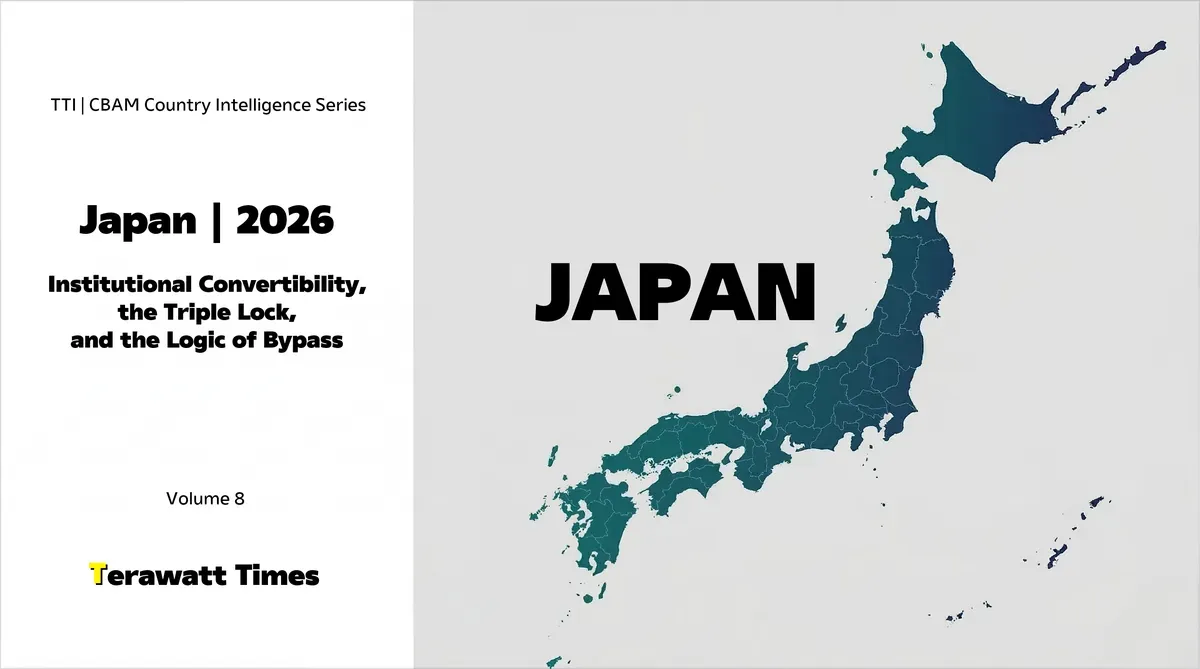
CBAM Country Intelligence Japan 2026: Institutional Convertibility, the Triple Lock, and the Logic of Bypass
TTI’s Japan CBAM audit reveals a 1.33% convertibility rate for domestic carbon costs. With hydrogen steelmaking lagging until 2040, a 6-year "Death Valley" forces a strategic bypass. Analyze how institutional maturity creates a legacy lock-in trap and why M&A is the new compliance.
Executive Summary
Japan maintains one of the most sophisticated carbon governance architectures among industrialised nations. An upstream carbon tax, a newly mandatory emissions trading system, internationally recognised lifecycle assessment standards, and multi-billion-dollar hydrogen metallurgy research programmes collectively represent decades of institutional investment. Conventional assessments classify Japan as a low-exposure economy under the European Union's Carbon Border Adjustment Mechanism (CBAM), noting that the EU absorbs only 4.1% of Japanese steel exports. This report overturns that classification.
Through facility-level carbon intensity reconstruction under CBAM's Scope 1 boundary rules, statutory tax code analysis across Japanese and EU jurisdictions, and a standardised six-country comparison framework, TTI calculates a Convertibility Rate of 1.33% to 3.36% for Japan's carbon governance system at the CBAM border. The Convertibility Rate measures the fraction of domestically incurred carbon costs that the EU recognises as valid deductions under CBAM Article 9. Japan ranks first among six major CBAM-exposed economies on this measure. "First" means a hedge ratio below 3.4% against a gross CBAM liability of approximately €155 per tonne of steel by 2034.
The finding traces to a triple lock: a statutory tax exemption on coking coal extended through March 2029, a free allocation ratio of approximately 0.90 under the GX-ETS, and a procedural calendar mismatch between CBAM filing deadlines and GX-ETS compliance settlement timing. Eight components of Japan's carbon governance, each internally functional, simultaneously fail at the CBAM interface. Hydrogen steelmaking reaches commercial scale around 2040, six years after CBAM's free allocation reaches zero. Nippon Steel's $14.9 billion acquisition of U.S. Steel is analysed as the first macro-scale carbon governance bypass: acquiring assets inside the EU and in low-carbon jurisdictions rather than reforming the domestic system whose timeline exceeds the regulatory deadline.
Preface
This report is the fifth volume in TTI's CBAM Country Intelligence Series. It occupies a specific analytical niche. The World Bank and IMF produce computable general equilibrium models estimating aggregate GDP effects of carbon border adjustments; their Japan assessments typically yield impact figures measured in hundredths of a percentage point, numbers of limited operational value to a steel company CFO evaluating whether to reroute a shipment [1]. At the other end, the Big Four accounting firms offer installation-level compliance accounting, calculating CBAM certificate requirements for specific consignments without addressing whether the underlying business model survives the carbon border. TTI works between these scales, forcing facility-level physical data through the gears of international trade law, tax code architecture, and corporate financial modelling.
Japan presented an unusual analytical challenge. The country does not suffer from weak carbon governance. It operates extraordinarily sophisticated carbon governance that happens to be formatted in ways the EU does not recognise. Diagnosing why the most complete carbon pricing architecture in Asia achieves less than 3.4% penetration at the CBAM border required simultaneous fluency in Japanese tax law, EU customs regulation, metallurgical process chemistry, and cross-border corporate strategy. This cross-domain requirement defines TTI's meso-level work.
A technical point governs the entire quantitative framework of this report and must be stated at the outset. Under current CBAM rules, iron and steel products are listed in Annex II of Regulation (EU) 2023/956, meaning that only direct emissions (Scope 1) are included in the calculation of embedded emissions [2]. Indirect emissions from purchased electricity (Scope 2) are excluded for steel. All carbon intensity figures, cost calculations, and cross-country comparisons in this report adhere strictly to this Scope 1 boundary unless explicitly noted otherwise. Where Scope 2 is discussed, it pertains to the prospective risk of future regulatory extension, not to current CBAM obligations.
Three boundaries should be stated. This report does not cover financial institution credit exposure to Japanese steel assets. It uses data available as of March 2026; actual CBAM filing data from the definitive period will not become public until 2027. The European Commission's December 2025 proposal to extend CBAM to approximately 180 downstream products from January 2028 remains a legislative proposal, not enacted law [3].
Remaining content is for paid members only.
Please subscribe to any paid plan to unlock this article and more content.
Subscribe NowAuthors

Hiroto Nakamura is a research fellow focused on climate intelligence, satellite-based MRV, and AI-driven environmental monitoring. He analyzes geospatial data and verification systems to improve global carbon transparency and emissions accountability

Maya is a communications strategist bridging technical modeling and public policy. She synthesizes research on grid modernization and decarbonization, ensuring data-driven insights reach legislators and industry stakeholders.