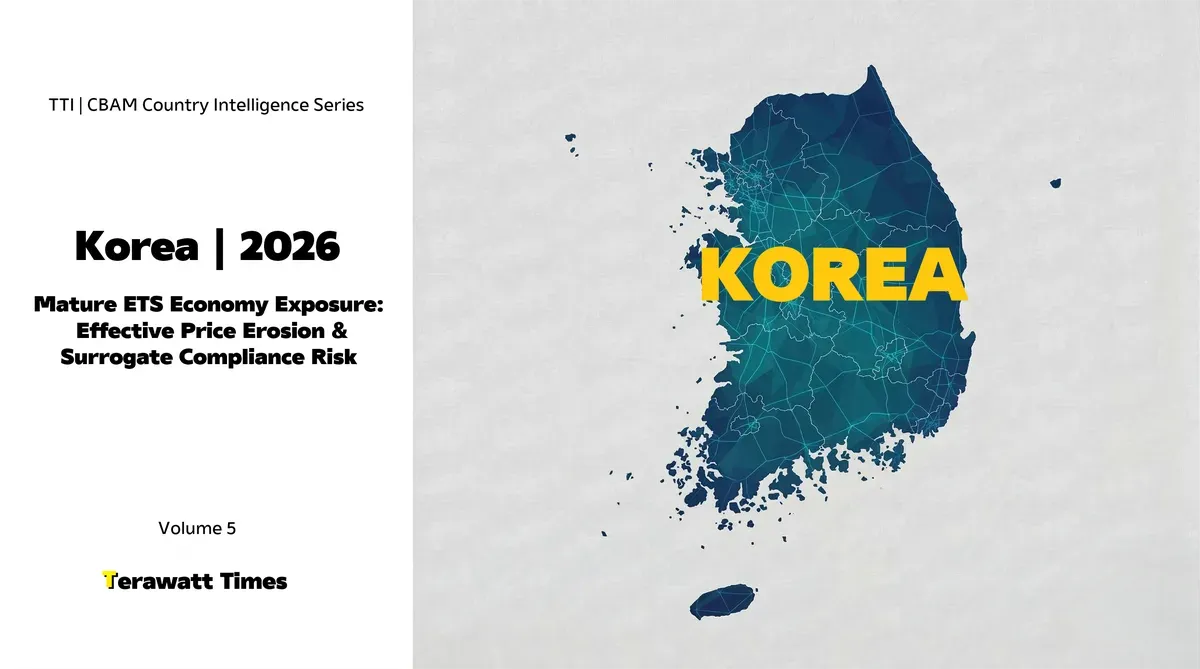
CBAM Country Intelligence Korea 2026: Mature ETS Economy Exposure: Effective Price Erosion and Surrogate Compliance Risk
South Korea faces a structural paradox under EU CBAM: operating a mature ETS yields near-zero financial benefit at the border. This report quantifies POSCO's exposure, detailing how Effective Price Erosion and Surrogate Compliance Risk threaten the competitiveness of Korean steel exports by 2034.
Executive Summary
South Korea's Carbon Border Adjustment Mechanism exposure is defined by a single structural paradox: the country operates the world's second-largest emissions trading system, yet derives near-zero financial benefit from it at the EU border. This report quantifies that paradox across five dimensions.
Key Figures
|
Metric |
Value |
Source |
|
POSCO HRC (CN 7208) product-level carbon
footprint under CBAM system boundaries |
2.127 tCO₂e/t |
Engineering calculation, Section 2.3 |
|
POSCO corporate-average carbon intensity
(ESG-reported) |
2.03 tCO₂e/t |
POSCO 2024 ESG Factbook [1] |
|
EU benchmark for BF-BOF flat steel free
allocation |
1.30 tCO₂/t |
Regulation (EU) 2023/956 [6] |
|
POSCO "benchmark penalty"
(intensity above EU threshold) |
0.827 tCO₂/t (2.127 − 1.30) |
Section 3.4 |
|
K-ETS Article 9 legal deductible (2026 →
2034) |
€2.92 → €13.38/tCO₂ |
Section 3.3 |
|
K-ETS coverage of EU ETS reference price |
3.4% → 9.9% |
Section 3.4 |
|
POSCO CBAM cost, 2026 (2.5% phase-in) |
€71/t product |
Table 3.1 |
|
POSCO CBAM cost, 2034 (100% phase-in) |
€259/t product |
Table 3.1 |
|
Export leverage ratio (domestic cost per
€1 of CBAM relief) |
14:1 |
Section 3.3/3.5 |
|
Korea's total CBAM-exposed EU trade
(incl. COM(2025)989 proposal) |
€65–75 billion |
Eurostat [16] + [7] |
|
Annual value of product-level data vs.
default values (HRC, 2.5 Mt) |
€32.5 million |
Section 2.7 |
|
SME export viability threshold under full
CBAM |
~€10 million annual EU revenue |
Section 6.6 |
Core Findings
POSCO's carbon intensity of 2.127 tCO₂/t exceeds the EU benchmark for free allocation (1.30 tCO₂/t) by 64%. This "benchmark penalty" of 0.827 tCO₂/t is fully taxable from CBAM's first day of operation, regardless of the 2.5% phase-in rate. The 2026 CBAM cost for POSCO HRC reaches approximately €71 per tonne of product, rising to €259 by 2034 at full phase-in. Over one-quarter of the terminal CBAM burden arrives in year one.
K-ETS carbon prices undergo compression through two multiplicative mechanisms when translated into CBAM Article 9 deductions: allocation dilution (69.2% of POSCO emissions freely allocated under official Phase 4 benchmarks) and the absolute price gap (K-ETS ~€9 vs. EU ETS ~€85). The resulting deductible of €2.92/tCO₂ covers 3.4% of the EU reference, shaving €2.51 off a gross CBAM bill of €73.1 per tonne of product in 2026. Parametric stress testing across six allocation scenarios reveals no allocation ratio that reduces global carbon costs below the current level; the 14:1 export leverage ratio ensures that every €14 in additional domestic carbon expenditure generates approximately €1 of CBAM relief. This Effective Price Erosion is architecturally embedded in the K-ETS-CBAM interaction and cannot be resolved through domestic allocation reform.
The existence of K-ETS simultaneously suppresses institutional awareness of this exposure through Surrogate Compliance Risk. Corporate emission provisions declined during 2023–2024 despite the onset of definitive CBAM. Three major Korean institutional studies omitted Article 9 analysis entirely. Capital markets registered zero abnormal returns at four CBAM regulatory milestones. The structural inadequacy of K-ETS protection is obscured by the system's genuine domestic effectiveness, creating a preparation deficit that the immediate financial pain of 2026 CBAM costs may belatedly correct.
Preface
On January 1, 2026, the European Union's Carbon Border Adjustment Mechanism entered its definitive financial phase. Among exporting economies exposed to CBAM, South Korea presents what appears to be the most favorable starting position. The Korean Emissions Trading System has operated continuously since 2015, covering approximately 73% of national emissions across three complete compliance phases. POSCO and Hyundai Steel maintain comprehensive greenhouse gas inventories verified under Korean national standards. The institutional infrastructure for carbon management is, by any domestic measure, mature [1][3].
The analysis presented here offers a substantial correction to this assessment.
K-ETS carbon prices, when processed through CBAM Article 9's deduction methodology, are compressed to near-zero by three structural factors operating simultaneously. The mechanism, which this report terms Effective Price Erosion, is not a policy failure amenable to reform. It is a mathematical property of the interaction between K-ETS design parameters and CBAM legal architecture, robust across the full range of allocation scenarios tested. Separately, the very completeness of Korea's domestic carbon compliance infrastructure has generated what this report terms Surrogate Compliance Risk: a condition in which genuine domestic carbon management achievement is mistaken for international CBAM readiness, suppressing preparation urgency across corporate, academic, capital market, and political domains.
Three prior Korean institutional studies have examined CBAM exposure at the macroeconomic level. KEEI's 2022 input-output analysis estimated Korea's CBAM-covered exports at $2.952 billion [9]. KIET's 2024 price elasticity study projected export declines of 2.9% by 2026 and 10.4% by 2030 [8]. KIEP's 2021 firm-level assessment identified indirect export channels through SME suppliers [10]. Each contributed valuable aggregate insights. None examined whether K-ETS payments generate meaningful Article 9 deductions. None constructed product-level carbon footprints under CBAM system boundary rules. None mapped the downstream expansion proposed in COM(2025)989 at HS code granularity. These gaps define the analytical territory of the present report.
Four contributions distinguish this work from existing literature. First, an engineering-grade carbon footprint calculation for each major POSCO export product by CN tariff code, with default-value gap analysis revealing that optimal compliance strategy varies by product in opposing directions. Second, a complete mathematical derivation of K-ETS price erosion under Article 9, with parametric stress testing across six allocation scenarios and three carbon price paths. Third, an HS code–level mapping of the 180 downstream products proposed for CBAM coverage under COM(2025)989. Fourth, a triple compliance overlay integrating CBAM, CSRD, and Digital Product Passport requirements with EU/UK/US/CA carbon border mechanism fragmentation.
Dimensions not covered include Korea's aluminum processing sector and its precursor traceability challenges, CBAM declaration data beyond Q1 2026, and the final legislative text of the U.S. Clean Competition Act. These will be addressed in subsequent research.
Terminology convention. Throughout this report, "€/tCO₂" denotes cost per tonne of embedded carbon dioxide equivalent; "€/t product" denotes cost per tonne of physical steel product. The conversion between them is: €/t product = €/tCO₂ × product carbon intensity (tCO₂/t). Where a figure could be ambiguous, the unit is stated explicitly.
Remaining content is for paid members only.
Please subscribe to any paid plan to unlock this article and more content.
Subscribe NowAuthors

Preston studies the policy and social dimensions of the energy transition, focusing on urban electrification, energy equity, and how emerging technologies shape outcomes for middle‑ and working‑class communities.

U.S. energy strategist focused on the intersection of clean power, AI grid forecasting, and market economics. Ethan K. Marlow analyzes infrastructure stress points and the race toward 2050 decarbonization scenarios at the Terawatt Times Institute.

Hiroto Nakamura is a research fellow focused on climate intelligence, satellite-based MRV, and AI-driven environmental monitoring. He analyzes geospatial data and verification systems to improve global carbon transparency and emissions accountability

Maya is a communications strategist bridging technical modeling and public policy. She synthesizes research on grid modernization and decarbonization, ensuring data-driven insights reach legislators and industry stakeholders.