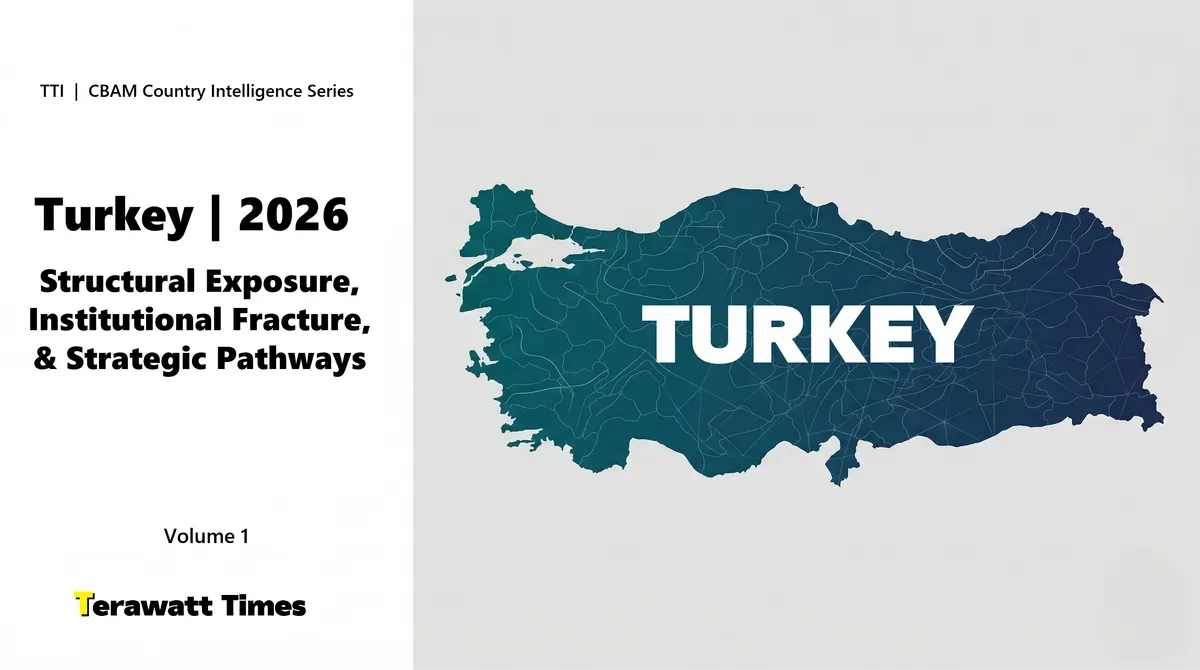
CBAM Country Intelligence Turkey 2026: Structural Exposure, Institutional Fracture, and Strategic Pathways
In 2026, Turkey’s 70% EAF steel advantage remains unmonetized under EU CBAM. This report reveals how default-value reliance traps large producers in a €120M–€180M annual penalty, and maps why a €2M MRV investment and unlocking Article 9 are critical to preserving market access.
Executive Summary: Turkey's CBAM Exposure and the Institutional Blind Spot
The EU Carbon Border Adjustment Mechanism (CBAM) definitive phase (January 2026) imposes an immediate financial liability on Turkey's €9.75 billion EU-directed steel and aluminum export base [2]. While macroeconomic models project a negligible -0.0017% GDP impact [1], this aggregate conceals severe enterprise-level divergence, timing mismatches, and systemic institutional fragmentation.
Turkey’s exposure is defined by three structural realities:
- The MRV Data Penalty vs. EAF Advantage: Turkey’s 70% Electric Arc Furnace (EAF) production share [5] provides a massive competitive baseline. However, highly efficient EAF producers like Çolakoğlu (0.34 tCO₂/t) [11] face €120 million to €180 million in annual excess CBAM certificate costs if they rely on EU default values (1.0–1.3 tCO₂/t) [3]. Investing <€2 million in Measurement, Reporting, and Verification (MRV) infrastructure yields a payback period of mere months at a €60 EU Allowance (EUA) price [11]. Similarly, cement exporters (averaging 0.88 tCO₂/t) face an unnecessary €40/tonne penalty against the 1.551 tCO₂/t EU default [3][16].
- The "Death Valley" Transition: Blast Furnace (BF-BOF) operators like Kardemir (2.45 tCO₂/t) and Erdemir face extreme CBAM costs reaching €147–€196 per exported tonne [6][8]. Despite committing billions to 3.9 million tonnes of new EAF capacity [9][10], these low-carbon facilities will not be operational until 2029, leaving integrated producers exposed to hundreds of millions in unmitigated transitional certificate liabilities.
- The Article 9 and ÖTV Paralysis: CBAM Article 9 permits deductions for domestic carbon costs [24]. Turkey’s Special Consumption Tax (ÖTV) covers ~32% of emissions [21] but lacks the attribution methodology required by the EU. Fragmented jurisdiction across the Ministries of Trade, Finance, and the Climate Change Directorate has stalled this critical pathway [19][20][21]. Furthermore, TR ETS pilot quotas (2026–2027) protect high-carbon employment provinces (Karabük, Zonguldak) [18][20], diluting the "effective carbon price" required for EU recognition.
Strategic Imperatives (2026–2028):
- Mandate Cross-Ministry Coordination: Instantly establish a joint task force to engineer an Article 9-compliant ÖTV attribution methodology.
- SME Compliance Financing: Small and medium fabricators are trapped between BF-BOF input costs and CSRD Scope 3 data demands. The Ministry of Trade must launch concessional MRV finance facilities to prevent mass SME exits from EU supply chains.
- Bridge the Transformation Gap: Implement provincial employment transition programs to enable TR ETS free quota tightening, ensuring an EU-recognized domestic carbon price.
Preface
The European Union's Carbon Border Adjustment Mechanism (CBAM) entered its definitive collection phase in January 2026. Turkey, as one of the EU's largest steel and aluminum suppliers and a country without a recognized carbon pricing mechanism during the transitional period, faces the full financial weight of that shift. CBAM's impact is immediate and material. The critical analytical challenge is tracing how that impact is distributed, why Turkey's institutional response has fallen short of its industrial assets, and what concrete actions are available to firms and policymakers operating under time pressure.
The World Bank's CCDR Background Note 7 provides the most rigorous macroeconomic baseline available for this question [1]. Using the ENVISAGE computable general equilibrium (CGE) model — a framework that simulates how an entire economy adjusts to a policy shock, accounting for price responses, trade diversion, and factor reallocation across all sectors simultaneously — the report projects Turkey's GDP impact under the Current CBAM Proposal at approximately -0.0017 percent, equivalent to about $24 million annually, with steel export losses around $96 million and job displacement near 1,200 workers [1]. These numbers are internally consistent and methodologically sound. They are also, as a guide to corporate or policy decision-making, significantly incomplete.
CGE models are designed to capture net equilibrium outcomes across entire economies. A model showing that Turkish automotive exports increase by $47 million under the Current Proposal is describing what happens after all adjustment mechanisms have run their course at the aggregate level [1]. It cannot see that Kardemir's per-tonne CBAM certificate cost is roughly seven times higher than Çolakoğlu's. It does not capture why Turkey's Ministry of Finance has never coordinated with the Ministry of Trade on an Article 9 carbon cost deduction strategy, despite a potentially significant financial opportunity sitting at exactly that intersection. It has nothing to say about why TR ETS free quota allocation will likely be engineered to protect high-carbon employment provinces rather than drive genuine emissions reduction. This report addresses those gaps.
Understanding Turkey's CBAM position requires working across four dimensions simultaneously: the concentrated sectoral vulnerabilities hidden inside aggregate trade statistics, the diverging compliance cost trajectories between individual enterprises, the institutional fragmentation that has suppressed Turkey's national response below its industrial potential, and the domestic political economy that shapes carbon market design from the inside. Each layer conditions the one below it, which is why aggregate numbers alone consistently mislead.
The data timeline matters here and is stated plainly. The World Bank baseline runs from 2018 to 2020, using GTAP trade and production aggregates [1]. This report uses 2024–2026 enterprise sustainability reports, Turkey's Climate Law (Law No. 7552, enacted July 2025), CBAM transitional period declaration data, and current EU Allowance (EUA) pricing. The gap between those two time horizons includes Turkey's entire post-2022 EAF capacity expansion, the 2023 Hatay earthquake and its industrial recovery, and the full legislative history of TR ETS. On questions where the two datasets diverge, the more recent evidence takes precedence, with the World Bank figures retained as macroeconomic anchors rather than operational forecasts.
Remaining content is for paid members only.
Please subscribe to any paid plan to unlock this article and more content.
Subscribe NowAuthors

Alex is the founder of the Terawatt Times Institute, developing cognitive-structural frameworks for AI, energy transitions, and societal change. His work examines how emerging technologies reshape political behavior and civilizational stability.

Preston studies the policy and social dimensions of the energy transition, focusing on urban electrification, energy equity, and how emerging technologies shape outcomes for middle‑ and working‑class communities.

Maya is a communications strategist bridging technical modeling and public policy. She synthesizes research on grid modernization and decarbonization, ensuring data-driven insights reach legislators and industry stakeholders.

Hiroto Nakamura is a research fellow focused on climate intelligence, satellite-based MRV, and AI-driven environmental monitoring. He analyzes geospatial data and verification systems to improve global carbon transparency and emissions accountability