CBAM Survival Boundary for Global Logistics: Carbon Data and Competitive Restructuring Through a Tri-Flow Coupling Framework
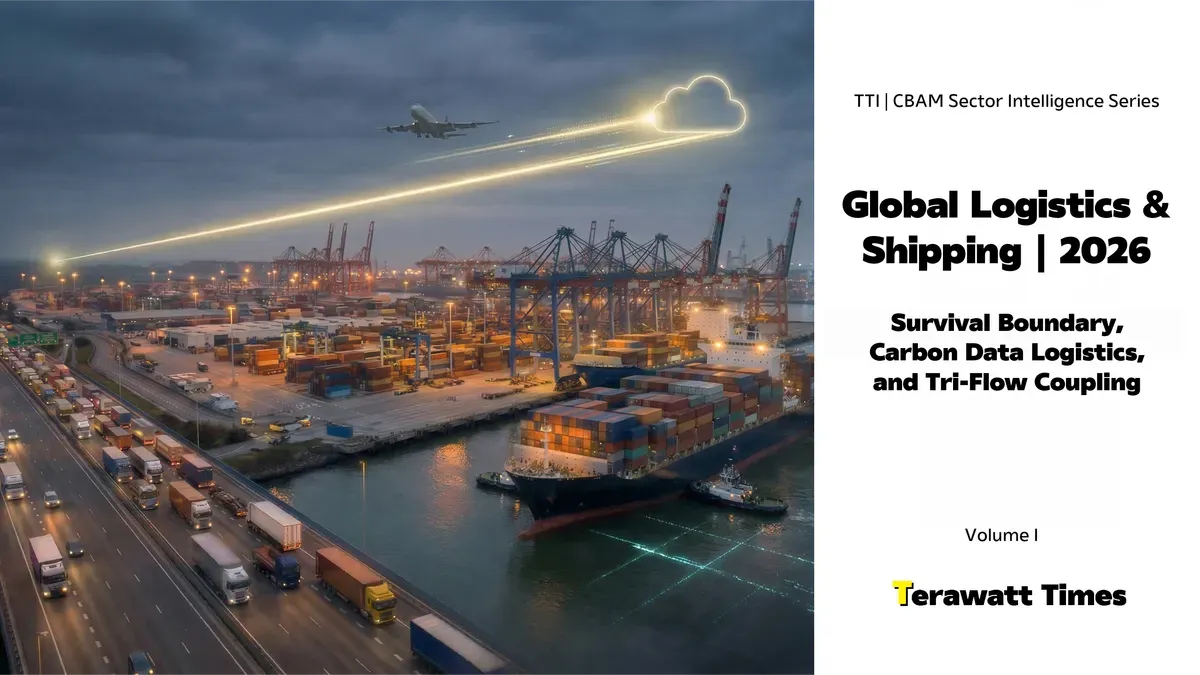
CBAM Sector Intelligence: Explores the "Survival Boundary" for logistics and shiping. Introducing the Tri-Flow Coupling Framework (Physical, Carbon, Trust). Analysis reveals a structural break at CDCS 0.35, forcing reliance on punitive default values. A 2026 roadmap for Maersk, UPS, and SF Express.
Executive Summary: Carbon Data Logistics and the Tri-Flow Coupling Framework
The EU's Carbon Border Adjustment Mechanism (CBAM) presupposes that verified carbon emissions data can travel seamlessly alongside physical goods from foreign factories to EU customs authorities. This presupposition is wrong. Carbon data lacks a standardized transmission infrastructure, resulting in a Default Value Reliance (DVR) rate that imposes punitive costs of EUR 30 to 80 per tonne of product [2, 3].
The Tri-Flow Coupling Framework
Drawing on a systematic literature gap audit across 4,400 publications in carbon accounting, supply chain management, and trade facilitation, we identify a structural blind spot: no existing framework treats carbon data as an independent information flow with its own transmission dynamics, failure modes, and jurisdictional friction. To fill this gap, we propose the Tri-Flow Coupling Framework, decomposing cross-border supply chains into three interdependent but operationally distinct mechanisms: the Physical Logistics Flow, the Carbon Data Flow, and the Trust Bypass. We introduce two quantitative constructs: the Carbon Data Continuity Score (CDCS), measuring node-by-node data integrity across seven standard supply chain nodes, and the Default Value Reliance rate (DVR), capturing the proportion of CBAM declarations that fall back on the EU's punitive default emission factors.
Core Empirical Findings
Regression analysis across 55 trade routes covering steel, aluminum, and fertilizer exports to the EU yields four core findings.
First, a 0.1-point improvement in CDCS is associated with a 6.15-percentage-point reduction in DVR (p < 0.001). Second, a threshold regression identifies a structural break at CDCS values between 0.35 and 0.40, below which the marginal effect of data improvement on compliance behavior approaches zero — indicating collective abandonment of actual-value reporting. Third, propensity score matching on 40 Houston-EU trade routes confirms that third-party verification operates through bypass rather than repair via the O3CI portal [12]: it does not improve mid-chain data availability (p = 0.485) but raises terminal actual-value usage by 55 percentage points (p < 0.001). Fourth, a Carbon Data Capability Index (CDCI) applied to 15 global logistics enterprises reveals a systematic dimensional mismatch between carrier decarbonization investments and data transmission infrastructure, with technology middleware firms (e.g., CarbonChain, Carbmee) averaging 11.0 out of 12 versus ocean carriers at 7.25 out of 12 [18] — with high-capability firms like Kuehne+Nagel (CDCI 11/12) avoiding the 10–30% default markup [2, 19].
These findings establish carbon data logistics as a distinct problem space requiring its own theoretical vocabulary, empirical metrics, and policy interventions.
Strategic Imperatives for 2026
For Logistics Providers: Invest in downstream transmissibility mapped to CBAM Annex IV XML specifications rather than just fleet-average calculators.
For Importers: Prioritize bypass channels through factory-level verification (TV-A) to achieve immediate compliance, as logistics chain repair is currently ineffective [12].
For Policy Makers: Target trade routes near the 0.35 CDCS threshold for technical assistance to flip the compliance calculus from default reliance to actual reporting [2].
1. Introduction
In 2026, a shipment of Chinese steel pipe leaving Tianjin port for Rotterdam will navigate two entirely separate global infrastructures. The first is the physical logistics network: GPS satellites, AIS transponders, bills of lading, and terminal operating systems will maintain unbroken visibility across 12,000 nautical miles. At no point during the three-week voyage will the container disappear. The second infrastructure, the one that determines whether the goods clear EU customs at a reasonable cost, barely exists. The producing mill holds emissions records under China's national ETS, calibrated to GB/T 32150 methodology. The ocean carrier reports voyage-level CO2 to the European Maritime Safety Agency's THETIS-MRV database via IMO DCS protocols [1]. The EU importer needs installation-level embedded emissions expressed in CBAM-compatible units for quarterly declaration. Three data systems, three jurisdictions, three incompatible methodologies, and no handoff protocol connecting them.
We can track a container in real time as it crosses half the planet, yet we cannot reliably transmit the carbon footprint of its contents from factory gate to customs authority. The physical supply chain has accumulated over a century of standardization, from harmonized tariff codes to electronic bills of lading. Carbon data has no equivalent transmission infrastructure. When CBAM enters its definitive financial period, importers who cannot present verified actual emissions will be assigned default values calculated from the weighted average of the ten worst-performing exporting countries, plus a punitive markup [2]. For a typical steel import from a non-EU country, the gap between actual emissions and the default value can translate into an additional carbon cost of EUR 30 to 80 per tonne of product, depending on the country of origin and the prevailing EU ETS allowance price [3]. On a 10,000-tonne annual steel import contract, that penalty amounts to EUR 300,000 to 800,000 per year in excess carbon costs that could have been avoided with verified data. The financial consequence of data transmission failure is neither abstract nor marginal.
Existing scholarship has done substantial work on the component parts of this problem without recognizing the problem as a whole. The climate policy literature on MRV (Monitoring, Reporting, and Verification) has reached maturity in designing national-level emissions inventories and ETS frameworks. The International Carbon Action Partnership catalogued 38 operational emissions trading systems covering roughly 19% of global greenhouse gas emissions as of 2025 [4]. But when these studies model the trade effects of carbon border adjustments, they rely on computable general equilibrium models and multi-region input-output tables that assume carbon data transmission is frictionless [5]. Larch and Wanner's widely cited analysis of carbon tariff effects, with over 230 citations, does not contain a single paragraph on how the emissions intensity of a specific traded good would actually arrive at an importing country's customs authority [5]. The OECD's 2025 working paper on border carbon adjustments similarly tracks value-added linkages and macro-level carbon footprints through supply chains, but does not model the information transmission costs, format conversion friction, or cross-border verification barriers that arise in practice [6].
In supply chain management, Ströher et al. published a grounded theory analysis of automated carbon data sharing across organizational boundaries, proposing blockchain, API, and semantic web architectures for cross-firm product carbon footprint exchange [7]. This represents the academic frontier. Its scope, however, remains confined to business-to-business cooperation. The paper does not address what happens when cooperative data sharing collides with mandatory sovereign audit requirements under a unilateral trade measure. Dahlmann and Roehrich, in a study cited over 220 times, analyzed how core firms manage climate change information through relational governance and supplier engagement [8]. Their framework treats carbon data as a "soft" shared asset exchanged through cooperative relationships. Under CBAM, carbon data becomes a hard compliance instrument; when its transmission fails, goods are financially penalized at the border regardless of the quality of the buyer-supplier relationship. The JRC's 2023 technical report estimating greenhouse gas emission intensities for CBAM-covered industries across the EU's trading partners reveals the problem from the other direction: the very existence of default values is an institutional acknowledgment that real data transmission routinely fails [3]. The JRC report provides the fallback numbers. It does not explain why the fallback is needed.
In trade facilitation, the WCO Data Model and electronic Single Window systems have reduced friction for static trade attributes: tariff classification, origin certificates, sanitary permits [9]. Carbon data is different in kind. It is cumulative, accruing across multiple production stages. It is methodologically heterogeneous, with different jurisdictions applying different system boundaries. And it is dynamic, changing with each batch of production. The WCO Data Model has no native field for product-level embedded emissions [9]. The World Economic Forum's 2025 report on border carbon adjustments captures the strategic urgency but does not provide a theoretical architecture to analyze where and why data transmission fails [10]. The Smart Freight Centre's iLEAP technical specification, released in 2025, comes closest to bridging these domains by providing HTTP REST API protocols allowing logistics providers to feed transport emissions into the WBCSD PACT product carbon footprint framework [11]. iLEAP is an impressive engineering achievement, but it is a protocol, not a theory. It specifies how systems ought to interoperate. It cannot explain why, in practice, most participants in most supply chains will not be able to use it.
Our systematic gap audit, covering over 4,400 initial search results across Scopus, Web of Science, and Google Scholar filtered through title-abstract screening and full-text review of 80 publications, confirms this void. Of 73 publications classified as relevant across carbon accounting and MRV (18), supply chain data sharing (37), and trade facilitation and digital product passports (18), none treats carbon emissions data as an independent dynamic information flow with its own transmission mechanics and jurisdictional friction. The gap is not a matter of emphasis or framing. It is a missing field.
This paper proposes the Tri-Flow Coupling Framework to fill that gap. We introduce two quantitative constructs and test three core propositions using regression analysis on 55 trade routes and propensity score matching on 40 additional routes. We then apply a purpose-built Carbon Data Capability Index to 15 global logistics enterprises. The combined evidence base establishes carbon data logistics as a field requiring its own theoretical vocabulary, empirical metrics, and policy interventions.
Remaining content is for paid members only.
Please subscribe to any paid plan to unlock this article and more content.
Subscribe NowAuthors

Alex is the founder of the Terawatt Times Institute, developing cognitive-structural frameworks for AI, energy transitions, and societal change. His work examines how emerging technologies reshape political behavior and civilizational stability.

U.S. energy strategist focused on the intersection of clean power, AI grid forecasting, and market economics. Ethan K. Marlow analyzes infrastructure stress points and the race toward 2050 decarbonization scenarios at the Terawatt Times Institute.

Preston studies the policy and social dimensions of the energy transition, focusing on urban electrification, energy equity, and how emerging technologies shape outcomes for middle‑ and working‑class communities.