From Voluntary Pledges to Mandatory Proof: CBAM, DPP, and the Rise of Verification Imperium
As voluntary climate pledges fail, this paper introduces the "Verification Imperium." Unlike the Brussels Effect, CBAM and DPP dictate evidence standards, not conduct. By controlling methodologies and digital systems, the EU locks global trade into a mandatory proof regime.
Abstract
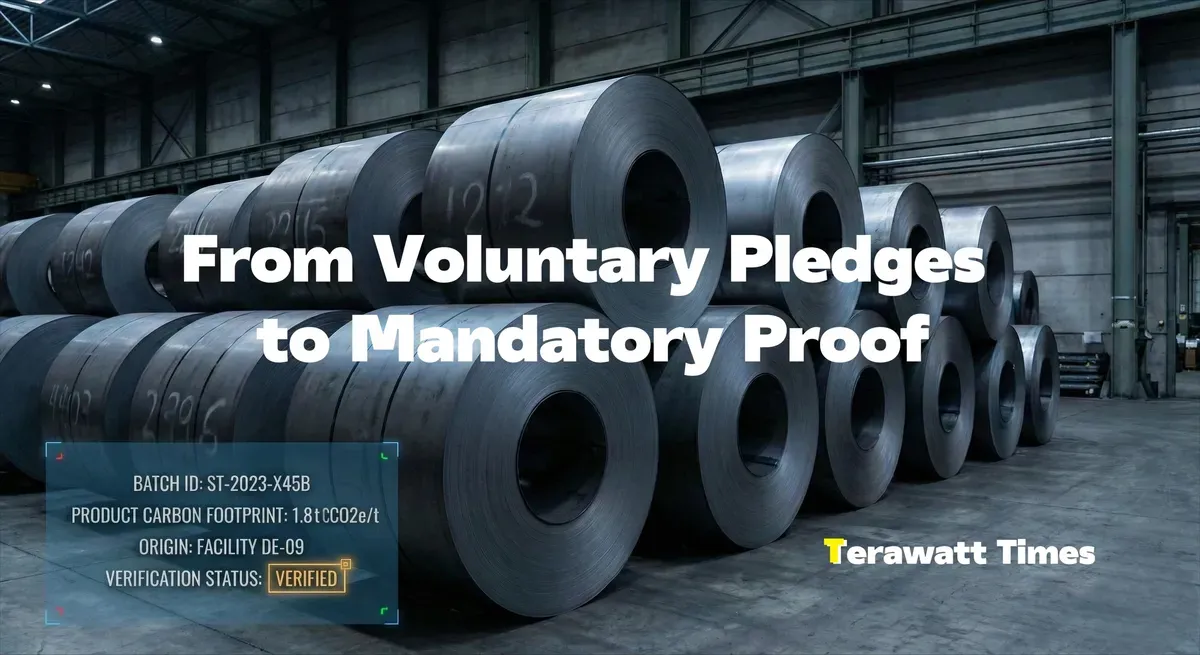
A Turkish steelmaker shipping hot-rolled coil into the European Union under CBAM does not need to lower the steel's carbon intensity. They need to document it, in formats specified by Brussels, verified by an accredited third party, submitted through the CBAM Registry. The price at the border follows from the documentation. CBAM admits steel of any carbon intensity, charging the corresponding differential. The Digital Product Passport regime works the same way for batteries, textiles, electronics. Neither instrument prescribes conduct. Both prescribe evidence.
The standard framework for understanding European regulatory influence, Anu Bradford's Brussels Effect, explains how European rules of conduct become global standards through market access conditionality. It does not explain CBAM and DPP, because CBAM and DPP do not prescribe rules of conduct. They determine what counts as adequate proof of whatever conduct the regulated party chooses. This paper names that modality Verification Imperium and develops the analytical machinery to study it.
Trust in voluntary climate governance collapsed comprehensively by the early 2020s. Material constraints on supply-chain reconstitution foreclosed retreat from interdependence. Between these, the choice of governance form turned on a property of the governed object: whether it admits audit. Manufactured products do. Financial flows do not. Counterfactual carbon credits, despite trading like commodities, do not either, which is why the voluntary offset market collapsed where CBAM stabilized. This paper develops the auditability condition as a generalizable proposition, distinguishes Verification Imperium from the broader Brussels Effect by its operation at the evidence-standard rather than rule-of-conduct layer, and traces the propagation, capture, and lock-in mechanisms that distinguish the two layers. The remaining carbon budget, 130 GtCO₂ for a coin-flip chance at 1.5°C, sets a horizon within which the architecture must either stabilize or fail.
The contribution is conceptual. Whether Verification Imperium reduces emissions is an empirical question that institutional design alone cannot settle.
1. Introduction: A Power That Has Not Been Named
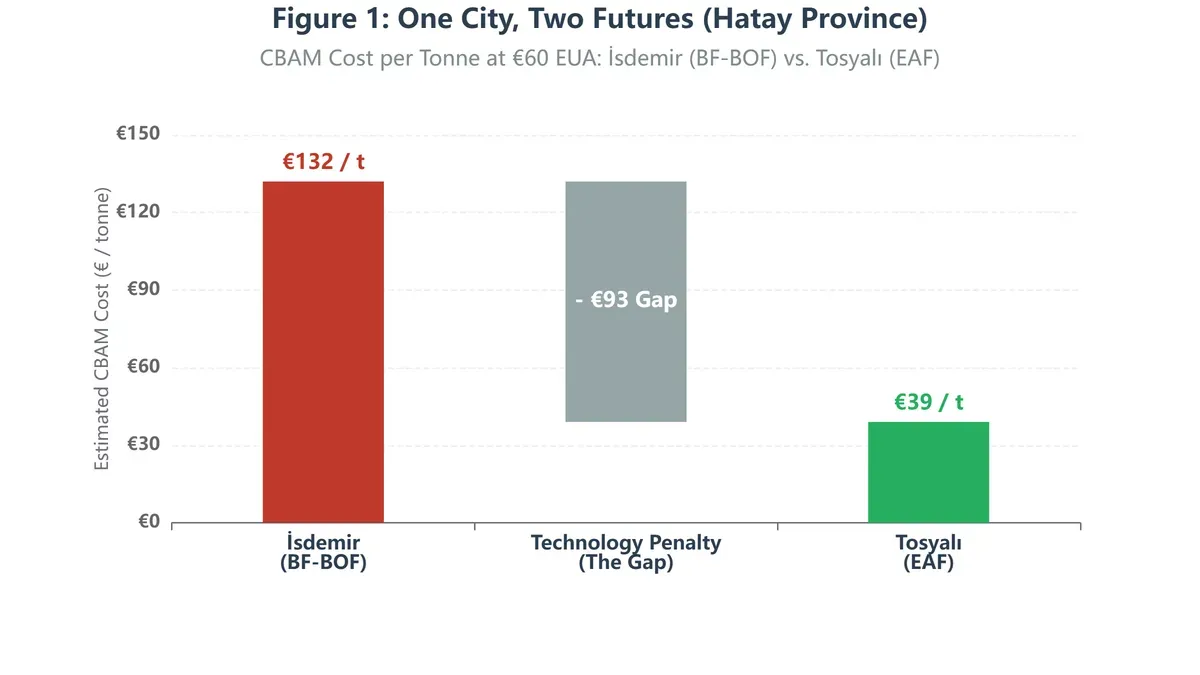
Turkey ships steel to the European Union. Under the operative CBAM, the steelmaker faces a question with no behavioral content. Brussels does not ask what carbon intensity the steel carries. Brussels asks for proof. Specifically: an emissions report prepared under Implementing Regulation 2025/2547, verified by an accredited verifier following Annex VI of Regulation 2023/956, transmitted through the CBAM Registry. The certificate price follows from the verified number.
The steelmaker can ship high-intensity steel and pay more, low-intensity steel and pay less, or no documentation and accept the default value. The choice across intensities is theirs. The choice about evidence is not. Brussels fixes the mode of compliance. The substance of what is being shipped, it does not touch.
Existing scholarship on European regulatory power does not prepare us for this. Anu Bradford's Brussels Effect analyzes how European rules of conduct propagate beyond European jurisdiction through market access [1]. The European Union forbids certain chemicals; multinationals producing for multiple markets adopt the European prohibition globally because differentiated production costs more than uniform compliance. The mechanism is documented across REACH, GDPR, antitrust enforcement, food safety. In each case the regulated entity is told what to do.
CBAM and DPP do not tell exporters what to do. They specify what must be proven, how the proof must be constructed, by whom it must be certified, and through what infrastructure it must travel. Regulation targets the evidentiary record about production, not production itself.
Call this Verification Imperium: the unilateral capacity to determine, for traded goods, what counts as adequate evidence of a contested empirical claim. Three mechanisms together exercise this capacity, developed in Section 5: specifying methodology, accrediting verifiers, prescribing the digital infrastructure through which substantiated claims travel. The three mechanisms exercise a form of structural power located in Susan Strange's knowledge structure [2], at a layer the Brussels Effect does not reach.
Section 2 documents the trust collapse that produced the demand for verification. Section 3 develops the auditability thesis, which explains why the audit form became available here when prudential alternatives were forced in finance, and why it failed inside climate governance itself when applied to counterfactual carbon credits. Section 4 separates Verification Imperium from the Brussels Effect, with attention to where capture lives in each. Section 5 builds the formal account. Sections 6 and 7 examine what makes the architecture stable: how it resists the pathologies Michael Power documented in earlier audit regimes [3], and why industry coalitions fracture under evidence-standard regulation along the regulation's own discriminating dimension. Section 8 anchors the analysis in the remaining carbon budget. Section 9 specifies boundary conditions. Section 10 closes with the questions handed to the next paper in the series.
Remaining content is for members only.
Please become a free member to unlock this article and more content.
Subscribe NowAuthors

U.S. energy strategist focused on the intersection of clean power, AI grid forecasting, and market economics. Ethan K. Marlow analyzes infrastructure stress points and the race toward 2050 decarbonization scenarios at the Terawatt Times Institute.

Caroline is a Houston-born analyst focusing on Gulf Coast oil, LNG, and industrial electrification. She studies how legacy energy systems and new clean-power infrastructure reshape the economic future of the American South.

Hiroto Nakamura is a research fellow focused on climate intelligence, satellite-based MRV, and AI-driven environmental monitoring. He analyzes geospatial data and verification systems to improve global carbon transparency and emissions accountability