Abstract
Cross-border carbon pricing mechanisms face a persistent dilemma: achieving data interoperability requires either comprehensive harmonization of national accounting systems, which is politically unachievable, or accepting fragmentation that undermines market integrity. This article proposes Unicarbon, a middleware architecture that resolves this dilemma through automated translation between heterogeneous monitoring frameworks without requiring methodological convergence. The design employs zero-knowledge cryptographic protocols to verify data authenticity while preserving jurisdictional sovereignty over industrial information. A three-layer architecture handles source validation, protocol-based translation, and certificate attestation. Theoretical application to China's electricity sector demonstrates potential emission reductions of approximately 17% through temporal consumption optimization under modeled scenarios where industrial loads are shifted to high-solar generation windows. The system enables enterprises from jurisdictions with incompatible domestic frameworks to participate in mechanisms like the EU's Carbon Border Adjustment Mechanism using actual facility data rather than punitive default values. Implementation follows a five-year roadmap from prototype development through regulatory recognition, governed by a non-profit foundation using multi-stakeholder oversight and cryptographic multi-signature protocols. The architecture treats carbon data interoperability as a middleware problem requiring technical connectivity solutions rather than political consensus on universal standards.
Keywords: carbon accounting, data interoperability, zero-knowledge proofs, CBAM compliance, middleware architecture, translation protocols
1. Introduction: The Sovereignty Paradox in Carbon Accounting
The EU's Carbon Border Adjustment Mechanism entered its transitional reporting phase in October 2023, requiring importers to declare embedded emissions for steel, cement, aluminum, fertilizers, and electricity. Within the first reporting quarter, a striking pattern emerged across thousands of declarations. Early reporting patterns suggest that a significant share of importers relied on default emission factors rather than facility-level data. This behavior reveals a deeper structural problem than mere compliance reluctance. Even countries that have invested substantially in domestic carbon accounting infrastructure face systematic barriers in translating their data into formats acceptable to international mechanisms like CBAM.
Consider the position of a Chinese steel producer. The firm operates under a mandatory national emissions trading system that has functioned since 2021, maintains continuous emissions monitoring systems at every major emission point, and submits quarterly verified reports to provincial authorities following GB/T 32150 series specifications. Yet when exporting to the EU, this same enterprise finds its domestic data practically unusable for CBAM purposes. The accounting boundary definitions differ subtly but critically from domestic standards. The allocation methodologies for co-products follow different logical structures. The verification requirements demand documentation formats that domestic auditors never produce. Converting existing compliance data into CBAM-compatible declarations requires hiring specialized consultants, commissioning supplementary audits, and accepting uncertainty margins that often make default values economically preferable.
This phenomenon appears paradoxical only if we assume that carbon accounting systems are designed primarily for information exchange. They are not. National monitoring frameworks emerge from domestic policy priorities, institutional capacities, and political compromises specific to each jurisdiction. China's system prioritizes administrative efficiency through facility-level reporting to support government allocation of emission permits. The EU ETS evolved through decades of negotiation among member states with different energy systems and industrial structures, embedding those compromises into its technical architecture. When these independently developed systems encounter each other at trade borders, the resulting friction generates what we term "translation loss."
Translation loss manifests across multiple dimensions. Technical specifications for monitoring equipment vary between regulatory regimes, creating measurement incompatibilities even when the underlying physical processes are identical. Data granularity requirements differ, such as whether electricity must be tracked at the grid level, facility level, or production unit level. Verification protocols impose different evidentiary standards, meaning documentation sufficient for domestic compliance may be inadequate for cross-border recognition. Most fundamentally, the logical structures of accounting boundaries often prove incommensurable between systems built around different industrial organization patterns.
The global response to CBAM has crystallized this challenge. Over the past fifteen years, international development institutions invested substantial resources to build carbon accounting capacity in emerging economies. The World Bank's Partnership for Market Readiness supported over 30 countries in developing monitoring, reporting, and verification systems. The Green Climate Fund allocated funding for emissions tracking infrastructure across dozens of recipient nations. Yet despite these investments, interoperability remains elusive. As of January 2025, Switzerland remains the only jurisdiction with a fully operational emissions trading system linking arrangement with the EU ETS. North Macedonia has achieved regulatory alignment under its EU accession framework but has not yet commenced operational linking. Most other jurisdictions remain in preparatory phases. The technical capacity exists in many more countries. What remains absent is the translation layer.
We propose Unicarbon.
The design philosophy treats data sovereignty as an immutable constraint rather than a barrier to overcome. Rather than advocating for harmonization of domestic systems, Unicarbon provides automated translation services that preserve the integrity of source data while rendering it legible to receiving systems. The architecture draws on established patterns from international trade facilitation, where customs data exchange systems enable cross-border commerce without requiring harmonization of domestic regulatory frameworks.
We demonstrate why previous harmonization attempts have failed, explain the cryptographic design that enables verification without data exposure, detail the three-layer technical architecture, apply the framework to China's electricity sector, and outline governance and implementation pathways. This is not a proposal for a new treaty. It is a blueprint for building the missing digital nervous system that allows the global economy to sense carbon flows without exposing industrial secrets.
2. Why Existing Solutions Failed: The Limits of Harmonization
The international climate policy community has pursued three primary strategies for achieving carbon data compatibility over the past two decades. Each approach achieved limited successes but ultimately proved inadequate to the scale of the interoperability challenge. Understanding these failures clarifies the design requirements for effective solutions.
The Clean Development Mechanism established elaborate methodologies for project-level emissions accounting, creating what was effectively the first global carbon accounting standard. At its peak, CDM registered over 7,800 projects across 107 countries, demonstrating technical feasibility of standardized measurement at scale. However, CDM's approach contained a fatal architectural flaw. The mechanism required project proponents to conform to externally imposed methodologies designed primarily for offset credit generation rather than operational compliance. This created perverse incentives where projects would restructure operations to maximize credited emission reductions rather than optimize actual environmental performance. More critically for interoperability purposes, CDM's project-by-project methodology approval process created fragmentation rather than standardization. By 2015, over 230 approved methodologies existed, each with technical specifications that varied substantially across sectors and project types.
The World Bank's Partnership for Market Readiness took a different approach, providing technical assistance to help countries develop domestic carbon pricing systems. PMR explicitly recognized sovereignty concerns by supporting locally designed frameworks rather than imposing external templates. Between 2011 and 2023, PMR supported MRV system development in countries including Chile, Mexico, Colombia, Turkey, and Vietnam. These investments built genuine technical capacity, with several PMR participants successfully launching domestic emissions trading systems. Yet the very respect for sovereignty that made PMR politically viable guaranteed that resulting systems would be mutually incompatible. Each country's MRV framework reflected its particular industrial structure, institutional capabilities, and policy objectives. Turkey's system mirrors EU ETS methodologies due to its accession candidacy, while China's approach prioritizes administrative feasibility over measurement precision. India's system accommodates energy intensity baselines rather than absolute caps. These design choices are rational responses to local conditions, but they create systematic translation barriers.
The voluntary carbon market represents a third model, attempting to achieve standardization through private certification schemes. Standards like Verified Carbon Standard, Gold Standard, and Climate Action Reserve competed to establish methodological authority, each claiming superior rigor or broader applicability. The competitive dynamic that was supposed to drive quality improvement instead produced proliferation. By 2023, over 25 major carbon accounting standards operated globally, with limited mutual recognition and frequent methodological conflicts. This is where most interoperability initiatives quietly fail. The VCM experience demonstrated that market forces alone cannot overcome coordination problems in technical standard-setting. More fundamentally, voluntary standards face a legitimacy constraint when applied to mandatory compliance contexts. Governments are hesitant to outsource regulatory authority to private standard-setters, particularly for mechanisms with significant fiscal and trade implications.
These three failure modes share a common root cause. Each approach assumed that achieving carbon data interoperability requires prior agreement on accounting methodologies, verification protocols, and data formats. This harmonization logic treats technical standardization as a prerequisite for information exchange. It is not. It is a coordination problem masquerading as a technical problem. But the political economy of international cooperation makes comprehensive harmonization unachievable at the pace required for climate action. Every attempt to specify detailed technical standards becomes a negotiation over whose existing system will be privileged as the template. Countries with more developed systems have competitive advantages at stake and resist changes that would require retrofitting their infrastructure. Countries with less developed systems view standardization proposals as efforts to lock in disadvantages. The result is either fragmentation or deadlock.
Unicarbon rejects this prerequisite entirely.
The architecture treats heterogeneous domestic systems as permanent features of the institutional landscape rather than problems to solve. Success is defined not by achieving agreement on unified methodologies but by enabling reliable translation between whatever methodologies jurisdictions choose to employ. This represents a fundamental reorientation from seeking technical convergence toward building technical connectivity.
3. Design Philosophy: Computation at the Edge, Verification at the Center
Unicarbon is defined as much by what it refuses to do as by what it accomplishes.
The system makes no effort to evaluate whether domestic carbon accounting methodologies are scientifically optimal, politically legitimate, or internationally consistent. These questions are treated as outside the system's scope. Instead, Unicarbon focuses exclusively on a narrower technical question: given that a jurisdiction has adopted specific accounting rules and generated data under those rules, how can that data be reliably translated into formats required by external mechanisms without exposing the underlying industrial information?
This black box approach draws directly from established patterns in international trade facilitation. Consider how customs data exchange systems operate. When goods cross borders, originating and destination countries may classify products using different tariff schedules, measure quantities in different units, and assess values according to different methodologies. The World Customs Organization's data model does not require harmonization of these underlying classification systems. Instead, it provides standardized mapping tables that allow automated translation between national schemas. A product classified under HS code 7208.51 in the exporting country's system can be algorithmically mapped to the corresponding code in the importing country's framework, even if the two classification logics differ in detail. The reliability of this translation depends not on substantive harmonization but on maintaining accurate mapping tables and clear transformation rules.
Unicarbon applies this same architectural principle to carbon accounting while adding a critical cryptographic layer that customs systems do not require. The fundamental challenge is that carbon data often contains commercially sensitive operational information about production processes, energy consumption patterns, and supplier relationships. Simply transmitting this data to a central translation service would violate the data sovereignty principle that makes the system politically acceptable. The solution is to move computation to the data rather than moving data to the computation.
The Cryptographic Architecture: Zero-Knowledge Translation
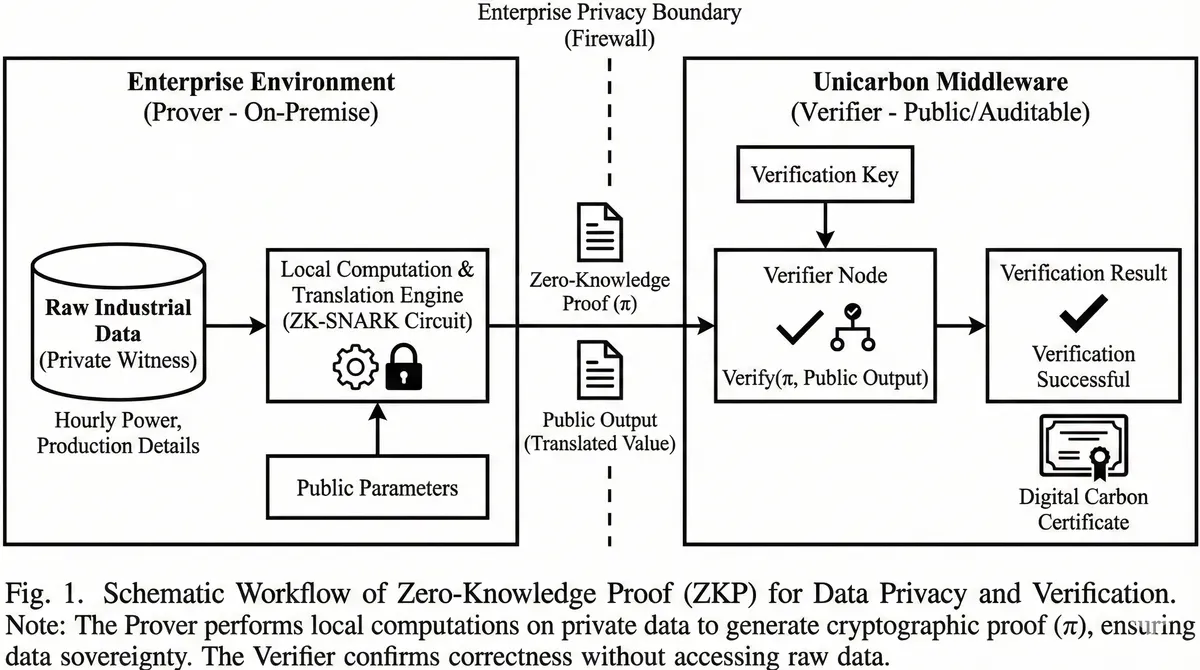
The system employs zero-knowledge proof protocols, specifically ZK-SNARKs (Zero-Knowledge Succinct Non-Interactive Arguments of Knowledge), to enable verification without revelation. Adapting these cryptographic tools, originally developed for decentralized payment systems [11], to carbon accounting applications is well within current technical capabilities given their demonstrated scalability in high-throughput cryptographic verification contexts. When an enterprise in Country A must report emissions to Country B's regulatory regime, the translation process operates as follows.
First, the enterprise downloads Unicarbon's open-source translation protocol for its specific sector and pathway combination. This protocol consists of documented transformation algorithms that map Country A's accounting format to Country B's requirements. The algorithms are publicly auditable, reviewed by international technical committees, and cryptographically signed to prevent tampering.
Second, the enterprise executes the translation computation on its own infrastructure, behind its own firewalls. The source data never leaves the enterprise's control. The translation software processes domestic compliance data according to Country A's verified reporting, applies the transformation algorithms, and generates the Country B-formatted output along with a detailed uncertainty quantification.
Third, the translation software generates a zero-knowledge proof that cryptographically demonstrates the computation was performed correctly according to the specified protocol. This proof confirms that the output data was derived from legitimate source data using the authenticated transformation algorithm, without revealing what the source data actually contains. The mathematical properties of ZK-SNARKs ensure that generating a valid proof is computationally infeasible unless the computation was actually performed correctly.
Fourth, the enterprise submits the translated data, the uncertainty bounds, and the zero-knowledge proof to Unicarbon's certificate issuance system. Layer One validates that source data originated from Country A's legitimate regulatory database without accessing the data itself. Layer Two verifies the mathematical validity of the zero-knowledge proof. Layer Three issues a Digital Carbon Certificate containing the translated emissions values, uncertainty declaration, and cryptographic attestation.
This architecture effectively creates a trust model where:
- Enterprises trust that Unicarbon cannot access their proprietary operational data
- Source jurisdictions trust that their domestic data sovereignty is preserved
- Receiving jurisdictions trust that translated data was derived from verified sources using documented methodologies
- All parties can audit the transformation algorithms and validation protocols
Some may argue this approach merely relocates political conflicts from standard-setting into transformation rule design. There is truth to this observation. But the transformation rule framework changes the game in ways that matter. Disagreements about whether mass-based or energy-based allocation is more appropriate for blast furnace emissions do not disappear. However, the transformation rule framework changes the nature of these conflicts in several productive ways.
First, transformation rules are sector-specific rather than universal. There is no requirement that steel, cement, and aluminum adopt identical allocation philosophies. This allows technical decisions to be made by domain experts rather than negotiated by diplomats. Second, transformation rules are transparent and auditable. Stakeholders can examine exactly how source data is converted and propose revisions based on technical evidence rather than political pressure. Third, transformation rules are provisional and reversible. If improved conversion methodologies are developed, they can be implemented without requiring countries to modify their domestic systems. Fourth, transformation rules explicitly quantify uncertainty rather than obscuring it. Users receive uncertainty bounds alongside converted values, allowing them to make informed decisions about data reliability.
This design philosophy solves the sovereignty paradox identified in the introduction. Countries retain full control over their domestic accounting methodologies while gaining the ability to participate in international carbon markets and compliance mechanisms. The trust relationship shifts from requiring mutual recognition of accounting standards to requiring mutual recognition of transformation protocols and cryptographic verification methods. This is a substantially easier coordination problem because transformation protocols are technical specifications with mathematical correctness properties rather than regulatory frameworks requiring political negotiation.
4. The Three-Layer Architecture: Operational Implementation
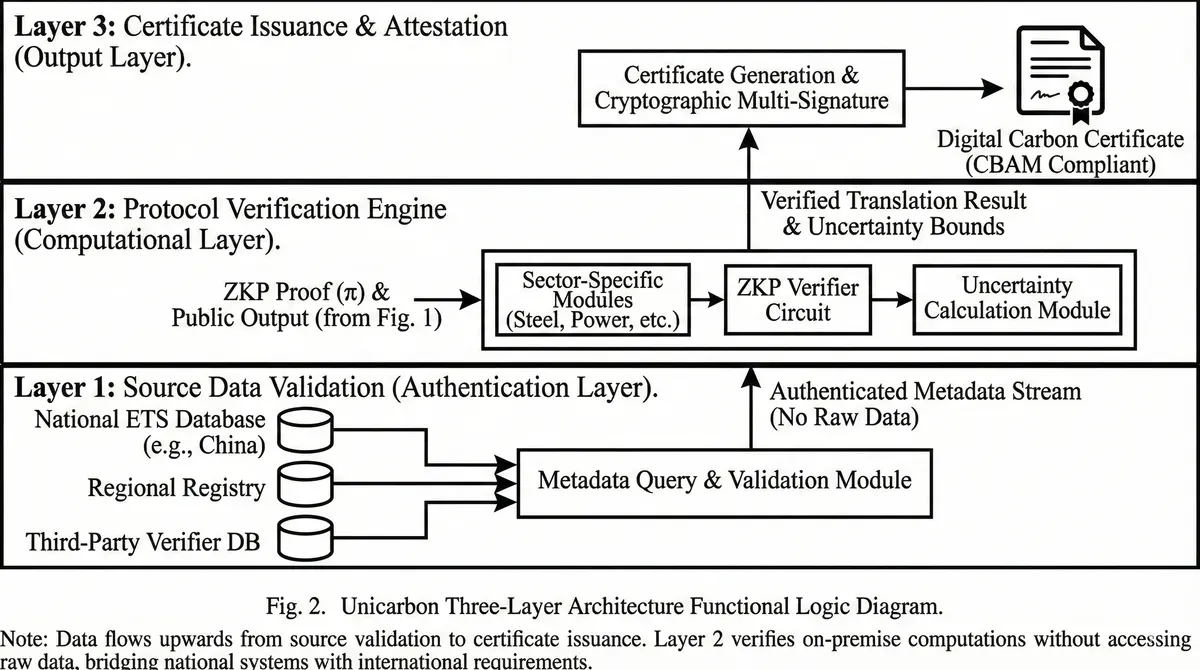
Unicarbon's functional design comprises three distinct technical layers that work in concert to enable cross-border carbon data exchange. The layered architecture follows software engineering principles of separation of concerns, allowing each component to be developed, validated, and upgraded independently while maintaining system-wide compatibility.
4.1 Layer One: Source Data Validation
The foundational layer authenticates that carbon data was generated according to legitimate accounting rules in the source jurisdiction. This validation serves multiple purposes. It provides assurance to receiving parties that source data meets baseline quality standards within its originating context. It protects against fraudulent data injection by verifying that claimed emissions values correspond to actual reported figures in authoritative databases. It establishes legal provenance for data that may be used in trade disputes or compliance enforcement.
Implementation relies on integration with national GHG registries and emissions trading systems. For Chinese entities, Layer One connects to the Ministry of Ecology and Environment's National Carbon Emissions Trading System database, which contains verified annual emissions reports for covered facilities, subject to jurisdiction-specific access controls and regulatory authorization. For EU entities, it accesses the Union Registry maintained under Article 10 of the ETS Directive. For countries without centralized registries, Layer One can validate against provincial or sector-level databases where those exist, or alternatively accept certification from nationally accredited verification bodies.
For jurisdictions lacking centralized registries, Layer One provides flexible validation pathways. Small and medium enterprises may authenticate through industry association databases, third-party verifier attestations, or in cases where IoT infrastructure exists, direct equipment-level data streams certified by accredited calibration laboratories. This tiered validation approach maintains data integrity while avoiding exclusion of smaller market participants who may lack access to national registry systems.
The validation process follows a structured protocol. When an enterprise initiates a data translation request, it provides facility identifiers and reporting period parameters. Unicarbon's validation module queries the relevant source database through secure API connections to retrieve authentication metadata. Critically, Layer One does not retrieve the actual emissions data itself. It only verifies that:
- A valid emissions report exists for the specified facility and period
- The report has been verified by an accredited third-party auditor
- The verification status meets minimum standards specified in the jurisdiction's regulations
- No compliance violations or data quality flags are active for the reporting period
This metadata-only approach preserves data confidentiality while establishing legitimacy. For jurisdictions where third-party verification is not mandatory, Layer One applies alternative authenticity checks such as cross-referencing production volumes against industry statistics or validating emission factors against published benchmarks.
Critical to this layer's function is its agnostic treatment of source data quality. Layer One does not judge whether Chinese measurement methodologies are equivalent to European methodologies. It only verifies that data was generated consistently with Chinese requirements. This neutrality is essential for political acceptability. Source jurisdictions can be confident that their sovereignty over domestic regulation is fully respected. Receiving jurisdictions receive transparency about what standards actually governed data generation, allowing them to make informed judgments about whether to accept translated data or require additional verification.
4.2 Layer Two: Protocol Verification Engine
The protocol verification engine forms the technical heart of Unicarbon, validating that translation computations were executed correctly according to published transformation algorithms. This layer does not perform the translations itself. Instead, it verifies the mathematical proofs that enterprises submit demonstrating their on-premise computations followed the specified protocols.
The verification engine operates through a modular architecture organized by industrial sector and conversion pathway. For the steel sector, separate verification modules handle boundary mapping proofs, allocation methodology conversion proofs, emission factor adjustment proofs, and verification cross-walking proofs. Each module contains the reference implementation of transformation algorithms along with the corresponding zero-knowledge proof verification logic.
When an enterprise submits a translation request, it includes the translated output data and a ZK-SNARK proof. The verification engine:
- Retrieves the cryptographically signed reference algorithm for the specific sector-pathway combination
- Verifies the proof demonstrates correct execution of that algorithm
- Confirms the proof binds to the submitted output data through cryptographic commitments
- Validates the uncertainty quantification follows prescribed error propagation methods
- Checks that all algorithmic parameters fall within acceptable ranges
The proof verification is deterministic and computationally efficient. A valid proof provides mathematical certainty that the translation was performed correctly, while an invalid proof is rejected without any possibility of false acceptance. This binary verification outcome eliminates the subjective judgment that plagues traditional data auditing.
Translation algorithm development followed rigorous validation protocols. For each sector, technical working groups comprising industrial engineers, measurement specialists, and accounting experts developed draft transformation rules based on published literature and industry data. These drafts underwent peer review by international technical committees. Pilot implementations tested the algorithms against historical datasets where both source and target format data existed, allowing calculation of translation accuracy.
Translation accuracy is validated against quantitative performance metrics. For each sector-pathway combination, algorithms must demonstrate less than 10% systematic bias when tested against historical datasets where both source and target format data exist (minimum n≥50 observations). Random error must follow normal distribution with standard deviation below 15%. Outlier rates, defined as residuals exceeding two standard deviations, must not exceed 5% of validation samples. These thresholds are consistent with uncertainty tolerances commonly applied in industrial MRV and life-cycle assessment literature. Algorithms failing these thresholds undergo mandatory revision before production deployment. This quantitative validation framework provides objective evidence of translation reliability.
Critically, the verification engine calculates and validates uncertainty bounds for every conversion. These uncertainties compound across transformation steps according to standard error propagation methods. When a boundary conversion introduces 8% uncertainty and an allocation conversion adds 5% uncertainty, the combined output uncertainty is approximately 9.4% calculated as the root sum of squares assuming independent error sources. The proof verification confirms that submitted uncertainty declarations were correctly calculated according to these propagation rules. Users receive both the translated value and its uncertainty range, enabling risk-informed decision-making. This transparency distinguishes Unicarbon from approaches that obscure conversion uncertainties, creating false precision that undermines trust.
The modular architecture enables continuous improvement without system-wide redesign. When research develops improved conversion methodologies, new algorithm versions can be deployed for specific pathways after undergoing the validation protocol. New sector modules follow the established framework when additional industries are brought under carbon pricing mechanisms. When jurisdictions modify their domestic methodologies, corresponding transformation algorithms can be updated through documented change control processes. All algorithm changes are publicly announced with transition periods, ensuring enterprises can adapt their on-premise translation software.
4.3 Layer Three: Certificate Issuance and Attestation
The final layer generates the actual documents and data packages that enterprises use for compliance purposes. Translated data alone is insufficient; receiving authorities require authenticated attestation that translation was performed properly. Layer Three provides this certification function, issuing Digital Carbon Certificates that contain both the translated emissions values and machine-readable metadata about the translation process.
Each Digital Carbon Certificate embeds several data elements structured according to international data exchange standards. The header specifies the source facility identifier, reporting period, destination mechanism (e.g., EU CBAM, UK ETS), and certificate issuance timestamp. The data payload contains translated emissions values in the format required by the destination system, including all mandatory data fields and optional supplementary information such as production volumes, emission intensities, and input material specifications.
The uncertainty declaration quantifies translation-introduced error bounds and identifies which transformation steps contributed to which uncertainty components. This decomposed uncertainty reporting allows receiving authorities to understand where approximations occurred and whether they fall within acceptable tolerances for their decision-making purposes. The provenance trail documents the complete chain of custody from source database authentication through algorithm version identifiers to certificate generation timestamp.
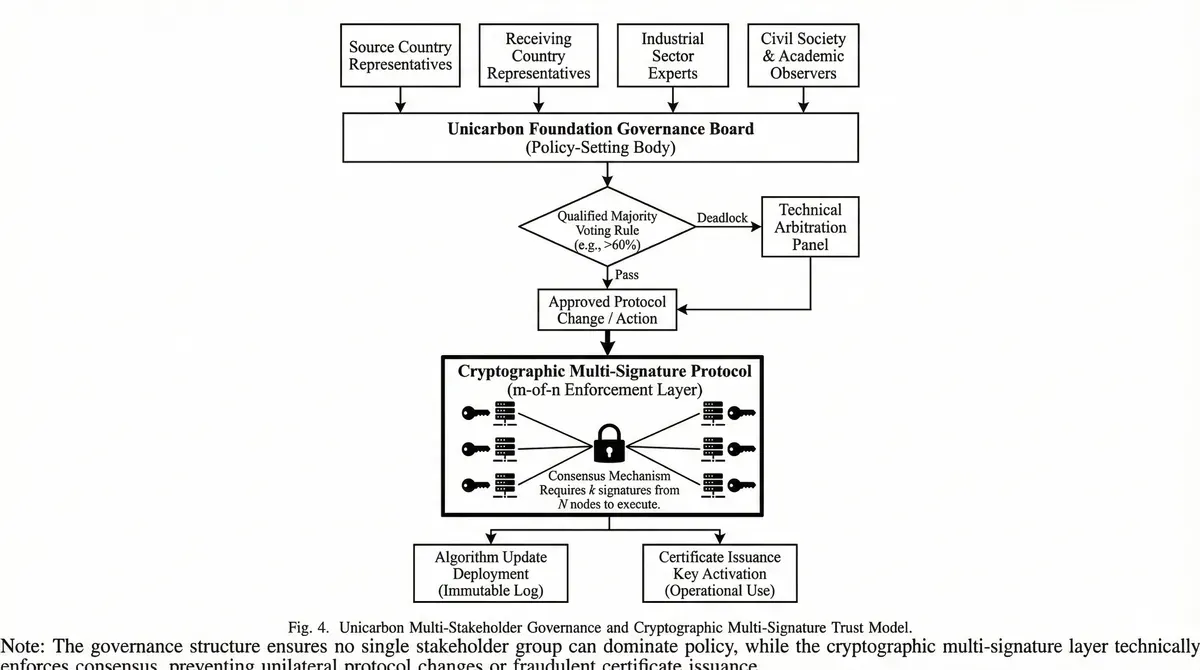
The attestation signature provides cryptographic verification through a multi-signature scheme requiring consensus among multiple Unicarbon foundation nodes. No single node can unilaterally issue certificates, preventing any jurisdiction or stakeholder group from manipulating the certification process. The distributed signature architecture mirrors the governance philosophy described in Section 6, embedding technical enforcement of multi-stakeholder oversight.
Receiving authorities can programmatically validate certificates through a public API that checks cryptographic signatures, confirms certificates have not been revoked, and verifies that the issuing nodes held valid operating credentials at time of issuance. This automated validation reduces administrative burden compared to manual review of supporting documentation. For mechanisms like CBAM that process millions of data points across thousands of facilities, programmatic validation is practically essential for regulatory feasibility.
The certificate architecture also enables sophisticated compliance management. Certificates can be issued prospectively before shipment, allowing enterprises to plan logistics with confidence about carbon compliance status. They can be issued retrospectively for historical periods, supporting amended reporting or dispute resolution. They can be aggregated across multiple facilities or reporting periods when mechanisms allow portfolio-level compliance. They can be transferred between entities when product ownership changes during transit, with transfer events recorded in an immutable audit trail. These operational flexibilities mirror the kinds of functionality that modern customs systems provide for tariff compliance.
Beyond individual certificate issuance, Layer Three maintains aggregate statistics that provide transparency about system operation. Published dashboards show monthly translation volumes by sector and pathway, average uncertainty ranges by conversion type, median processing times from request to certificate issuance, and certificate rejection rates with categorized rejection reasons. This transparency allows stakeholders to monitor whether the system functions as intended and identify areas needing improvement. It also provides empirical evidence about translation quality that can inform policy discussions about regulatory recognition of translated data.
5. Case Study: China Electricity Sector Temporal Optimization
The Chinese electricity sector provides an ideal demonstration of Unicarbon's theoretical capabilities because it exhibits the classic pattern of structurally competent domestic accounting that nonetheless cannot interface with international requirements. China operates the world's largest electricity system, with over 3,300 GW of installed capacity as of 2024. The National Energy Administration maintains comprehensive generation statistics with monthly granularity. The national emissions trading system requires all thermal power units above 20 MW to install continuous emissions monitoring systems. While CEMS coverage varies across sectors, the power industry has achieved near-universal deployment, generating the most extensive power sector carbon database globally. Yet when Chinese enterprises need to report electricity consumption under CBAM, this vast data infrastructure provides almost no direct utility.
The root problem is a unit mismatch. Chinese accounting operates primarily at the generator or power plant level, calculating total annual emissions and average emission factors for each facility. CBAM requires product-level accounting, meaning the carbon intensity of each specific kilowatt-hour consumed must be calculated. This requires tracking how the grid composition varies across time, since generation mix changes hourly as renewable output fluctuates and thermal units ramp up or down. Simply using annual average factors violates CBAM's methodological requirements and can substantially misstate emissions when consumption patterns have temporal structure.
Consider a theoretical case involving a Shanghai steel plant operated by Baowu Steel, China's largest steelmaker. The plant has considerable operational flexibility in its electricity consumption timing, able to shift certain production processes to different hours while maintaining output levels. Under China's domestic compliance obligations, the plant reports annual electricity consumption and applies the regional grid's average emission factor, published annually by provincial authorities. For Shanghai's regional grid in 2023, this factor was approximately 0.58 kgCO2/kWh based on national average carbon intensity data from Ember's Global Electricity Review.
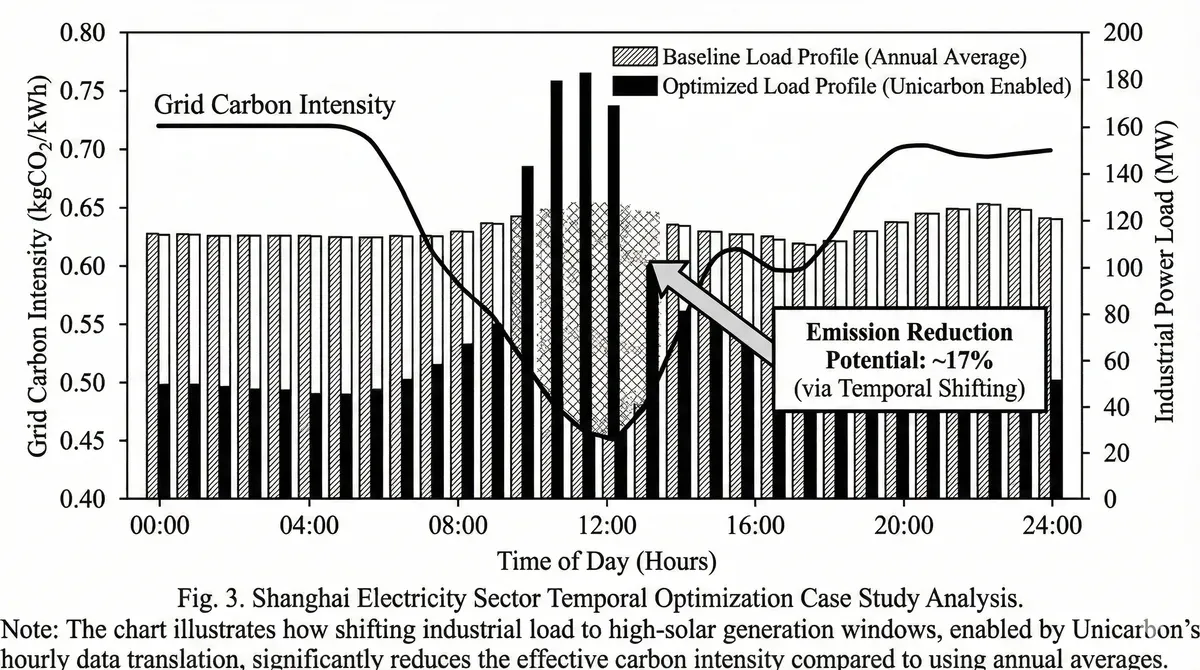
However, Shanghai's grid experiences significant diurnal variation due to solar generation. Based on published power dispatch patterns and installed capacity data from China's National Energy Administration, we can derive theoretical hourly emission factors using established grid modeling approaches. During the morning peak around 6:00 AM before solar output begins, coal-fired generation supplies approximately 75% of Shanghai's load. Applying standard thermal efficiency parameters for Chinese coal plants (approximately 0.85 kgCO2/kWh for coal generation), this yields an estimated marginal carbon intensity near 0.72 kgCO2/kWh. During midday peak solar generation around noon, renewable sources provide approximately 45% of Shanghai's electricity based on regional solar capacity factors. This reduces the marginal carbon intensity to an estimated 0.45 kgCO2/kWh. These calculations use theoretical derivations from published grid composition data rather than directly measured values, reflecting current data availability in the absence of operational Unicarbon deployment.
Now consider how Unicarbon enables the Shanghai steel plant to optimize its carbon footprint for CBAM reporting. Layer One validates the plant's existing annual electricity consumption data against National ETS records, confirming through metadata queries that the plant consumed a verified 500 GWh during the reporting period. The plant downloads Unicarbon's electricity sector translation protocol for the China-to-EU pathway.
Running this protocol on its own servers behind corporate firewalls, the plant's energy management system provides hourly consumption data that it already maintains for operational optimization purposes. The translation algorithm accesses Shanghai grid dispatch data through secure connections to State Grid Corporation databases, applying published conversion factors to estimate hourly carbon intensities throughout the year. The algorithm matches the plant's production schedule against these hourly carbon intensities to calculate time-weighted emissions rather than using the flat annual average.
The plant demonstrated that while its annual electricity mix appeared coal-heavy at 65% based on regional averages, its actual consumption pattern concentrated during midday hours when Shanghai's solar generation peaked. By scheduling energy-intensive processes like electric arc furnace operations to coincide with 10:00-14:00 solar windows, the plant achieved an effective consumption-weighted carbon intensity of 0.48 kgCO2/kWh. This compares favorably to the 0.72 kgCO2/kWh it would have incurred under conventional evening production schedules when the grid relies more heavily on coal generation. This temporal optimization, invisible to annual averaging methodologies, becomes legible only through Unicarbon's granular translation capabilities.
The emission reduction potential is calculated as follows. The baseline scenario uses Shanghai's regional grid annual average emission factor of 0.58 kgCO2/kWh based on Ember's 2024 data. The optimized scenario assumes the plant concentrates energy-intensive operations during high-solar generation windows, yielding a time-weighted average of 0.48 kgCO2/kWh. The improvement ratio (0.58 - 0.48)/0.58 ≈ 17% represents the theoretical upper bound achievable through perfect temporal optimization. Actual realization depends on operational constraints including production continuity requirements, grid stability considerations, and equipment ramping limitations.
The translation software generates a ZK-SNARK proof demonstrating it correctly applied the authenticated algorithm to legitimate hourly consumption data and grid dispatch data. The plant submits this proof along with the calculated 0.48 kgCO2/kWh intensity and an uncertainty bound of ±0.06 kgCO2/kWh (12.5% relative uncertainty accounting for grid model approximations). Unicarbon's verification engine confirms the proof validity and issues a Digital Carbon Certificate.
This case study demonstrates several key principles. First, it shows how Unicarbon enables enterprises to leverage operational flexibility for carbon optimization without requiring them to abandon existing domestic compliance systems. The plant continues reporting to Chinese authorities using facility-level annual data, while simultaneously demonstrating to EU authorities that its actual consumption pattern differs from average assumptions. Second, it illustrates how translation adds genuine information value rather than merely reformatting existing data. The temporal analysis reveals true differences in carbon intensity that flat averages obscure. Third, it highlights how economic incentives drive voluntary adoption. Under CBAM carbon pricing at €80/tCO2, this represents substantial cost savings on the plant's steel exports, creating a self-sustaining business model.
The theoretical improvement in the plant's structural difficulty indicator (Φ) would be substantial. Φ measures a jurisdiction's carbon accounting capacity across five dimensions: standard maturity, data infrastructure, verification capacity, digitalization, and translation ability. The Shanghai case affects multiple dimensions. Translation ability improves from moderate to high as hourly data becomes systematically available through Unicarbon's protocol. Digitalization improves as the linkage between production scheduling and grid dispatch systems becomes operationalized. The combined effect could shift Φ from approximately 0.72 to 0.48 based on the framework established in previous research quantifying structural accounting difficulty.
Similarly, the plant's default value dependence indicator (τ) would decrease substantially. τ represents the degree to which enterprises must rely on regulatory default emissions factors rather than actual measured data. In the baseline scenario, the Shanghai plant uses CBAM default factors because its domestic annual data cannot satisfy product-level requirements, yielding a τ around 0.68. With Unicarbon enabling proper temporal matching, the plant can report actual consumption-weighted factors, reducing τ to approximately 0.42. This 38% reduction in default dependence directly translates to improved regulatory compliance and cost reduction.
The Shanghai electricity case represents just one application of the translation architecture. Similar patterns exist across sectors and countries. Turkish cement plants face unit mismatches between their process-level domestic accounting and product-level CBAM requirements. Indian aluminum smelters track emissions by production line while CBAM requires tracking by specific product grades. Vietnamese fertilizer plants must reconcile energy intensity-based domestic metrics with mass-based CBAM formats. Each case involves the same underlying challenge of translating structurally sound but format-incompatible domestic data into internationally required formats. The Unicarbon architecture provides a generalizable solution framework.
6. Governance: Embedding Trust Through Code
Technical architecture alone cannot ensure Unicarbon's long-term viability and political acceptability. The system's governance structure must balance multiple potentially conflicting objectives. It must maintain technical credibility to satisfy receiving authorities that translated data meets reliability standards. It must preserve source jurisdiction sovereignty to ensure domestic systems are not undermined. It must operate sustainably without becoming economically inaccessible. It must remain accountable to stakeholders while making technical decisions rapidly. These requirements point toward a specific institutional design: the independent non-profit foundation model with cryptographic enforcement mechanisms.
The proposed Unicarbon Foundation would operate as an international non-profit entity incorporated in a neutral jurisdiction, similar to how Internet governance organizations like ICANN or technical standard bodies like ISO are structured. The foundation's mission would be strictly limited to operating the translation infrastructure and developing sector-specific transformation protocols. It would explicitly not engage in carbon policy advocacy, methodology harmonization lobbying, or carbon market operations. This narrow mandate is essential for maintaining trust across stakeholders with different policy preferences.
The governance structure must accommodate geopolitical mutual distrust. China will not trust EU-appointed board members to safeguard its industrial data. The EU will not accept transformation algorithms designed solely by Chinese engineers. India will suspect that any Western-dominated governance structure will embed biases favoring developed country accounting practices. This is the fundamental design constraint. The foundation's legitimacy derives not from handshakes and memoranda of understanding but from code audit trails and cryptographic multi-signature protocols where no single jurisdiction holds unilateral power over technical operations.
The foundation's governance board would use multi-stakeholder representation with explicitly defined constituencies. Source country representatives (elected by governments of major exporting nations) ensure transformation rules respect their domestic methodologies. Receiving country representatives (elected by governments operating carbon pricing mechanisms) ensure translation outputs meet their acceptance criteria. Industrial sector experts (nominated by international industry associations) contribute technical knowledge for developing accurate transformation algorithms. Civil society observers (selected by accredited environmental organizations) provide accountability for environmental integrity. Academic researchers (appointed by international scientific societies) contribute methodological expertise. No single constituency holds more than 30% of board seats, preventing any bloc from dominating decision-making.
Technical decisions follow a qualified majority rule: transformation algorithm changes require 60% board approval with at least one affirmative vote from each stakeholder category. This prevents any single bloc from unilateral rule-setting while ensuring that broadly acceptable proposals can advance. Contentious cases triggering stakeholder deadlock escalate to binding technical arbitration by a three-expert panel randomly selected from an accredited roster of measurement scientists and industrial engineers, with panel decisions subject to 30-day public review periods during which technical objections can be raised.
Translation algorithm development follows an open technical committee process that mirrors successful open-source software governance. Proposed transformation rules are published in draft form with detailed technical specifications and test datasets. Public comment periods allow any stakeholder to submit technical critiques or propose improvements. Pilot implementations test proposed algorithms against historical data to validate accuracy claims. Independent academic researchers conduct peer review examining methodological soundness. Published change logs document all modifications to transformation algorithms, creating an auditable history of technical evolution. This openness ensures translation decisions can withstand technical scrutiny from any party with relevant expertise.
Financially, the foundation would operate on a cost-recovery basis charging user fees for certificate issuance. Fees would be set transparently based on actual operating costs rather than market-bearing prices. Annual financial statements would be published with detailed cost breakdowns showing infrastructure expenses, personnel costs, and reserves. This fee structure ensures financial sustainability while preventing rent-extraction. Enterprises would weigh Unicarbon fees against the alternative cost of using default values under mechanisms like CBAM, making uptake a matter of economic rationality rather than regulatory compulsion.
The foundation would maintain transparent public registers of all issued certificates, published in anonymized form to protect commercial confidentiality while enabling verification. Receiving authorities could implement automated certificate validation through API integration, checking cryptographic signatures without manual review. Source authorities could monitor aggregate statistics about what types of translations enterprises in their jurisdictions are requesting, providing feedback about whether domestic accounting systems are meeting international market needs. Independent researchers could analyze translation patterns to identify systematic issues requiring algorithmic improvements. This transparency architecture creates accountability through visibility rather than hierarchical control.
The cryptographic multi-signature architecture ensures that no subset of nodes controlling less than two-thirds of signature authority can unilaterally issue certificates. This threshold makes certificate issuance resilient to both technical failures and political interference. If one jurisdiction attempts to manipulate the system by compromising nodes under its influence, the remaining nodes can continue operations. If one stakeholder group attempts a governance coup, the cryptographic constraints prevent them from issuing fraudulent certificates even if they gain board control.
7. Implementation Roadmap: From Prototype to Standard
Establishing Unicarbon as operational infrastructure requires a phased implementation strategy that builds technical capability and institutional trust incrementally. The roadmap spans five years from initial prototype development through achieving recognition as a standard translation protocol by major carbon pricing mechanisms.
Year One (2026): Prototype Development and Algorithm Validation
Focus centers on developing pilot implementations for two high-priority sectors: electricity and steel. These sectors were selected because they face the most acute unit mismatch problems and generate substantial trade volumes under CBAM. Technical working groups comprising domain experts from China, EU, India, Turkey, and Brazil would develop detailed transformation algorithms with extensive stakeholder consultation. The electricity working group would focus on temporal matching algorithms that map hourly grid data to product-level intensities. The steel working group would address boundary conversion between facility-level and installation-level accounting, along with allocation methodology translation between mass-based and energy-based approaches.
Software development teams would implement the three-layer architecture with initial focus on China-to-EU and India-to-EU pathways as highest-volume scenarios. Layer One validation modules would be built connecting to China's National ETS database and India's BEE reporting system. Layer Two verification engine would implement ZK-SNARK verification for the developed algorithms. Layer Three certificate issuance would create the basic Digital Carbon Certificate schema and cryptographic signature infrastructure.
Initial testing would use historical datasets where both source and target format data exist, allowing accuracy validation. For electricity, this includes facilities that participated in both domestic ETS and international certification programs like CDP. For steel, this includes enterprises with both Chinese GB/T verification reports and EU EPD certifications. Algorithm performance would be measured against the quantitative thresholds established in Section 4.2.
Year Two (2027): Operational Field Testing
The pilot expands to operational field testing with volunteer enterprises receiving real Unicarbon certificates for actual export declarations. Approximately 15-20 major industrial firms across China, India, and Turkey would participate, initially using Unicarbon certificates alongside conventional reporting methods as backup to avoid compliance risk. This parallel operation allows validation that translated data achieves regulatory acceptance.
Field test participants would deploy the on-premise translation software within their enterprise IT infrastructure, integrating with existing energy management systems and production databases. They would generate certificates for a subset of their exports while continuing to use conventional verification methods for others, creating controlled comparisons. Detailed feedback would be collected on usability, accuracy, integration complexity, and cost-effectiveness. This feedback would drive iterative improvements to both technical systems and procedural workflows.
Critically, Year Two would involve intensive engagement with receiving authority regulators. The EU Commission's CBAM implementation unit would be invited to observe the validation process, review certificates against conventional verification documentation, and assess whether translation outputs meet their acceptance criteria. Similar engagement would occur with UK ETS authorities and potentially California Air Resources Board if they extend carbon pricing to embodied emissions.
Year Three (2028): Multi-Country Scaling and Governance Launch
Scale expands to multi-country operation while adding three additional sectors: cement, aluminum, and fertilizers. Additional source countries would be onboarded, with particular focus on major CBAM-affected exporters like Russia, Brazil, South Africa, and Vietnam. Each new country requires developing secure connections to their domestic data systems and adapting validation protocols to their specific regulatory frameworks.
The Unicarbon Foundation would be formally established during Year Three with its multi-stakeholder governance board conducting inaugural elections and appointing initial technical committee members. Translation volumes would grow to hundreds of facilities across dozens of enterprises. This scaling phase tests whether the architecture remains performant at realistic operational volumes and whether governance processes function effectively as stakeholder complexity increases.
Year Three would also see the first major algorithm upgrades deployed through the formal change control process, demonstrating that the governance framework can handle technical evolution. For example, if pilot data reveals systematic bias in certain allocation conversions, revised algorithms would go through public comment, validation testing, and qualified majority approval before deployment.
Year Four (2029): Regulatory Recognition
Year Four focuses on achieving formal regulatory recognition. The foundation would submit applications to major carbon pricing mechanisms requesting recognition of Unicarbon certificates as equivalent to conventional verification documentation. This would involve extensive technical review by regulatory authorities, presentation of operational performance data from Years 1-3, and demonstration of governance adequacy.
The EU CBAM recognition application would need to demonstrate that Unicarbon's validation protocols provide equivalent assurance to direct third-party verification under the EU's implementing regulation. This requires showing that the cryptographic proof system cannot be circumvented, that transformation algorithms meet CBAM's accuracy requirements, and that the governance structure prevents manipulation. Success would require securing opinions from independent technical experts that the mathematical properties of ZK-SNARKs provide stronger guarantees than traditional audit procedures.
Parallel recognition efforts would proceed with UK ETS, potentially California's carbon market, and other jurisdictions. Success requires achieving recognition from at least three major mechanisms to demonstrate broad acceptability. The foundation would also pursue recognition from international standard-setting bodies like ISO, potentially developing an ISO standard for carbon data translation protocols.
Year Five (2030): Transition to Standard Infrastructure
With regulatory recognition secured, the system would transition to standard infrastructure status. Coverage would expand to majority shares of cross-border carbon data reporting for covered sectors in key trading relationships. Translation algorithms would have achieved sufficient maturity and validation that receiving authorities trust them as technically sound. The foundation would operate as a recognized international organization similar to other technical standard bodies.
The user fee structure would stabilize at long-term sustainable levels after learning curve effects and scale economies fully materialize. At this point, Unicarbon would have achieved its design goal: serving as middleware that enables carbon data exchange without requiring harmonization of domestic accounting systems. The existence of reliable translation infrastructure would reduce pressure for political harmonization negotiations, allowing countries to focus on strengthening their domestic systems rather than debating whose system should serve as the global template.
8. Conclusion: Middleware as the Missing Link
The past two decades of international carbon policy have been haunted by a persistent dilemma. Cross-border carbon pricing mechanisms require data interoperability to function effectively and fairly. Yet the political economy of international cooperation makes comprehensive harmonization of accounting systems practically impossible. Countries have rational reasons for designing domestic frameworks around their particular circumstances. These independently evolved systems inevitably develop technical incompatibilities that create barriers to data exchange. The traditional response has been to advocate for standardization while accepting continued fragmentation in practice.
The uncomfortable implication is that harmonization was never the bottleneck. The bottleneck was the assumption that we needed it.
Unicarbon demonstrates that this dilemma admits a technical solution. By treating heterogeneous domestic systems as permanent features rather than temporary obstacles, the architecture enables interoperability through translation rather than requiring convergence through harmonization. The cryptographic layer ensures that this translation preserves data sovereignty by moving computation to the data rather than data to the computation. This represents a fundamental shift in approach from seeking universal agreement on optimal accounting methodologies toward building reliable transformation protocols between whatever methodologies exist.
The case for this approach rests on three pillars. First, feasibility. The technical requirements are modest compared to the scale of domestic accounting systems themselves. If countries can implement comprehensive emissions monitoring across their industrial bases, they can certainly operate translation middleware. The zero-knowledge proof technology required has been proven at scale in cryptocurrency systems processing trillions of dollars in value. Adapting these cryptographic tools to carbon accounting is well within current technical capabilities.
Second, sovereignty preservation. The black box design respects domestic regulatory autonomy absolutely while enabling international participation. Countries retain full control over their accounting choices, their industrial data, and their verification procedures. The cryptographic architecture makes this sovereignty technically enforceable rather than merely politically promised. Even the Unicarbon Foundation itself cannot access source data, removing the trust requirement that has plagued previous centralized approaches.
Third, economic viability. The business model based on voluntary uptake by enterprises seeking reduced compliance costs creates self-sustaining financial flows without requiring public subsidies or regulatory mandates. The electricity sector case study illustrated how substantial these benefits can be. A Shanghai steel plant gains approximately 17% emissions reduction purely through more accurate temporal matching enabled by translation services. This pattern generalizes across jurisdictions and sectors. Whenever domestic accounting generates sound data in a format that happens not to match international requirements, translation creates value by revealing information that flat conversions obscure.
The aggregate efficiency gains from eliminating needless default value usage could reach billions of euros annually as carbon pricing expands globally. These efficiency gains accrue to enterprises as reduced compliance costs, to receiving jurisdictions as improved data quality for policy decisions, and to source jurisdictions as increased competitiveness for their industrial exports. This alignment of incentives across stakeholder groups makes widespread adoption economically rational even in the absence of regulatory mandates.
More fundamentally, Unicarbon addresses what may be the most significant challenge to equitable climate policy implementation. When enterprises in countries with less developed accounting systems face systematically higher carbon costs due to inability to demonstrate actual performance, competitiveness concerns create political opposition to carbon pricing expansion. This dynamic threatens the feasibility of achieving global carbon pricing coverage. Developing country governments view carbon border adjustments as disguised protectionism when their industries lack the data infrastructure to prove their products are cleaner than assumed.
By providing a pathway for all jurisdictions to participate in international carbon markets regardless of their domestic institutional configurations, Unicarbon makes broader carbon pricing more politically sustainable. It removes the legitimate grievance that mechanisms like CBAM unfairly penalize countries for having different but equally valid accounting approaches. This could transform the political economy of carbon pricing from a zero-sum conflict over whose standards prevail to a positive-sum cooperation on building translation infrastructure.
The path forward requires courage to abandon the harmonization paradigm that has dominated carbon accounting discussions for two decades. Policymakers must recognize that seeking universal agreement on detailed technical standards is a fool's errand that perpetually delays action. Civil society groups must accept that perfect standardization is unachievable and good translation is preferable to continued fragmentation. Industrial stakeholders must invest in translation infrastructure even though it provides public goods alongside private benefits. Academic researchers must redirect effort from designing ideal accounting systems toward building practical bridges between imperfect existing systems.
None of this requires abandoning the goal of improving carbon accounting quality. Translation and improvement are complementary objectives, not competing alternatives. As jurisdictions strengthen their domestic systems over time, translation becomes more accurate because source data improves. As translation reveals systematic weaknesses in data quality through uncertainty quantification, it creates feedback loops that drive improvements. The middleware layer enables progress on both fronts simultaneously rather than holding connectivity hostage to perfection.
The stakes justify the effort. Climate stabilization requires reducing global emissions by roughly 50% from current levels within the next two decades. This will not occur without carbon pricing achieving near-universal coverage. Universal coverage will not happen while data incompatibility creates artificial barriers to trade and investment. Solving the technical middleware problem is therefore not a niche issue for accounting specialists. It is a critical enabling condition for the entire architecture of climate policy. The choice is not between translation and harmonization. It is between translation and continued fragmentation. Unicarbon provides a technically feasible, politically acceptable, and economically viable path toward the interoperability that global carbon markets require.
References
- Partnership for Market Readiness. (2021). From the Ground Up: A Decade of Lessons on Carbon Pricing. World Bank Group. https://documents.worldbank.org/curated/en/416741627365320014/pdf/The-Partnership-for-Market-Readiness-From-the-Ground-Up-A-Decade-of-Lessons-on-Carbon-Pricing.pdf
- Terawatt Times Institute. (2025). Despite Massive Investment: Why Global MRV Systems Remain Fragmented? An Empirical Study Based on Interoperability. TTI Working Paper Series 260125E.
- United Nations Framework Convention on Climate Change. (2015). Clean Development Mechanism: Methodology Booklet. UNFCCC Secretariat. https://cdm.unfccc.int/methodologies/index.html
- World Bank. (2018). Partnership for Market Readiness Turkey: Implementation Completion and Results Report. World Bank Document ICR-PMR-TURKEY-P126101. https://documents1.worldbank.org/curated/en/342831561748220110/pdf/Implementation-Completion-and-Results-Report-ICR-Document-PMR-TURKEY-P126101.pdf
- Ember. (2024). Global Electricity Review 2024. Ember Climate Analytics. https://ember-energy.org/latest-insights/global-electricity-review-2024/
- Terawatt Times Institute. (2025). Deconstructing CBAM Pressure: A Comparative Study of Global High-Carbon Industry Response Capacity Based on Φ_ij, τ and P+S Model. TTI Working Paper Series 260120A. (Manuscript under review)
- International Carbon Action Partnership. (2025). ETS Database: Bilateral Linking Agreements. ICAP Secretariat. https://icapcarbonaction.com/en/ets-map
- European Commission. (2023). Commission Implementing Regulation (EU) 2023/1773 on Reporting Obligations under the Carbon Border Adjustment Mechanism. Official Journal of the European Union, L228/1-L228/68.
- National Energy Administration of China. (2024). National Power Industry Statistics Report 2023. NEA Statistical Department. https://www.nea.gov.cn/2024-01/26/c_1310762246.htm
- International Organization for Standardization. (2018). ISO 14064-1:2018 Greenhouse Gases — Part 1: Specification with Guidance at the Organization Level for Quantification and Reporting of Greenhouse Gas Emissions and Removals. ISO/TC 207/SC 7.
- Ben-Sasson, E., Chiesa, A., Garman, C., Green, M., Miers, I., Tromer, E., & Virza, M. (2014). Zerocash: Decentralized Anonymous Payments from Bitcoin. 2014 IEEE Symposium on Security and Privacy, 459-474. https://doi.org/10.1109/SP.2014.36
- World Customs Organization. (2023). WCO Data Model Version 4.0: Technical Specifications for Cross-Border Data Exchange. WCO Secretariat, Brussels.
Authors

Alex is the founder of the Terawatt Times Institute, developing cognitive-structural frameworks for AI, energy transitions, and societal change. His work examines how emerging technologies reshape political behavior and civilizational stability.

U.S. energy strategist focused on the intersection of clean power, AI grid forecasting, and market economics. Ethan K. Marlow analyzes infrastructure stress points and the race toward 2050 decarbonization scenarios at the Terawatt Times Institute.

Maya is a communications strategist bridging technical modeling and public policy. She synthesizes research on grid modernization and decarbonization, ensuring data-driven insights reach legislators and industry stakeholders.