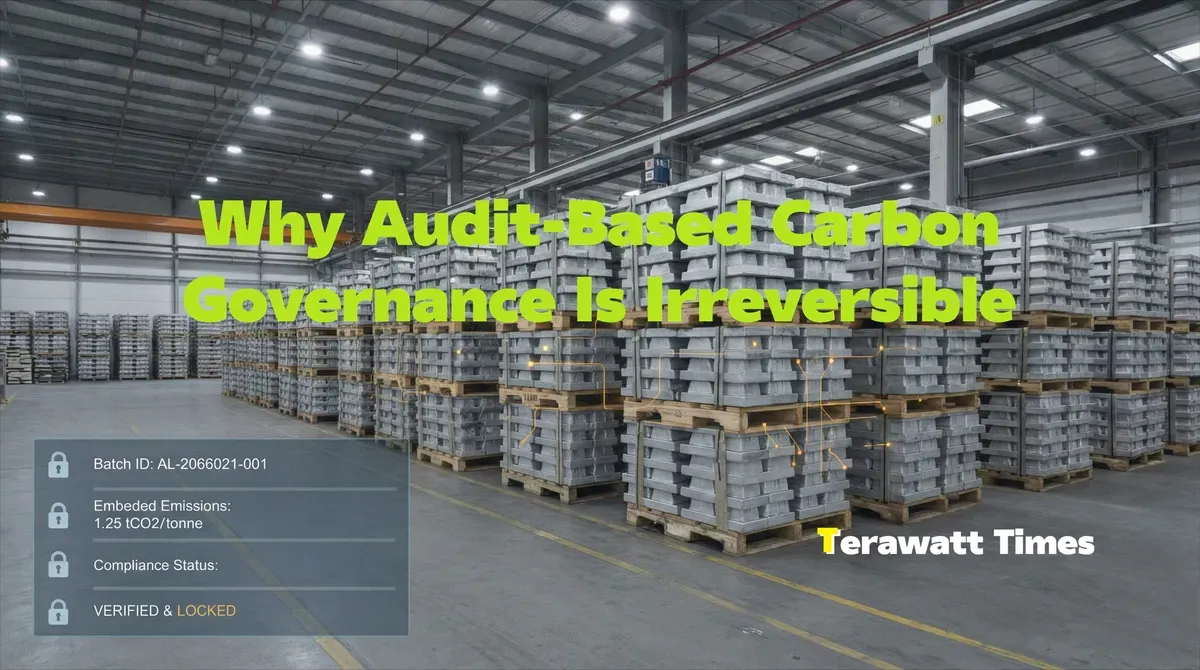
Why Audit-Based Carbon Governance Is Irreversible: Trust Bankruptcy, Carbon Budgets, and the Transparency Threshold
Climate policy has crossed the transparency threshold into irreversible mandatory proof. With a depleting carbon budget and a four-polar compliance pincer eliminating regulatory arbitrage, global firms are locked into a permanent, infrastructure-based verification regime.
Abstract
Once verification-based climate governance crosses a threshold, withdrawal becomes progressively more expensive than continuation. This paper develops the irreversibility argument formally. The case rests on three independent lock-in mechanisms operating at different time horizons and through different causal channels.
The first is conceptual. The viable band of regulatory disclosure lies between two failure modes: insufficient disclosure that produces quality collapse through adverse selection, and excessive disclosure that produces market exit through compliance cost burden. We name this band the transparency threshold. The voluntary carbon market collapsed below it. The U.S. residential mortgage-backed securities market exited above it under Regulation AB II, with the Securities and Exchange Commission in October 2025 officially acknowledging the market closure and seeking input on whether the 270-data-point asset-level disclosure requirement should be reduced. The European Union's Digital Product Passport pushes into territory financial regulation retreated from. Its disclosure content is heavier than Reg AB II's, and unlike financial issuers, physical products have no private-market exit equivalent to Rule 144A.
The second is physical. The remaining carbon budget for a 50 percent chance of limiting warming to 1.5°C stood at 130 GtCO₂ from the start of 2025 and is depleting at approximately 40 GtCO₂ per year. The constraint does not negotiate. Financial constraints are elastic (central banks can expand balance sheets, regulators can adjust capital requirements); the atmosphere is not. Time horizons that voluntary mechanisms require to discipline behavior have been exceeded by the time horizon the budget allows.
The third is geopolitical. Four verification infrastructures are emerging simultaneously: European, Chinese, American, and Indian. Their requirements contradict each other. Firms cannot escape through regulatory arbitrage because no single bloc offers full compliance with the others' requirements. The compliance pincer drives firms to invest in all four sets of verification capability, deepening lock-in rather than producing pressure for retreat.
The February 2027 battery passport implementation deadline marks the threshold. Before implementation, reversal is policy change. After implementation, reversal requires dismantling systems, abandoning investments, and forfeiting data. The direction is locked; parameters will adapt.
1. Introduction: The Irreversibility Question
Previous analysis has characterized the emerging architecture of audit-based climate governance as Verification Imperium: structural power exercised through unilateral determination of the methodologies, credentials, and infrastructure by which empirical claims about traded goods must be substantiated [1]. That analysis established what the new power is, why it became available when finance was forced toward prudential regulation, and how it differs from the rule-of-conduct diffusion captured by Bradford's Brussels Effect framework. It deferred the question this paper takes up. Why should we expect this transformation to prove irreversible? Why can political shifts, industry resistance, or jurisdictional fragmentation not roll it back?
The question is not academic. Industry coalitions opposed to the architecture exist. Political constituencies skeptical of climate ambition exist. The 2025 U.S. withdrawal from the Paris Agreement removed one major jurisdiction from the multilateral framework that supports the architecture's legitimacy. None of these has slowed the architecture's deployment. The February 18, 2027 battery passport implementation deadline approaches without serious challenge from any party whose compliance the deadline requires. Something locks the architecture in place against forces that, under conventional regulatory analysis, should have triggered retreat.
This paper identifies that something. Three independent mechanisms produce irreversibility, operating at different time horizons through different causal channels.
The first mechanism is the transparency threshold. The viable band of mandatory disclosure for any traded product lies between two failure modes that have been empirically observed. Below a minimum level of disclosure, information asymmetry enables adverse selection and quality collapse, the dynamic Akerlof identified in markets for lemons [2]. The voluntary carbon market is the contemporary instance: market value fell 29 percent in 2024 to $535 million [3], a six-year low, after sustained investigation of credit integrity revealed that the methodologies certifying credits as additional could not survive empirical examination [4]. Above a maximum level of disclosure, compliance costs exceed market participation benefits and the regulated market exits to private alternatives. Regulation AB II is the financial-regulatory instance. Section 3 develops both bounds.
The second mechanism is the rigid carbon budget constraint. The most recent Indicators of Global Climate Change update places the remaining carbon budget for a 50 percent probability of limiting warming to 1.5°C at 130 GtCO₂ as of January 2025, exhaustible in roughly three years at current emission rates [5]. Financial constraints are elastic. Central banks can expand balance sheets when stability is threatened. Regulators can adjust capital buffers when conditions warrant. The atmospheric system has no equivalent flexibility. Section 5 develops the implications: time horizons available to voluntary adjustment have been exceeded by the time horizon the budget allows, forcing institutional selection toward immediate verification over slower disclosure-only or pledge-based architectures.
The third mechanism is the compliance pincer across four emerging verification infrastructures. The European framework anchored in CBAM and DPP is the most developed, but China is building its own infrastructure through the Industrial Internet Identifier Resolution System [6], the United States is using securities regulation and the Uyghur Forced Labor Prevention Act to extend product-level verification into supply chains [7][8], and India is attaching traceability conditions to its Production-Linked Incentive subsidies. Section 6 develops the consequence: contradictory demands across these four systems eliminate regulatory arbitrage as an exit route, forcing multinational firms to invest in all four sets of verification capability. Every additional investment increases the cost of subsequent retreat from any one bloc.
These three mechanisms compound. The transparency threshold makes withdrawal from disclosure architectures costly because the dynamics that produced trust bankruptcy recur as soon as disclosure relaxes. The carbon budget makes withdrawal infeasible because the time horizon has run out. The compliance pincer makes withdrawal individually irrational because no single retreat reduces aggregate compliance burden. The architecture's stability is overdetermined.
Section 2 addresses why existing governance theories miss this configuration. Section 3 develops the transparency threshold concept with empirical anchoring in the voluntary carbon market and Regulation AB II. Section 4 identifies the Digital Product Passport as a second offensive into territory financial regulation retreated from, heavier in disclosure content and without the private-market exit that financial issuers used to escape. Section 5 develops the rigid constraint argument. Section 6 maps the four-polar competition and the compliance pincer it generates. Section 7 examines enterprise differentiation patterns that will follow the February 2027 deadline. Section 8 specifies boundary conditions on the irreversibility claim. Section 9 concludes.
Remaining content is for members only.
Please become a free member to unlock this article and more content.
Subscribe NowAuthors

U.S. energy strategist focused on the intersection of clean power, AI grid forecasting, and market economics. Ethan K. Marlow analyzes infrastructure stress points and the race toward 2050 decarbonization scenarios at the Terawatt Times Institute.

Hiroto Nakamura is a research fellow focused on climate intelligence, satellite-based MRV, and AI-driven environmental monitoring. He analyzes geospatial data and verification systems to improve global carbon transparency and emissions accountability

Preston studies the policy and social dimensions of the energy transition, focusing on urban electrification, energy equity, and how emerging technologies shape outcomes for middle‑ and working‑class communities.