Multi-Source Convergence in EU Battery Regulation: A Field of Differentiation in the Making
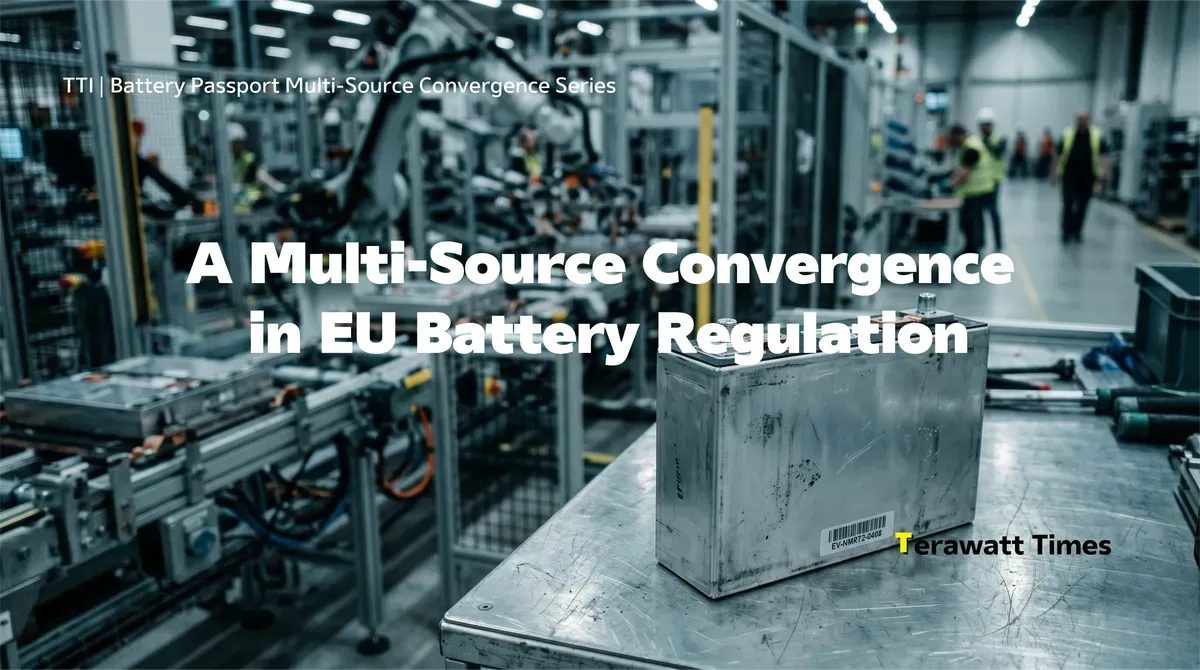
The EU Battery Regulation looks like one product law. Its text bundles six policy traditions. Three chemistries (VRFB, lead-acid, sodium-ion) show where this multi-source convergence stops being technology-neutral. The runtime is a field of differentiation in the making.
Abstract
The EU Battery Regulation (Regulation (EU) 2023/1542) is widely read as a sustainability law for batteries. That reading underestimates what the text actually does. The Regulation pulls together at least six distinct policy traditions into one legal instrument: hazardous-substance restriction inherited from REACH and RoHS; carbon-footprint accounting tied to the European Green Deal and the Product Environmental Footprint method; recycled-content targets aligned with the Critical Raw Materials Act; supply-chain due diligence modelled on Regulation (EU) 2017/821 and the Corporate Sustainability Due Diligence Directive; data governance through the Battery Passport linked to the Ecodesign for Sustainable Products Regulation; and internal-market harmonisation under Article 114 TFEU. Each tradition arrived with its own policy history, its own measurement methodology, and its own Directorate-General sponsor. The Regulation does not merge them. It places them side by side. We name this structural condition multi-source convergence, and we argue it produces a runtime that behaves less like a unified rule-set and more like a field where different actor classes move along different trajectories.
Drawing on early signals from the 2023–2026 transitional period, including Notified Body capacity, cross-border data flows, carbon-footprint dispersion, corporate response patterns, and industry self-regulation, we map how convergence at the text level is already producing differentiation at the operational level. Three battery chemistries inside the Regulation's scope, vanadium redox flow, lead-acid, and sodium-ion, reveal where this convergence stops being technology-neutral, each in a different way. Five evolutionary pathways remain plausible after 2027, none predetermined: gradual strengthening, stratified accountability, selective intensification, structural restructuring, and certification crisis. The pattern is not unique to batteries; CSRD, CSDDD, CRMA, ESPR, and EUDR were drafted in the same multi-source style, and the Battery Regulation's experience offers the first empirical signal of how this style of EU product law performs once it meets reality. The work is observational. It builds the analytical frame on which subsequent articles in this series, covering physical reference frames, historical archetypes, and power-technology coupling, will rest.
Remaining content is for members only.
Please become a free member to unlock this article and more content.
Subscribe NowAuthors

U.S. energy strategist focused on the intersection of clean power, AI grid forecasting, and market economics. Ethan K. Marlow analyzes infrastructure stress points and the race toward 2050 decarbonization scenarios at the Terawatt Times Institute.

Caroline is a Houston-born analyst focusing on Gulf Coast oil, LNG, and industrial electrification. She studies how legacy energy systems and new clean-power infrastructure reshape the economic future of the American South.

Maya is a communications strategist bridging technical modeling and public policy. She synthesizes research on grid modernization and decarbonization, ensuring data-driven insights reach legislators and industry stakeholders.

Hiroto Nakamura is a research fellow focused on climate intelligence, satellite-based MRV, and AI-driven environmental monitoring. He analyzes geospatial data and verification systems to improve global carbon transparency and emissions accountability