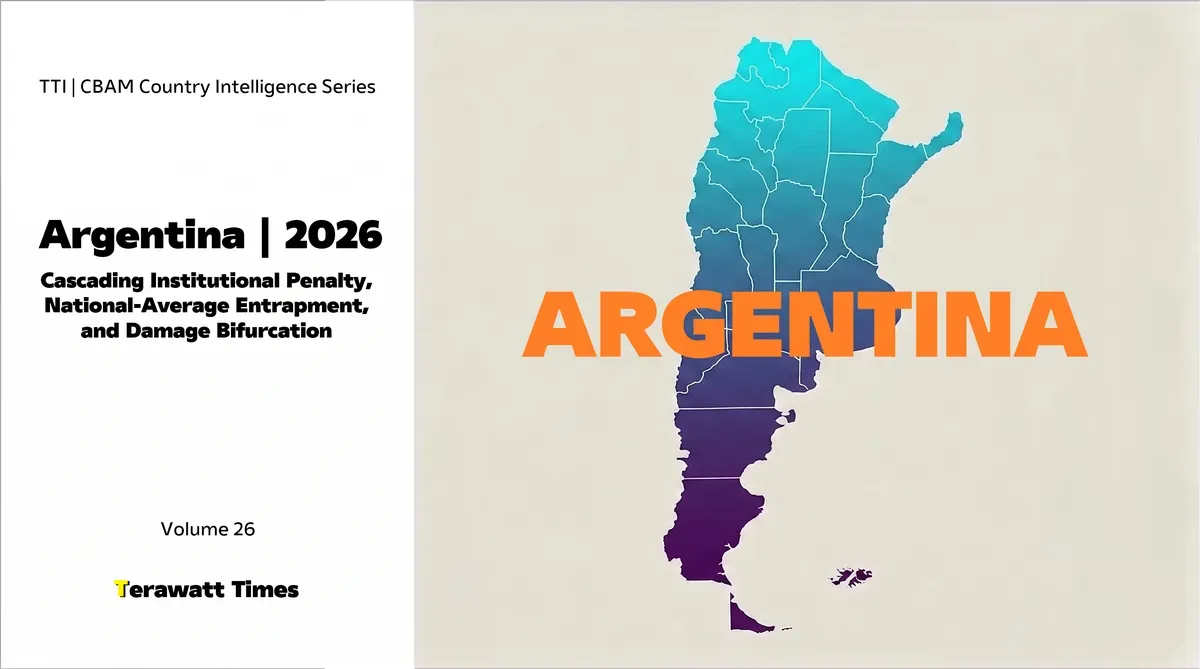
CBAM Country Intelligence Argentina 2026: Cascading Institutional Penalty, National-Average Entrapment, and Damage Bifurcation
Argentina's aluminium and steel rank among the cleaner exporters in their sectors, yet face EU CBAM costs like far dirtier rivals. This facility-level study of ALUAR, Ternium, Acindar and Tenaris traces the gap to three institutional gaps, not emissions, pricing each to 2034.

Executive Summary
Scope. This report quantifies Argentina's exposure to the EU Carbon Border Adjustment Mechanism (CBAM) at the level of individual facilities, using parameters taken from the primary EU legal texts (Regulation 2023/956 and Implementing Regulations 2025/2547, 2025/2620, and 2025/2621). Four installations account for essentially all of Argentina's CBAM-covered exports: ALUAR (primary aluminium), Ternium San Nicolás (integrated steel), ArcelorMittal Acindar (DRI-EAF long products), and Tenaris Siderca (seamless tube).
Headline finding. Argentina's producers are low-emission by international standards — ALUAR at about 5.43 tCO₂/t and Argentine DRI steel at roughly 0.78 tCO₂/t Scope 1 — yet they face CBAM costs closer to those of far more emission-intensive producers. The cause is not their physical carbon intensity but three overlapping institutional gaps, which this report terms the Cascading Institutional Penalty (CIP): the absence of an Article 9-eligible domestic carbon price (P_art9 = 0), inflated national-average default values, and the absence of enterprise-level monitoring, reporting and verification (MRV) capacity.
Concentration of exposure. Total Argentine CBAM-covered exports to the EU were approximately €142 million in 2024, of which aluminium was 78.8 percent and steel 21.2 percent. Exposure is therefore concentrated in a single company, ALUAR.
Key quantified results.
- Under the default-value pathway, ALUAR's aluminium faces an embedded intensity of 6.032 tCO₂/t in 2026, rising to 6.372 from 2028 — about 11 to 27 percent above its verified intensity, driven mainly by the grid-average treatment of its indirect (Scope 2) emissions.
- For Acindar's DRI steel in 2026, the default pathway implies a CBAM cost of about €110.97/t versus about €57.25/t under verified actual data. The €53.72/t difference is the cost of being unable to document a physically true, lower emission intensity (National-Average Entrapment).
- A dedicated natural-gas DRI benchmark, set below the blast-furnace benchmark, leaves a residual charge on DRI steel even after full emission verification (the DRI Benchmark Squeeze): about €57.64/t for Acindar in 2028.
- For ALUAR at the 45,000-tonne baseline, moving from the default pathway to verified MRV data saves about €2.17 million in 2026, rising to about €3.39 million by 2028, against a one-time MRV cost of roughly €250,000 — a payback of a few months.
Enterprise MRV is the dominant lever. Across aluminium, Argentine DRI steel, and a South African steel comparison, building enterprise MRV capacity reduces CBAM cost more than introducing a modest domestic carbon price. For Argentine DRI steel, MRV cuts cost by about 64 percent (default to verified), against about 20 percent for a €10/tCO₂ carbon tax alone. The two levers are not fully additive: because the Article 9 deduction is the product of emission intensity and carbon price, verifying a lower intensity shrinks the base on which a carbon price generates a deduction (the Carbon Shield Dilution Effect).
Trade context. The 2024–2025 shift of ALUAR's exports toward the EU was driven primarily by the escalation of US Section 232 tariffs on aluminium to 50 percent, not by CBAM carbon arbitrage. With the US market effectively closed and limited absorption capacity in other markets, the EU has become ALUAR's principal remaining outlet at the point where CBAM costs apply. The EU-Mercosur interim agreement provides little offsetting relief, because Argentina's main CBAM-covered steel products already enter the EU at zero MFN tariff and the aluminium tariff saving is small relative to the CBAM cost.
Timeline. CBAM costs rise on a fixed schedule as free allocation phases out, with the steepest single step in 2029 (the CBAM factor moves from 10 to 22.5 percent) and full phase-in in 2034. The period available for Argentina to close its institutional gaps is correspondingly short.
Caveats. Facility-level Scope 1 and Scope 2 figures are engineering estimates cross-validated against corporate disclosures and Environmental Product Declarations, not audited CBAM declarations. Cost projections assume an EU carbon price of €80/tCO₂ and P_art9 = 0 for Argentina throughout; both are stated assumptions rather than forecasts. Regulatory parameters are current as of the cited implementing regulations and are subject to the scheduled 2027 review.
Remaining content is for paid members only.
Please subscribe to any paid plan to unlock this article and more content.
Subscribe Now