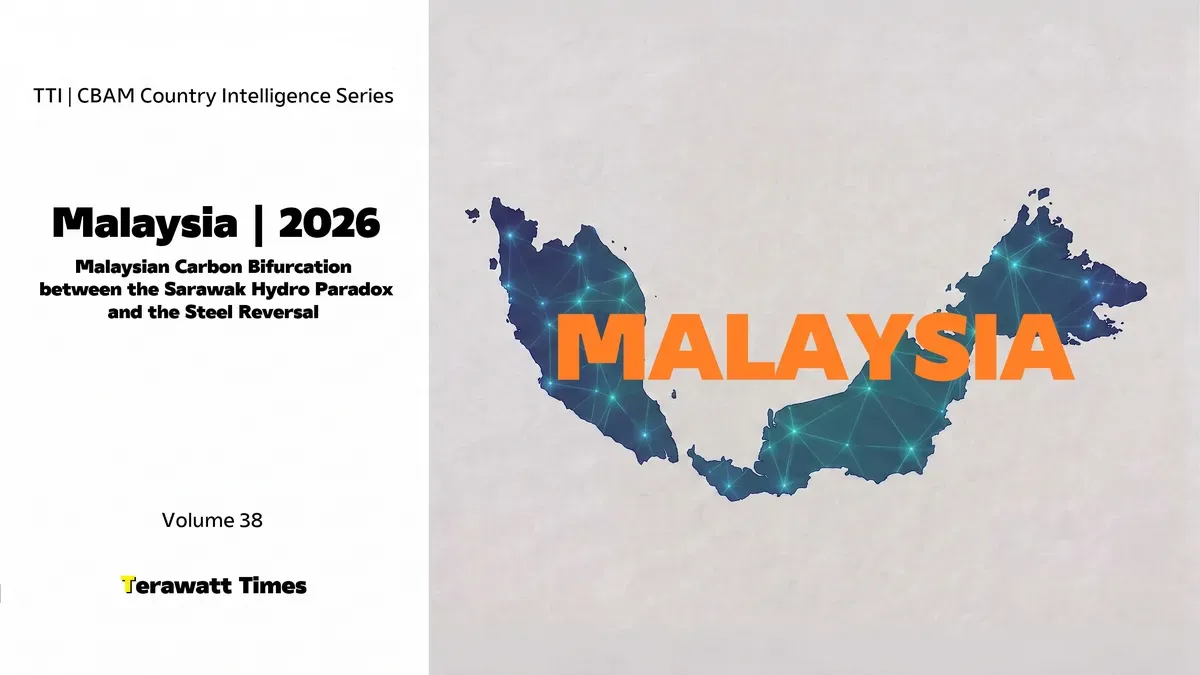
CBAM Country Intelligence Malaysia 2026: Malaysian Carbon Bifurcation between the Sarawak Hydro Paradox and the Steel Reversal
Malaysia’s CBAM exposure is small but sharply divided. Sarawak hydro aluminium has a major physical carbon advantage that current CBAM does not price through electricity, while expanding Malaysian BF steel places direct emissions firmly inside the CBAM boundary.

Executive Summary
Malaysia enters the definitive phase of the European Union Carbon Border Adjustment Mechanism (CBAM) with a modest aggregate trade exposure and an unusually divided industrial carbon structure. CBAM applies to goods listed by Combined Nomenclature (CN) code rather than to whole industries. The current perimeter covers specified products in iron and steel, aluminium, cement, fertilisers, hydrogen and electricity. The definitive regime has applied since 1 January 2026, subject to the simplifications introduced by Regulation (EU) 2025/2083, including a 50-tonne annual threshold for the combined mass of iron and steel, aluminium, fertilisers and cement imported by an individual importer.[1][2]
EU goods imports from Malaysia reached €28.631 billion in 2024 and €30.3 billion in 2025, dominated by machinery, electrical equipment and other industrial products outside the present CBAM list.[3][4] A complete CN8 reconstruction of every Annex I line for 2024 and 2025 remains the final unresolved trade aggregation, so this assessment does not attach a point estimate to the covered share. The supported conclusion is that the present CBAM perimeter represents a low single-digit share of EU merchandise imports from Malaysia. That share establishes scale; the structure inside the exposure is the subject of this report.
The central finding is Malaysian Carbon Bifurcation: two industrial trajectories that coexist within the same economy but are treated very differently by the current CBAM emissions boundary. The first is Sarawak's hydro-based primary aluminium system. The Energy Commission reports provisional 2024 grid emission factors of 0.740 kg CO2e/kWh for Peninsular Malaysia, 0.539 for Sabah and 0.199 for Sarawak.[5] Press Metal operates 1.08 million tonnes per year of primary aluminium smelting capacity in Sarawak, 960,000 tonnes at Bintulu and 120,000 tonnes at Mukah.[6][7] Electricity is a major physical determinant of primary aluminium emissions, so this power system gives Sarawak metal a substantial physical carbon advantage.
Current CBAM treatment recognises a narrower boundary. Aluminium is listed in Annex II of Regulation (EU) 2023/956, so indirect electricity emissions are excluded from current aluminium liability, and alumina under CN 2818 is outside Annex I and is not a covered precursor for CN 7601.[1][8] Press Metal's hydropower lowers the physical and corporate carbon profile of its aluminium, supports customer Scope 3 reduction and strengthens low-carbon product positioning, while its marginal value in the current aluminium CBAM electricity calculation is zero. The Sarawak Hydro Paradox is the coexistence of that large physical electricity advantage with a zero electricity term in current aluminium CBAM liability.
The second trajectory moves in the opposite direction. Malaysia produced steel entirely through electric arc furnaces (EAF) until 2014; by 2022, according to the then Deputy Minister of Investment, Trade and Industry, Liew Chin Tong, blast furnaces accounted for 72 per cent of production.[9] The Steel Industry Roadmap 2035 (SIR2035) gives representative worldsteel-based emissions intensities of about 2.33 tCO2 per tonne for the blast furnace and basic oxygen furnace (BF/BOF) route and about 0.68 tCO2 per tonne for EAF production.[10] Malaysia has shifted toward a route whose defining carbon burden is direct, the category that current CBAM recognises for iron and steel. Since September 2025, SIR2035 has also barred new BF/BOF plants, which caps further expansion of that route while leaving the installed base in place.[10][11]
Eastern Steel at Kemaman provides the clearest connection between that route change and Europe. The plant, 68.8 per cent controlled by China's Jianlong Group with Hiap Teck Venture holding 27.3 per cent, commissioned a 1,380 m³ blast furnace in October 2023, raising capacity to 2.7 million tonnes, and started a 1,450 mm hot-rolled coil (HRC) mill in January 2025. FY2025 sales reached 2.45 million tonnes at 96 per cent utilisation, and in Q1 FY2026 HRC accounted for 78 per cent of the product mix while Italy took 27 per cent of sales.[12][13][14] World Steel Association data place Malaysian crude steel output at 9.0 million tonnes in 2024 and 7.7 million tonnes in 2025, which rules out the high-precision route-share estimates of earlier research but leaves the route reversal itself intact.[15]
A second layer concerns default values. Implementing Regulation (EU) 2026/1740 lists Malaysia in its country-specific default value tables for cement, fertilisers, aluminium and hydrogen, but its iron and steel block contains ferro-alloys only. Malaysian HRC declared on default values falls back to the Other countries and territories value of 4.049 tCO2e/t on a BF/BOF benchmark route, before the 10 per cent mark-up for 2026.[16] A default-path calculation on official parameters gives a residual liability in the region of 3.1 tCO2e per tonne of HRC in 2026, or about €235 per tonne at the Q1 2026 certificate price, before any Article 9 deduction.[17][16][18][19] The number belongs to the default path and measures nothing about Eastern Steel's own installation; it shows why verified installation data matter for Malaysian steel.
A third layer concerns origin. Malaysian customs origin does not identify where covered precursor carbon was produced. A pipe can acquire Malaysian origin while carrying upstream carbon from a foreign HRC installation; a Malaysian aluminium profile can inherit the emissions of foreign primary aluminium. Implementing Regulation (EU) 2025/2547 requires installation, origin, route and emissions information for covered external precursors when actual values are used.[8]
The report distinguishes physical carbon (emissions associated with production), regulatory carbon (the subset CBAM includes), verified carbon (regulatory carbon supported by acceptable evidence) and commercial carbon (the attribute incorporated into procurement, pricing, financing or market access). Press Metal can hold commercially valuable low-carbon aluminium without receiving a current electricity-related CBAM benefit. A BF steel producer can face substantial regulatory exposure even when the final economic burden is shared with importers or redirected through trade.
Malaysia's federal carbon tax remains under development. On 24 June 2026 the Deputy Minister of Finance told the Dewan Rakyat that the policy was in its final drafting stage, with initial implementation focused on iron, steel and energy and with rate, threshold and scope still under study.[20] Sarawak has separately enacted the Environment (Reduction of Greenhouse Gases Emission) Ordinance 2023 and created a statutory carbon levy framework, but public evidence does not yet establish a facility-level payment usable as an Article 9 deduction for the installations examined here.[21][22]
The regulatory boundary may change. The Commission's 2025 review placed possible inclusion of indirect emissions from aluminium, iron and steel and hydrogen on its agenda, and a separate proposal would extend CBAM to additional downstream steel- and aluminium-intensive goods.[23][24] If aluminium indirect emissions enter the mechanism under a methodology that recognises qualifying Sarawak electricity, the Hydro Paradox becomes a direct regulatory advantage. If downstream coverage broadens, verified precursor carbon matters more to Malaysian manufacturing. If EU carbon costs rise while BF assets remain competitive in Asia, trade destinations can shift before production technology does.
CBAM prices a legally defined subset of emissions embodied in legally defined goods and supported by legally recognised evidence. A country assessment has to work through product boundary, emissions boundary, production route, trade exposure and verification together, and Malaysia makes the gaps among those layers unusually visible.
Remaining content is for paid members only.
Please subscribe to any paid plan to unlock this article and more content.
Subscribe Now