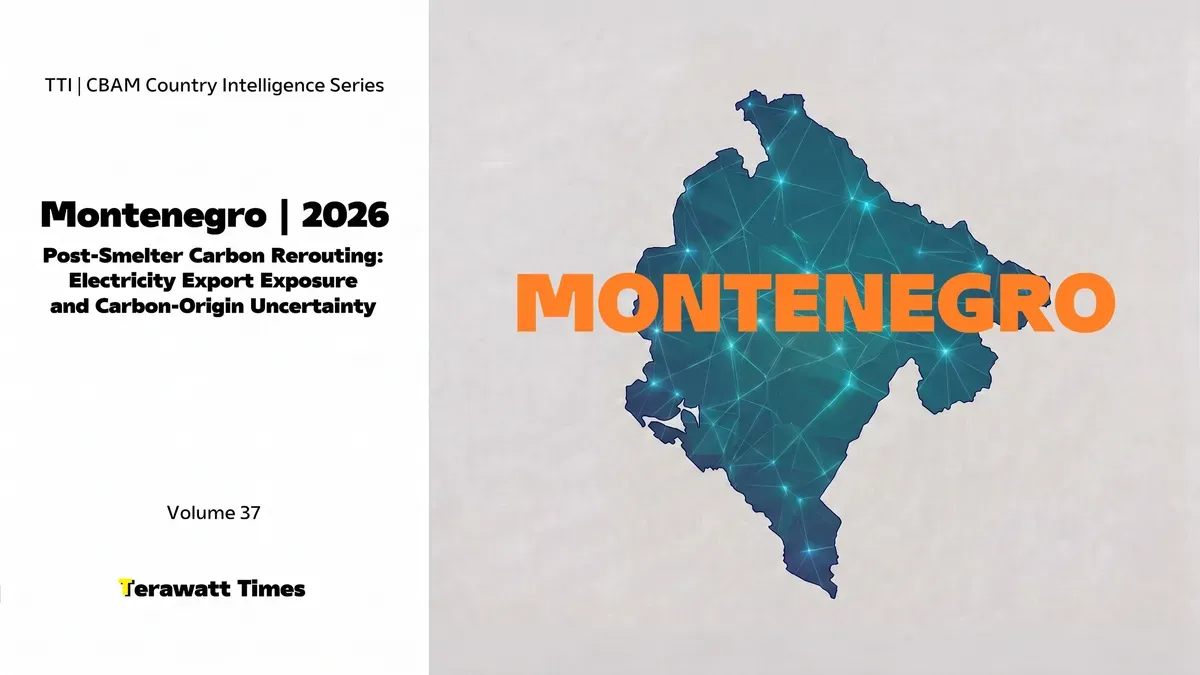
CBAM Country Intelligence Montenegro 2026: Post-Smelter Carbon Rerouting: Electricity Export Exposure and Carbon-Origin Uncertainty
Montenegro enters definitive CBAM after KAP's closure removed a 0.57 TWh industrial load, raising structural electricity exportability into Italy under a 0.979 tCO2e/MWh default worth about EUR 74/MWh. Surviving billet output relies on imported aluminium of unknown carbon origin.

Executive Summary
Montenegro enters the definitive phase of the European Union Carbon Border Adjustment Mechanism, or CBAM, with an exposure profile shaped by an industrial rupture that occurred before CBAM began imposing a financial obligation. Conventional trade metrics already identify Montenegro as unusually exposed. A 2026 Bruegel study found that an average 24.2% of Montenegro's exports to the EU and EFTA during 2014–2024 fell within CBAM-covered categories, the highest share in its sample. [6] That indicator captures the outcome of a deeper transformation. The present structure is best understood through the decline of primary aluminium smelting at Kombinat aluminijuma Podgorica, or KAP, and the way the electricity and aluminium systems reorganised around it.
KAP had been one of Montenegro's dominant industrial electricity consumers. EPCG supplied 567,179 MWh to KAP in 2021, while national final electricity consumption was 2,977.7 GWh. KAP absorbed roughly 19% of final national electricity demand and almost the entire non-ferrous-metals electricity category. [13,18] Most electrolysis cells were shut in December 2021 as the old electricity-price arrangement became economically unsustainable during the European power-price shock. The final twelve cells closed in May 2023, ending primary aluminium production after fifty-two years. Billet and alloy production continued using imported metal. [19,20]
The resulting structure is Post-Smelter Carbon Rerouting, which has two branches. Electricity Export Exposure is the first: removing a recurrent industrial load of about 0.57 TWh per year increased the amount of generation that could become available to the market under otherwise comparable conditions, a change described below as structural exportability. Carbon-Origin Uncertainty is the second: the aluminium-processing activity that survived now depends on imported unwrought aluminium, so part of the CBAM-relevant emissions history has moved upstream into foreign precursor production. A single industrial break pushed electricity exposure outward toward the EU border and moved aluminium carbon evidence upstream into the supply chain.
The electricity effect is visible in Montenegro's annual balances but is mediated by hydrology and plant availability. Net electricity exports were about 134.6 GWh in 2022, rose to roughly 866.5 GWh in 2023 and returned to about 155.9 GWh in 2024. [14–16] Hydro generation increased by 777.2 GWh between 2022 and 2023, a swing larger than KAP's 2021 electricity consumption. KAP's exit changed the structural level of domestic demand; hydrology explains much of the annual variance around that new level. A simple accounting sensitivity shows that restoring a 567.2 GWh KAP load to the observed 2022 and 2024 balances would shift both years from modest net export positions to net import positions.
Montenegro is also a regional electricity corridor. In 2024, MONSTAT recorded 5,952.8 GWh of imports and 6,108.7 GWh of exports, leaving a national net export balance of about 155.9 GWh. [16] Energy Community data show roughly 3.042 TWh of scheduled commercial electricity moving from Montenegro toward Italy during the same year. The Energy Community states that this volume includes both exports and transit and that the exact production origin of the transit component cannot be reconstructed from the aggregate data. [7] The direct Italy–Montenegro HVDC interconnector, in commercial operation since December 2019, gives this small power system a 600 MW route into the EU market. [21]
Definitive CBAM materially changes the economics of that route. Commission Implementing Regulation (EU) 2025/2621 assigns imported electricity from Montenegro a default value of 0.979 tCO₂e/MWh. [3] In Q1 2026, the relevant CBAM certificate price of €75.36/tCO₂e produced a gross default-value carbon component of about €73.78/MWh. The average Montenegro-to-southern-Italy day-ahead price spread was about €43/MWh, and scheduled as well as physical flows declined sharply. [8] Q2 provided an important counter-test. The gross carbon component remained near €73.70/MWh while the average price spread narrowed to about €27/MWh, yet scheduled exports recovered relative to Q2 2025. [9] The evidence supports a structural-cost interpretation: CBAM is now a major constraint on cross-border electricity economics, while hourly prices, generation, hydrology, contracts, transmission positions and trading expectations continue to determine actual flows.
The aluminium branch has moved in the opposite direction. Montenegro's 2026 Low Carbon Development Strategy reports continuing processing of imported primary and secondary aluminium into billets and alloys, with stated capacities of 70,000 tonnes per year for billets and 30,000 tonnes per year for alloys. [22] UN Comtrade data show 19.8 kt of HS 760110 unwrought non-alloyed aluminium imports in 2023 and 11.6 kt in 2024, alongside 22.9 kt and 15.1 kt respectively of HS 760120 unwrought alloyed aluminium exports. [24–27] These national data support an import-processing-export structure, while they do not identify every operator or close the material balance.
CBAM gives upstream information a direct regulatory role. Under Implementing Regulation (EU) 2025/2547, unwrought aluminium introduced from other sources into the relevant secondary-melting process is treated as a precursor. [2] A recorded trade partner cannot stand in for the precursor's producing installation or country of production. Malaysia illustrates the problem. It was the reported partner for about 14.4 kt of Montenegro's 2023 HS 760110 imports, while Malaysia itself imported nearly 790 kt of the same product that year from a wide set of supplying countries. [24,28] Regulation 2025/2621 provides that, where the country of production of a precursor cannot be identified, Annex IV default values apply. [3] Regulation 2026/1740 replaced Annex IV with effect from 1 January 2026 and lists a highest default value of 3.198 tCO₂e/t for CN 7601 unwrought aluminium; applying the 10% mark-up prescribed for aluminium in 2026 gives a fallback of 3.518 tCO₂e/t. [4]
EPCG forms the principal domestic transmission node for the electricity-side adjustment. The state remains the controlling shareholder, and the group spans major hydro and thermal generation, coal supply, electricity distribution and retail, renewable investment and Željezara. [30,31] CBAM reaches a state-controlled corporate balance sheet through export netback and portfolio economics even though the formal certificate obligation sits on the EU side. State-Centred Carbon Incidence names that institutional mechanism. Current public evidence does not establish a separately priced sovereign-credit CBAM risk. [35,37]
Montenegro's 2026 position is transitional. Primary aluminium is inactive, downstream aluminium processing is current, Željezara remains a dormant brownfield option, Jagnjilo offers resource-backed cement optionality, and the national hydrogen programme could eventually create a new electricity-intensive load. [22,38–43] Today a nationally significant industrial load has disappeared, electricity has become more structurally available to external markets and faces a strong EU regulatory carbon value, and the surviving aluminium economy increasingly depends on imported precursor metal whose production identity cannot always be reconstructed from public trade data. That dual movement defines Montenegro's post-smelter CBAM economy.
Remaining content is for paid members only.
Please subscribe to any paid plan to unlock this article and more content.
Subscribe Now