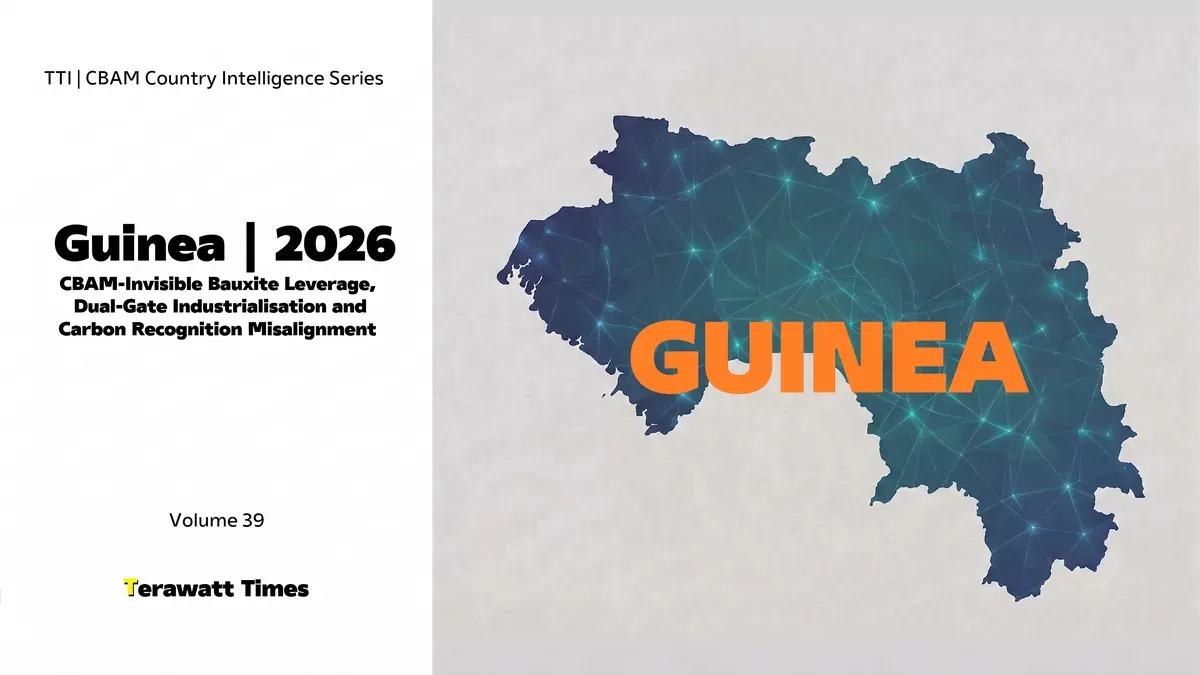
CBAM Country Intelligence Guinea 2026: CBAM-Invisible Bauxite Leverage, Dual-Gate Industrialisation and Carbon Recognition Misalignment
Guinea's CBAM position is a boundary misalignment: 71.9% of EU bauxite imports arrive outside CBAM scope, Simandou fines sit one pelletisation step from CN 2601 12, three 1.2 Mt/y alumina refineries are under construction, and a mining carbon price meets the limits of Article 9.

Executive Summary
Guinea occupies an unusual position in the European Union's Carbon Border Adjustment Mechanism (CBAM). Its dominant exports to Europe generate very little direct CBAM exposure, while the European aluminium industry depends heavily on Guinea for one of its most important upstream raw materials. In 2024 the European Union imported approximately 10.507 million tonnes of bauxite under HS 260600 from external suppliers, of which about 7.557 million tonnes originated in Guinea, a share of roughly 71.9%. Guinea's own bauxite exports reached 145.860 million tonnes in the same year, so the EU absorbed only about 5.2% of Guinean shipments when the EU import mirror is used as the numerator. China imported 110.091 million tonnes from Guinea, close to three quarters of the official annual export total. [5,6]
This asymmetry underpins the first country-specific concept developed in this report, CBAM-Invisible Bauxite Leverage: strategic supply importance located upstream of the present CBAM product boundary. Bauxite under CN 2606 is outside the current CBAM goods list, as is alumina under CN 2818 20, the product of Bayer refining. The aluminium chain reaches the CBAM boundary farther downstream at CN 7601, unwrought aluminium, and at the specified semi-finished and fabricated aluminium products that follow it. [1,2] Europe can be highly dependent on Guinean material long before that material acquires a CBAM-regulated identity.
Guinea's upstream scale is still growing. Official mining statistics show bauxite production rising from 141.709 million tonnes in 2024 to 175.454 million tonnes in 2025, with exports increasing from 145.860 million tonnes to 182.828 million tonnes. Alumina production at Friguia, the country's only operating refinery, was 361,831 tonnes in 2025. [5,7] The comparison does not imply a physical conversion ratio between ore and alumina; it shows the shape of the industrial system, in which mining and ore export already operate at global scale while domestic chemical transformation is only beginning to expand.
The second defining feature of Guinea is Dual-Gate Industrialisation: its two most important mineral value chains enter CBAM at materially different stages of processing. In the iron ore chain, non-agglomerated ore under CN 2601 11 lies outside CBAM scope; once the ore is agglomerated into pellets or sinter under CN 2601 12 it becomes a covered good. Implementing Regulation (EU) 2025/2547 places all forms of iron ore pellet production in the Sintered Ore category, and Implementing Regulation (EU) 2026/1740 confirms that indirect emissions for CN 2601 12 are within scope. [1,2,4] The aluminium chain has a later gate: bauxite can be transformed into alumina while remaining outside the product list, and only the further transformation into unwrought aluminium crosses it. An alumina refinery and an iron ore pellet plant can represent comparable ambitions for domestic value addition while producing very different immediate CBAM consequences.
Simandou makes the iron-side transition economically real. Rio Tinto reports Ore Reserves for the Ouéléba deposit, within Simfer's Blocks 3 and 4 concession, of about 0.2 billion tonnes proved at 66.4% Fe and 1.3 billion tonnes probable at 65.0% Fe. The Guinean Ministry of Mines records the first commercial shipment of Simandou ore on 11 November 2025 at Morebaya; in February 2026 the RTM Cartier loaded 201,500 tonnes of SimFer ore there and reached Dalian on 25 March, and Rio Tinto recorded first Simandou sales in April. [5,8,9,10,16] The current product is high-grade fines, not pellets or DRI. The same official bulletin records the start of a pelletisation feasibility study, which means that a future domestic pellet investment would be both an industrial project and a Regulatory Boundary Event. Because Regulation 2026/1740 lists no country entry for Guinea, a Guinean pellet producer relying on default values would inherit the Other Countries and Territories value for CN 2601 12, which is 0.686 tCO₂e per tonne (0.617 direct, 0.070 indirect) before the annual mark-up. [4,5]
The aluminium side is moving through a different transition. Three alumina projects of 1.2 million tonnes per year each entered officially recorded construction between March 2025 and June 2026: SPIC at Boffa, Winning Consortium Alumina Guinea (WCAG) at Dobali and Chalco at Démougala, together 3.6 million tonnes per year of announced new refinery capacity, with several further projects at earlier stages. [17,18,19,20] Guinea can industrialise substantially along the bauxite chain before the resulting product crosses the aluminium CBAM gate.
These projects also show how industrialisation is occurring. Large sponsors are internalising power, logistics and other industrial utilities within project boundaries. The pattern is Industrial Islanding: sponsors internalise, at project level, the critical utilities and logistics that common public infrastructure cannot be assumed to supply at the required scale and reliability. SPIC's package combines refinery, mine, a 250 MW power plant and shipping infrastructure, with 100 MW of the plant's output designated for the national grid; WCAG adds refining to an existing mining, railway, port and maritime system. [17,19,40] Industrial capability in Guinea is increasingly shaped by a sponsor's capacity to assemble an integrated production system around a resource asset.
The third structural issue is carbon pricing. Guinea is developing a sector-based carbon-pricing instrument initially focused on bauxite and iron ore mining, designed under the lead of the Ministry of Environment and Sustainable Development with technical support from the Partnership for Market Implementation (PMI). The design is a hybrid, intensity-based mechanism that prices only emissions above an output-based intensity target, with a de minimis payment exemption for the first 50,000 tCO₂e of annual emissions, mandatory reporting for all covered companies and a Mitigation Fund to receive payments. At the report cut-off the carbon-price level, the mandatory reporting decree, enforcement rules, verification arrangements and fund administration were still under development. [29,30]
Guinea's emerging domestic carbon-pricing boundary starts farther upstream than the CBAM boundaries relevant to its mineral exports, and its instrument prices only part of each installation's emissions. Both features feed the third core concept, Carbon Recognition Misalignment, the gap between a domestic carbon cost and the carbon value that CBAM recognises. Regulation (EU) 2025/2083 widened Article 9 to recognise a carbon price effectively paid in a third country, but recognition remains tied to the declared embedded emissions of the covered product, is available on the actual-emissions route only, and must net out rebates and other compensation. The Commission's draft implementing rules on Article 9, published for feedback in May 2026 and not yet adopted at the cut-off, would treat emissions exempted from a carbon price or falling below a baseline as reductions of the effective price. [32,36,41] Geographic flexibility does not erase the system-boundary rules, and instrument design determines how much of a nominal carbon price survives as recognised value.
The three concepts form a progression: CBAM-Invisible Bauxite Leverage describes Guinea's present strategic position, Dual-Gate Industrialisation explains how domestic processing changes the regulatory identity of its exports, and Carbon Recognition Misalignment identifies the institutional problem that arises as Guinea's own carbon policy meets an EU system whose recognised emissions boundary begins elsewhere in the value chain. Guinea is best understood as a boundary misalignment economy for CBAM purposes. Strategic dependence, product identity, industrial capability and carbon recognition operate across different perimeters, and the most consequential choices between 2026 and 2034 will concern where physical transformation takes place, which energy systems support it and whether the resulting carbon costs can be recognised in the destination market.
Remaining content is for paid members only.
Please subscribe to any paid plan to unlock this article and more content.
Subscribe Now