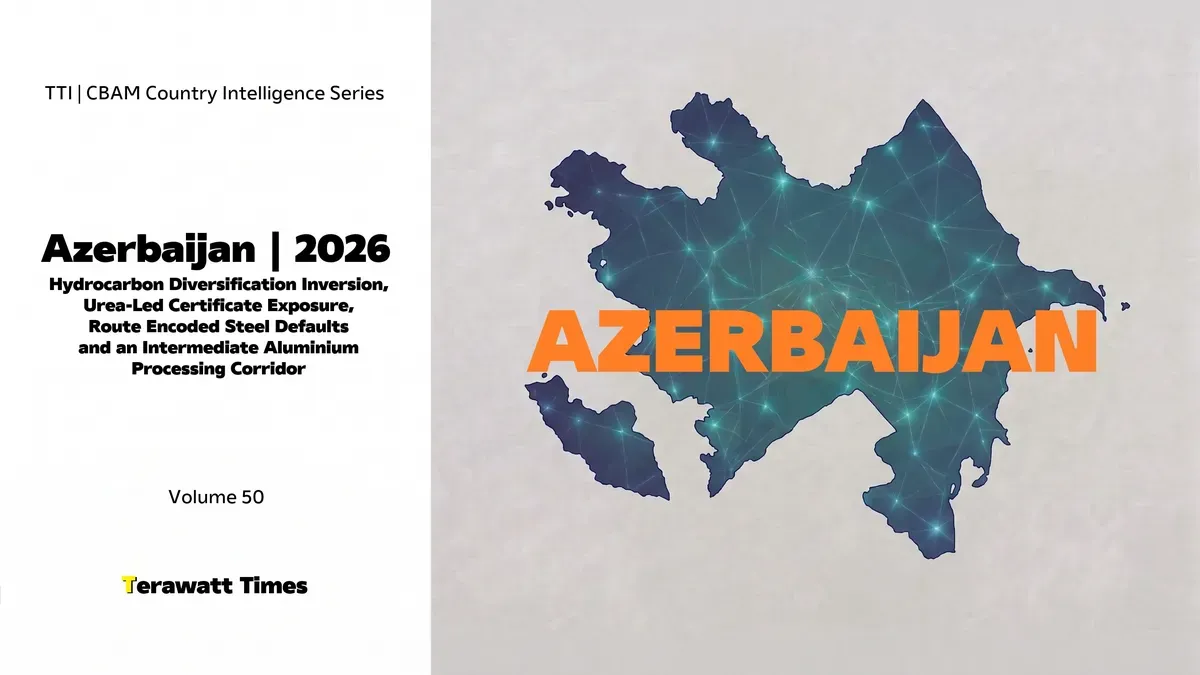
CBAM Country Intelligence Azerbaijan 2026: Hydrocarbon Diversification Inversion, Urea-Led Certificate Exposure, Route Encoded Steel Defaults and an Intermediate Aluminium Processing Corridor
Urea carries 95% of Azerbaijan's EUR 2m CBAM bill at EUR 50.1/t net in 2026. Route-E defaults cut seamless-pipe charges from EUR 228 to EUR 13.6/t, sheet sent to Turkish processors faces EUR 103.8/t, and the 2030 free-allocation phase-down triples the unwrought aluminium charge.

Executive Summary
Azerbaijan enters the definitive Carbon Border Adjustment Mechanism period with a small national exposure ratio and a concentrated industrial exposure beneath it. Merchandise exports were US$26.34 billion in 2024 and US$24.53 billion in 2025; non-oil-and-gas exports were US$3.36 billion and US$3.63 billion. [1-2] Urea and HS Chapter 76 aluminium alone earned US$415.7 million in 2025, equal to 1.7% of total exports and 11.5% of non-oil-and-gas exports before steel or cement are counted. [2-4]
Hydrocarbon Diversification Inversion names this configuration: CBAM is marginal against a hydrocarbon-dominated export basket and material inside the non-oil manufacturing portfolio through which Azerbaijan diversifies. Baku Steel Company and the Azerboru pipe chain, SOCAR Carbamide in Sumgait and Azeraluminium in Ganja carry that exposure, while Norm Cement combines large covered capacity with almost no EU trade. [5-13]
The decisive quantity is the net certificate obligation after the free-allocation adjustment. On the default pathway in 2026 the specific embedded free allocation equals the CBAM factor of 0.975, the cross-sectoral correction factor of 100% and the Column B benchmark of the product's production route. [14-16] Against the corrected Azerbaijan defaults, each tonne of urea carries a net obligation of 0.666 tCO2e, each tonne of primary unwrought aluminium 0.483 tCO2e and each tonne of route-E seamless tube 0.181 tCO2e; at the Q2 2026 certificate price of €75.28 these equal €50.1, €36.3 and €13.6 per tonne. [17-18] Applied to the observed EU-bound volumes of 37,965 tonnes of urea in 2025 and 3,488 tonnes of seamless pipe and 1,152 tonnes of alloyed unwrought aluminium in 2024, urea accounts for about 25,300 of 26,500 certificates at 2026 rules, some 95% of Azerbaijan's quantifiable direct CBAM cost of roughly €2.0 million, which makes the country's certificate exposure urea-led. [19-21]
Legal treatment differs sharply across these industries. Relevant iron, steel and aluminium goods fall under the Annex II direct-emissions treatment, while fertilisers and cement include indirect electricity emissions. [22-23] Alumina is physically indispensable to primary aluminium but lies outside the Annex I precursor list for CN 7601. Ferrosilicon, the ferroalloy produced by Baku Steel Company, is excluded from Annex I altogether, so that part of the company's export portfolio carries no CBAM obligation. [22,24]
The definitive regime has also changed since the original 2023 Regulation. Regulation (EU) 2025/2083 introduced a 50-tonne annual single mass-based threshold for aluminium, cement, fertilisers, and iron and steel, and moved the annual declaration and certificate-surrender deadline to 30 September of the following year. [25] Implementing Regulation (EU) 2025/2621 established the default-value system, and Implementing Regulation (EU) 2026/1740 replaced its Annexes I and IV with effect from 1 January 2026 to correct missing or incorrect production-route indicators. [17,26] Certificates for 2026 imports are priced quarterly, at €75.36 for Q1 and €75.28 for Q2, and purchased from February 2027. [18]
Steel shows how route coding changes the economics. Azerbaijani non-alloy seamless tubes carry a base default of 0.240 tCO2e/t with route E, carbon steel based on Scrap/EAF; CN 7207 semi-finished products sit at 0.130 to 0.140 tCO2e/t and ribbed rebar at 0.140 tCO2e/t. [17] The "Other Countries and Territories" value for CN 7304 39 is 3.981 tCO2e/t with route C, so route encoding reduces the 2026 net charge per tonne of seamless tube from about €228 to €13.6. [14,17] Baku Steel Company exported 7,000 tonnes to the EU in 2025 at an average of AZN 1,800 per tonne, a pipe-led product mix, and EU mirror data record 3,488 tonnes of HS 7304 seamless pipe from Azerbaijan in 2024. [5,20]
SOCAR Carbamide has 650,000 to 660,000 tonnes per year of urea capacity and a design natural-gas requirement of about 435 million cubic metres, and it produced 652,000 tonnes in 2024. [8,27] That design basis equals about 670 cubic metres per tonne of urea and, at standard natural-gas emission factors, 1.28 to 1.35 tCO2 per tonne, against a direct default of 1.460 tCO2e/t. [8,17,28] The resulting spread of €9 to €15 per tonne is worth €0.35 million to €0.57 million a year at 2025 EU volumes. EU-bound urea has fallen for three consecutive years, from 148,800 tonnes of company-reported EU sales in 2023 to 63,295 tonnes of EU imports in 2024 and 37,965 tonnes in 2025, while Ukraine took 393,704 tonnes in 2025. [19,29-31]
Azeraluminium's Ganja complex has roughly 50,000 to 54,000 tonnes per year of primary capacity plus casting and rolling. [9-10] Its unwrought metal carries an Azerbaijan default of 1.700 tCO2e/t under route K, or 1.870 tCO2e/t once the 2026 mark-up is applied. [17] Türkiye received all 9,547 tonnes of Azerbaijan's HS 760110 exports in 2024 and imported 17,531 tonnes of HS 760612 aluminium sheet from Azerbaijan. [32-33] Sheet under CN 7606 is itself a covered good with an Azerbaijan default of 2.570 tCO2e/t, the highest net per-tonne obligation in the country portfolio at €103.8 in 2026. [14,17] The result is an Intermediate Aluminium Processing Corridor, with Türkiye as the processing country: Azerbaijani unwrought metal and sheet enter downstream processing there that supplies covered aluminium goods to the EU, and the precursor share of any Turkish good is fixed by the processing installation's own monitoring records under Regulation (EU) 2025/2547. [23,34]
The legislated phase-down of free allocation already changes the 2030 picture. The CBAM factor falls to 0.515 in 2030 while the mark-up for steel, aluminium and cement reaches 30% from 2028; at current benchmark values the net default obligation per tonne rises by a factor of 1.5 for seamless tube, 1.6 for urea and 3.1 for unwrought aluminium. [14-15,17] The planned 2 Mt/y hot briquetted iron plant, due for commissioning at the end of 2029, adds a new covered product: CN 7203 has no Azerbaijan-specific default, so the "Other Countries and Territories" value of 1.325 tCO2e/t applies. [17,35] COM(2025) 989 would extend CBAM to selected steel- and aluminium-intensive downstream goods from 2028; the proposal is in the ordinary legislative procedure and has no effect on 2026 liability. [36-38]
Remaining content is for paid members only.
Please subscribe to any paid plan to unlock this article and more content.
Subscribe Now