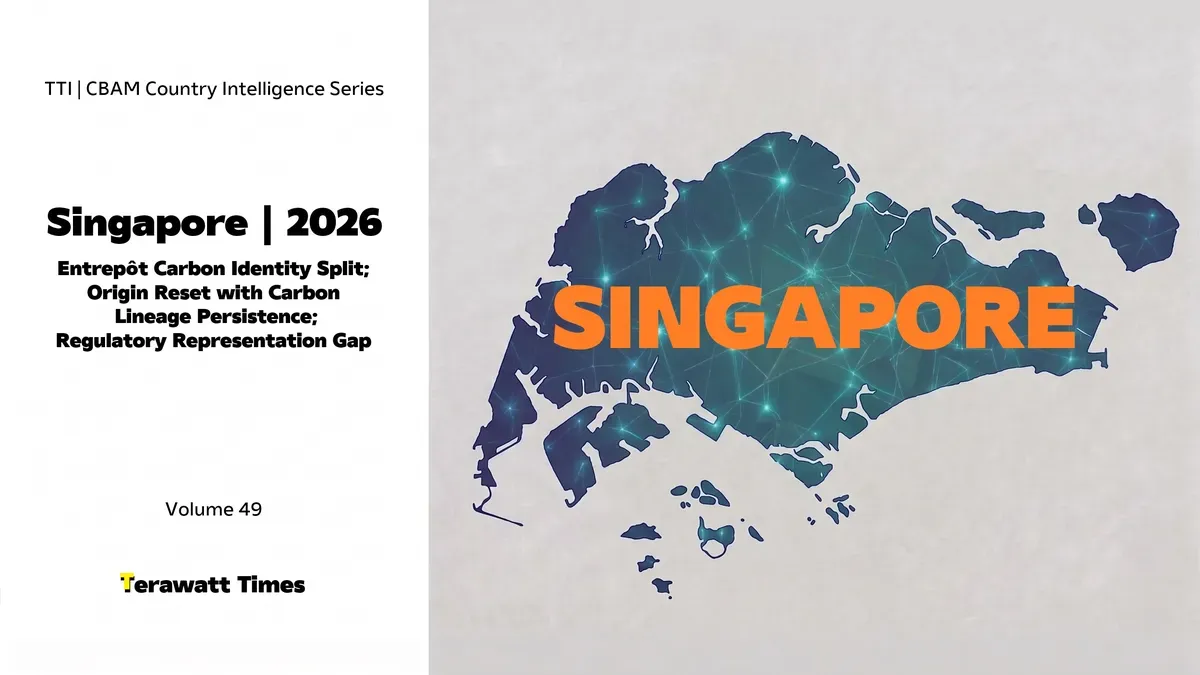
CBAM Country Intelligence Singapore 2026: Entrepôt Carbon Identity Split; Origin Reset with Carbon Lineage Persistence; Regulatory Representation Gap
EUR 788/t for hydrogen, EUR 310/t for steel structures, EUR 23/t for unwrought aluminium: Singapore's 2026 CBAM defaults invert its industry. Steel falls to blast-furnace values, untraced ingot faces Annex IV highs, and the S$45 carbon tax covers about 40% of the price.

Executive Summary
Singapore occupies an unusual position under the European Union Carbon Border Adjustment Mechanism (CBAM). It is a maritime hub, commodity trading centre, manufacturing location and financial jurisdiction, while several of the upstream activities that dominate the current CBAM scope are small, contracted or absent. Direct domestic-origin exposure is modest, yet the country is deeply involved in the movement, processing and commercial organisation of covered materials. The definitive regime applies a 50-tonne annual mass threshold per EU importer across iron and steel, aluminium, fertilisers and cement; hydrogen and electricity sit outside that threshold.[1]
The first official Singapore estimate set the scale. In 2021 the Ministry of Trade and Industry put products covered by the draft CBAM at about S$14 million a year, or 0.08 per cent of average annual domestic exports to the EU of around S$19 billion during 2016 to 2020.[2] The industrial baseline has not changed that profile. NatSteel, Singapore's only steel mill, now operates mainly as a processor, distributor and recycler of reinforcing steel, and national crude steel output was about 73,000 tonnes in 2025.[3][4][5] There is no primary aluminium smelter, and cement supply rests on imported cementitious materials handled through bulk terminals.[6][7] Hydrogen is the exception. Air Liquide's steam methane reformer on Jurong Island produces close to 100,000 Nm³ of hydrogen per hour, Linde gasifies heavy refinery residue to supply hydrogen and synthesis gas to ExxonMobil, and a 9 MW Linde electrolyser supplies Evonik.[8][9][10]
Singapore's trade infrastructure is exceptionally large. Container throughput reached a record 44.66 million TEUs in 2025, and around 90 per cent of container volume is transhipment to other destinations.[11][12] The London Metal Exchange continues to list new Singapore warehouses for primary aluminium, aluminium alloy and other base metals.[13] EU trade statistics record country of origin separately from country of consignment, and CBAM follows the Union's non-preferential origin rules rather than the seller's nationality or the port of dispatch.[14][15] The two recording bases diverge sharply: Singapore reported €31.3 billion of goods exports to the EU in 2025, while Eurostat recorded €17.7 billion of EU imports from Singapore, 56 per cent of that figure. Iron and steel of Singapore origin accounted for €9 million of the EU total and base metals and their articles for €231 million.[16]
The resulting structure is termed Entrepôt Carbon Identity Split. For a Singapore-linked good, the production jurisdiction, precursor jurisdiction, non-preferential origin, country of consignment, seller, warehouse operator, carbon-price jurisdiction, CBAM declarant and verifier accreditation can all differ. The distinction carries a price. At 2026 parameters, Singapore-origin unwrought aluminium on defaults requires about 0.307 CBAM certificates per tonne, against 1.036 for primary metal from a country without its own table entry.[17][18]
A second mechanism appears when imported material undergoes substantial manufacturing in Singapore. EU customs law can then assign Singapore non-preferential origin, while CBAM continues to account for the emissions of covered precursors in a complex good.[19][20][21] This is termed Origin Reset with Carbon Lineage Persistence. Where a Singapore processor cannot identify the country in which a precursor was produced, Annex IV of the default-value regulation applies the highest default value for that precursor: 3.198 tCO₂e per tonne for unwrought aluminium, almost nine times Singapore's own 7601 entry.[17] For material bought from exchange warehouses, the production record attached to the metal determines which value enters the calculation.
The third finding concerns the country table itself. Singapore's entry in Implementing Regulation (EU) 2026/1740 contains 38 rows, of which 30 carry values: two cement products, 24 aluminium products, hydrogen and three ferroalloys.[17] Unwrought aluminium carries 0.360 tCO₂e/t with Route L, the secondary aluminium benchmark route; hydrogen carries 14.030 tCO₂e/t. The ferro-manganese and ferro-chromium entries are identical to the "Other countries and territories" values, although Singapore has no ferroalloy industry.[17][6] Iron and steel products outside the ferroalloy headings, clinker and all fertilisers have no Singapore value and fall to the fallback table. Regulatory Representation Gap is the term used here for the distance between the observable industrial state of a country-product pair and the calculation state the default architecture assigns to it.
The arithmetic follows from those entries. On defaults in 2026, hydrogen carries a net 10.471 certificates per tonne, about €788 at the second-quarter certificate price of €75.28. Singapore reinforcing bar takes the blast-furnace fallback and carries about €231 per tonne, and steel structures about €310 per tonne, although Singapore's only steel mill is an electric arc furnace plant.[17][18][22][23]
Singapore's carbon tax provides a measurement base but only partial price coverage. The tax is S$45/tCO₂e for 2026 and 2027, about €30 at current exchange rates and roughly 40 per cent of the 2026 certificate price.[24][25] The Commission's draft rules on carbon prices paid in third countries, published on 13 May 2026, set out a recognition pathway for point-source carbon taxes of this kind.[26][27]
The proposed downstream extension would move CBAM closer to Singapore's manufacturing base. The Commission proposed about 180 steel- and aluminium-intensive downstream products from 2028, the Council adopted its general approach on 12 June 2026, and on 15 September 2026 the European Parliament adopted a mandate that more than doubles the product list and would let the Commission apply the default values of the true country of origin where circumvention patterns are identified.[28][29][30][31][32] Both provisions bear directly on a hub economy that stores, handles and processes foreign metal.
Production, customs origin, consignment, carbon pricing and verification can belong to different jurisdictions in the Singapore case. The durable compliance problem is to preserve the evidence links among them as goods move through a fragmented supply chain.
Remaining content is for paid members only.
Please subscribe to any paid plan to unlock this article and more content.
Subscribe Now