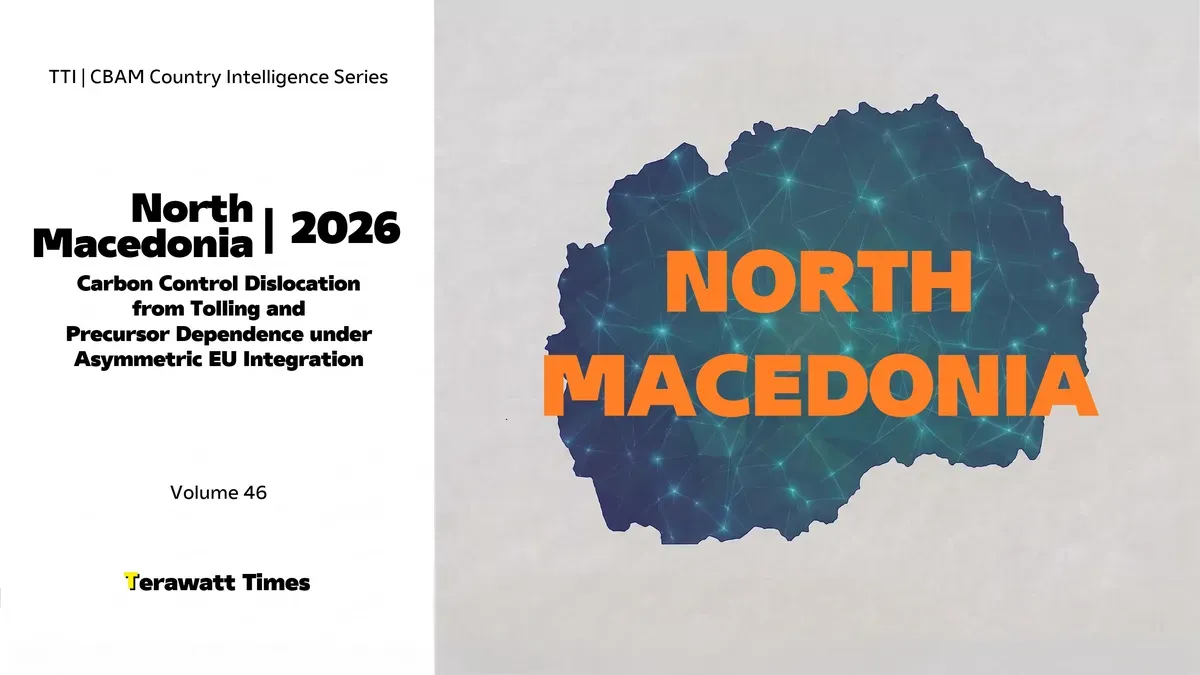
CBAM Country Intelligence North Macedonia 2026: Carbon Control Dislocation from Tolling and Precursor Dependence under Asymmetric EU Integration
Makstil plate owes about EUR 121/t in 2026 on the 1.530 tCO2e/t route-E CBAM default at EUR 75.36; verified values win below 1.72 t/t. IGM tube: EUR 147/t on the country default, EUR 80-100 with Turkish coil, up to EUR 166 with Chinese coil. EU-origin coil counts as zero.

Executive Summary
North Macedonia enters the definitive phase of the European Union Carbon Border Adjustment Mechanism, or CBAM, as a small manufacturing economy with unusually dense links to the EU market. Roughly three quarters of the country's goods exports went to the EU in 2025, and World Bank analysis identified metals, especially iron and steel, as the country's largest immediate source of CBAM exposure. More than 60 per cent of North Macedonia's iron and steel exports were directed to the EU. [1][2] The exposure is concentrated in a limited number of industrial chains.
Below the sector level, several variables that determine CBAM treatment are controlled at different points in the supply chain. The installation that creates industrial value may differ from the firm that controls an upstream precursor, the commercial counterparty that owns or distributes the good, the EU entity that imports it, and the operator or verifier that controls emissions evidence. Carbon Control Dislocation describes cases in which that separation is material to the reported carbon value, the usability of emissions evidence, or the economic incidence of CBAM. The EU location of an authorised declarant does not by itself meet that definition.
Makstil provides the clearest commercial example. Its Skopje plant melts scrap in an electric arc furnace, casts slab and rolls hot-rolled plate. Company data show 258,825 tonnes of slab and 267,036 tonnes of plate production in 2025. [3][4] The commercial route extends into the DITH network. Makstil's own shareholder materials state that its internal sales capacity can place only about one third of annual production and that the majority is sold to Duferco SA and placed on international markets through the Duferco Lugano sales network under a related-party Conversion Agreement. Duferco's advances finance about two thirds of Makstil's production costs under the arrangement. [5] Duferco Commerciale identifies itself as Makstil's exclusive distributor in Italy and sells on a Delivered Duty Paid basis while handling customs clearance, including CBAM compliance. [6] The plant controls steelmaking and production data in Skopje, while a substantial part of the commercial route and EU-side execution sits elsewhere in the group.
IGM Trade shows a different pattern. IGM manufactures welded pipes and profiles in Kavadarci from externally produced steel coil and sells about 95 per cent of its output outside North Macedonia, mainly into EU and CEFTA markets. It also owns the former ALPOS welded-pipe plant in Slovenia. [7][8] IGM controls its forming, welding, process data and procurement decisions, while the production route and primary emissions record of the coil originate at an upstream steel mill. Regulation 2025/2547 allows actual and default values to be combined in a complex-goods calculation, so a downstream process can use actual data while an external precursor without verified evidence takes a default. The default is that of the country where the coil was produced, and coil originating in the European Union counts as zero. [9][10] IGM's CN 7306 products are listed in Annex II of the CBAM Regulation, so only direct emissions count, including those carried by the steel precursor; purchased electricity at Kavadarci stays outside the calculation. [11]
The corrected 2026 default tables are central to this analysis. North Macedonia's CN 7208, 7209 and 7210 products carry a total-emissions default of 1.530 tCO₂e per tonne before mark-up, associated with route E, the scrap/EAF route. Carbon-steel welded tubes and profiles under CN 7306, including 7306 30 and 7306 61, carry 1.898 tCO₂e per tonne, also on route E. [10] At the first-quarter 2026 certificate price of EUR 75.36, a CBAM factor of 0.975 and a cross-sectoral correction factor of 100 per cent, the default pathway for Makstil's heavy plate implies about 1.61 certificates, or EUR 121, per tonne, and for a carbon-steel welded tube about 1.95 certificates, or EUR 147, per tonne. [12][13][14][15] Actual values give Makstil the lower obligation whenever its verified direct emissions stay below 1.72 tCO₂e per tonne of plate. For downstream tube the ranking depends on the coil: a hybrid calculation built on a Chinese blast-furnace coil default is close to or above the route-E country default, while Turkish coil lowers it and Union-origin coil removes the precursor term.
Other sectors show why industrial carbon weight and current border exposure require separate treatment. Most of North Macedonia's 2024 HS 2523 cement and clinker exports went to Serbia, with much smaller volumes shipped to Bulgaria and Greece. [16] Golden Eagle Nickel, the former Euronickel operation, remained out of commercial production during 2025, and the Jugohrom ferro-silicon plant at Jegunovce was closed in 2022 over missing filtration equipment. [17][18][19] These assets remain important to national decarbonisation and future industrial policy, but steel currently combines active production, EU market orientation and CBAM-covered trade more strongly than the other major carbon-intensive sectors.
The institutional setting adds a second layer to the country story. North Macedonia launched an intraday electricity market in May 2026 and entered the verification stage for future EU electricity market coupling in July. [20][21] MEMO also joined the Association of Issuing Bodies, but AIB still lists the North Macedonian operator as an Electricity Scheme Applicant rather than a full member of the EECS Electricity Scheme; the national GO certificates described by AIB remained non-EECS at the 2026 cut-off. [22][23] Domestic carbon-governance institutions have moved more slowly. The Energy Community recorded zero implementation across the ETS monitoring, reporting, verification and accreditation cluster in its 2025 assessment and kept Case ECS-11/26 open in 2026 over non-transposition of core EU ETS monitoring and verification rules. [24][25] The Law on Climate Action was still in the process of adoption according to a Ministry of Environment statement of 22 April 2026. [26] Asymmetric EU Integration denotes this uneven pace of market and carbon-governance integration: a national institutional condition that amplifies dependence on EU-side carbon rules and services, distinct from the two transaction-level forms of Carbon Control Dislocation.
North Macedonia's CBAM position is best read through the supply chains that connect production, precursor carbon, commercial control and admissible evidence. DITH already sells customs clearance, financing and certificate management as part of a steel service. [27] IGM's welded-product exposure depends on where its coil was produced and on whether a third-country mill can supply verified data. The country's electricity market is integrating with Europe faster than its domestic MRVA and carbon-pricing institutions. The operative question is which entities control the carbon-relevant variables that change the declared emissions, evidence quality and commercial treatment of a particular good.
Remaining content is for paid members only.
Please subscribe to any paid plan to unlock this article and more content.
Subscribe Now