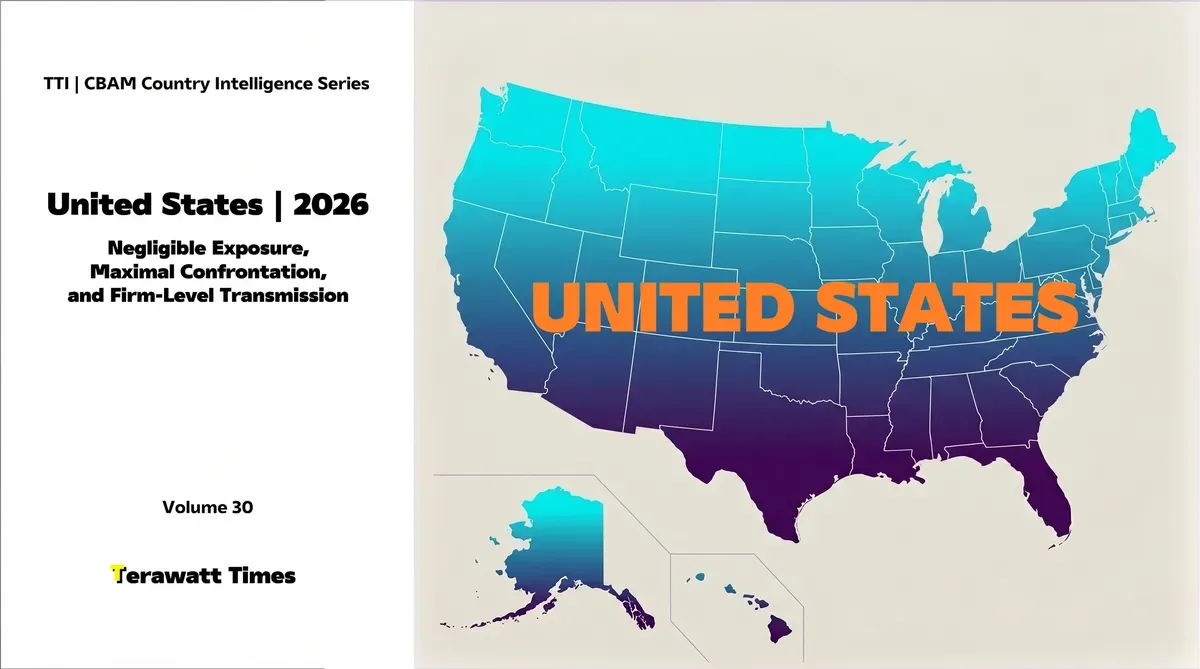
CBAM Country Intelligence United States 2026: Negligible Exposure, Maximal Confrontation, and Firm-Level Transmission
The EU's CBAM was expected to penalise American steel. It won't. Total US exposure stays near 0.02% of transatlantic trade, the heaviest per-tonne charge lands on ammonia, and the mechanism changes behaviour only at the firm level—led by CF Industries—not at the national one.

Executive Summary
The Carbon Border Adjustment Mechanism is the European Union's charge on the carbon embedded in selected imports, designed to put foreign producers on the same carbon-cost footing as domestic ones as the EU withdraws the free emission allowances its own industry has long received [1]. For the United States, the practical weight of that charge has been widely overstated. When the mechanism's statutory formula is applied to the verified default values published for American goods, total exposure across steel, aluminium, cement, fertilizers, and hydrogen lands between roughly €24 million and €42 million in 2026, and reaches at most about €184 million in 2034 under the least favourable assumptions [2][3]. Measured against United States to European Union goods trade of roughly €850 billion, even the worst case stays near two hundredths of one percent [4]. This figure is the empirical basis for the rest of the analysis.
Three findings follow from these numbers. First, the sector that anchors the public conversation is the wrong one. American hot-rolled steel carries a 2026 default value of 1.400 tonnes of carbon dioxide equivalent per tonne of product, and the free allocation benchmark assigned to it sits at 1.370, so the net charge after the allowance adjustment is small in the early years and only widens later as that allowance is withdrawn [2][3]. Ammonia tells the opposite story. Its default value of 3.41 tonnes runs far above the 1.522 benchmark, which leaves a per-tonne cost near €157 in 2026 at an allowance price of €80 [2][3]. The heaviest charge therefore lands on a product almost no one analysed.
Second, the United States barely ships the products that the charge bites. It is a net importer of ammonia, drawing roughly 0.9 million tonnes in 2024, and it does not rank among the world's leading ammonia exporters [6]. Its primary aluminium industry has shrunk to about 0.7 million tonnes a year across four smelters [7]. Its urea ammonium nitrate solution already faces a standing European anti-dumping duty renewed in January 2026 [8]. A high charge per tonne, applied to a trade flow that is thin or already obstructed, produces a small bill.
Third, the mechanism does change behaviour, but at the level of the firm rather than the nation. CF Industries shipped 23,500 tonnes of certified low-carbon ammonia into Antwerp in October 2025, with a verified carbon footprint well below the American default, turning the charge into an advantage over higher-carbon suppliers from Trinidad, Russia, and North Africa [5][9]. That move happened without any federal cooperation, and indeed against a federal posture that has rescinded the Environmental Protection Agency endangerment finding, stripped the principal industrial decarbonisation credits from the Inflation Reduction Act, and raised steel and aluminium tariffs to 50 percent under Section 232 [10][11]. The compliance channel that CBAM assumes is dead at the national level and alive at the level of individual decarbonised producers.
This report delivers three things. The first is a present-tense map of which American producers are positioned to use CBAM as a route into Europe and which will absorb the default charge and lose ground. The second is a clean measurement of the exposure itself, which clears away the mistaken expectation of a large bill. The third is a forward watch-list of the three conditions, namely the EU carbon price, the scheduled withdrawal of free allocation between 2029 and 2034, and the planned 2028 extension of CBAM to downstream goods, whose convergence would pull transmission back to the national level. Part 1 establishes the foundations and the measurement. Parts 2 and 3 develop the sectors, the inert national channels, the firm-level map, and the conditions for reactivation.
Remaining content is for paid members only.
Please subscribe to any paid plan to unlock this article and more content.
Subscribe Now