The Proportionality Trap: When Technical Compliance Standards Become Power Instruments
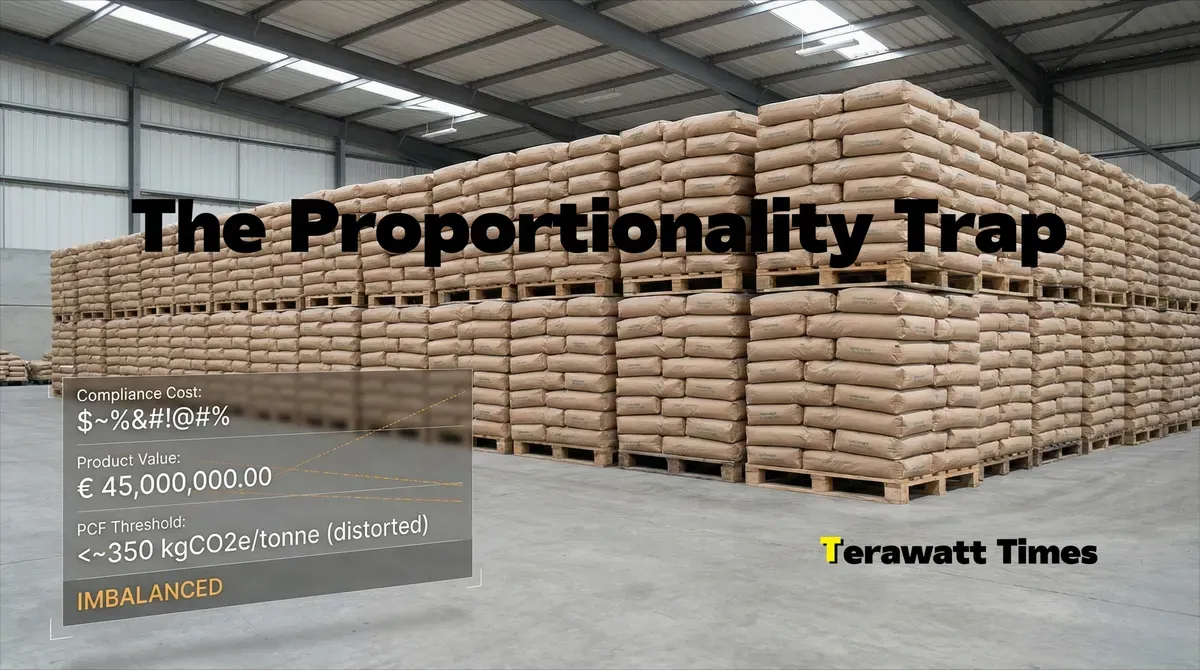
The EU’s CBAM and DPP fall into a "proportionality trap." While technically precise, they lack political legitimacy by excluding non-EU suppliers from standard-setting. This voice deficit turns compliance into an instrument of power, escalating into formal WTO trade disputes.
Abstract
The European Union's Digital Product Passport and Carbon Border Adjustment Mechanism embed environmental accountability into the architecture of global trade. Prior analysis has established that this audit-based governance is structurally irreversible under the physical constraint of a remaining carbon budget near 130 GtCO₂. This paper takes up the distributional question that irreversibility leaves open: how the compliance burden falls across industries and jurisdictions, and what the pattern of that distribution implies for the legitimacy the architecture needs to function.
The paper distinguishes three concepts of proportionality that operate in climate trade governance and are routinely conflated. Technical proportionality concerns whether data requirements correspond to environmental assessment needs. Legal proportionality concerns whether trade restriction exceeds what the policy objective requires. Political proportionality concerns whether the parties bearing compliance burdens have voice in the rules they must follow. European governance addresses the first through expert assessment and the second through litigation and treaty design. It does not address the third. The reason is structural rather than incidental. Political proportionality resists institutionalization, because it demands an answer to the question of who has authority to define rules, and no rule-making body can neutrally answer that question about itself.
Two bodies of evidence document the resulting deficit. Industry differentiation in disclosure requirements shows that burden allocation reflects consultation access and prior regulatory investment, not technical rationality alone. An assessment against Ostrom's eight design principles shows a system strong in monitoring and weak in participation, a pattern that is the equilibrium of externally organized governance rather than a stage on the way to fuller inclusion. The participation deficit appears in three places: in the composition of the consortium writing technical specifications, in consultation response rates, and in the escalation of unresolved concerns to formal trade disputes, including a Russian complaint filed at the World Trade Organization in May 2025.
The proportionality trap is the consequence. When a standard achieves technical precision while neglecting political proportionality, the parties who lack voice come to read the precision itself as the exercise of power. The technical becomes political through the failure to address the political directly. The verification machine the European Union has built with notable speed will hold longer if its legitimacy foundation is strengthened with comparable seriousness.
1. Introduction: From Irreversibility to Distribution
Previous analysis has characterized the emerging architecture of audit-based climate governance as Verification Imperium. The term names a specific power: the unilateral capacity to determine, for traded goods, what counts as adequate evidence of a contested empirical claim, exercised through control of methodology, verifier accreditation, and infrastructure [1]. Subsequent analysis established why this architecture proves irreversible, anchoring the argument in a remaining carbon budget near 130 GtCO₂ and in lock-in mechanisms that make retreat progressively more expensive than continuation [2]. Those analyses left a question unexamined. To know that audit-based governance has become structurally embedded says little about how its burdens fall across industries, firm sizes, and national contexts. This paper addresses that question, and argues that the pattern of distribution carries consequences for the legitimacy the architecture requires.
The European Union's Digital Product Passport and Carbon Border Adjustment Mechanism provide the terrain. The Digital Product Passport, established under the Ecodesign for Sustainable Products Regulation, mandates product-level environmental disclosure across an expanding set of categories [3]. The Carbon Border Adjustment Mechanism requires importers to report and pay for the embedded carbon in covered goods [4]. Both convert voluntary sustainability claims into mandatory, auditable requirements, and both impose demands that vary sharply by industry. Battery manufacturers face 73 core mandatory data fields, rising to 90 for high-risk categories. Textile producers face qualitative assessment frameworks with no fixed field count. Steel and aluminum producers inherit life-cycle methodologies developed over a decade of emissions trading. The variation tracks genuine differences in environmental impact. It also encodes choices about which industries carry the documentation burden and which receive accommodation, and those choices were made in forums to which the affected parties had unequal access.
The argument runs through several stages. The paper first separates three concepts of proportionality that climate trade governance routinely conflates, and shows why the political variant resists the institutionalization that the technical and legal variants admit. It then reads industry differentiation as evidence that burden allocation reflects political access alongside technical rationality. It assesses the Digital Product Passport against Ostrom's design principles, finding a system strong in monitoring and weak in participation, and argues that this pattern is the equilibrium of externally organized governance rather than a transitional state. It documents the participation deficit through the composition of the body writing technical specifications, through consultation response patterns, and through the escalation of concerns to formal trade disputes. It then identifies three tensions that make the deficit resistant to clean resolution, and three pathways that could address it within the existing architecture.
The stakes have moved beyond stakeholder grievance into inter-state dispute. Russia filed a formal complaint against the Carbon Border Adjustment Mechanism at the World Trade Organization in May 2025 [5]. India has signaled that carbon border measures could complicate its free trade negotiations with the European Union [6]. China has raised specific trade concerns in the Technical Barriers to Trade Committee regarding life-cycle methodology choices that disadvantage its manufacturing processes [7]. The European Union has built a verification machine of impressive reach and speed. Strengthening its legitimacy foundation is the governance challenge this paper identifies.
Remaining content is for members only.
Please become a free member to unlock this article and more content.
Subscribe NowAuthors

Preston studies the policy and social dimensions of the energy transition, focusing on urban electrification, energy equity, and how emerging technologies shape outcomes for middle‑ and working‑class communities.

Caroline is a Houston-born analyst focusing on Gulf Coast oil, LNG, and industrial electrification. She studies how legacy energy systems and new clean-power infrastructure reshape the economic future of the American South.

U.S. energy strategist focused on the intersection of clean power, AI grid forecasting, and market economics. Ethan K. Marlow analyzes infrastructure stress points and the race toward 2050 decarbonization scenarios at the Terawatt Times Institute.