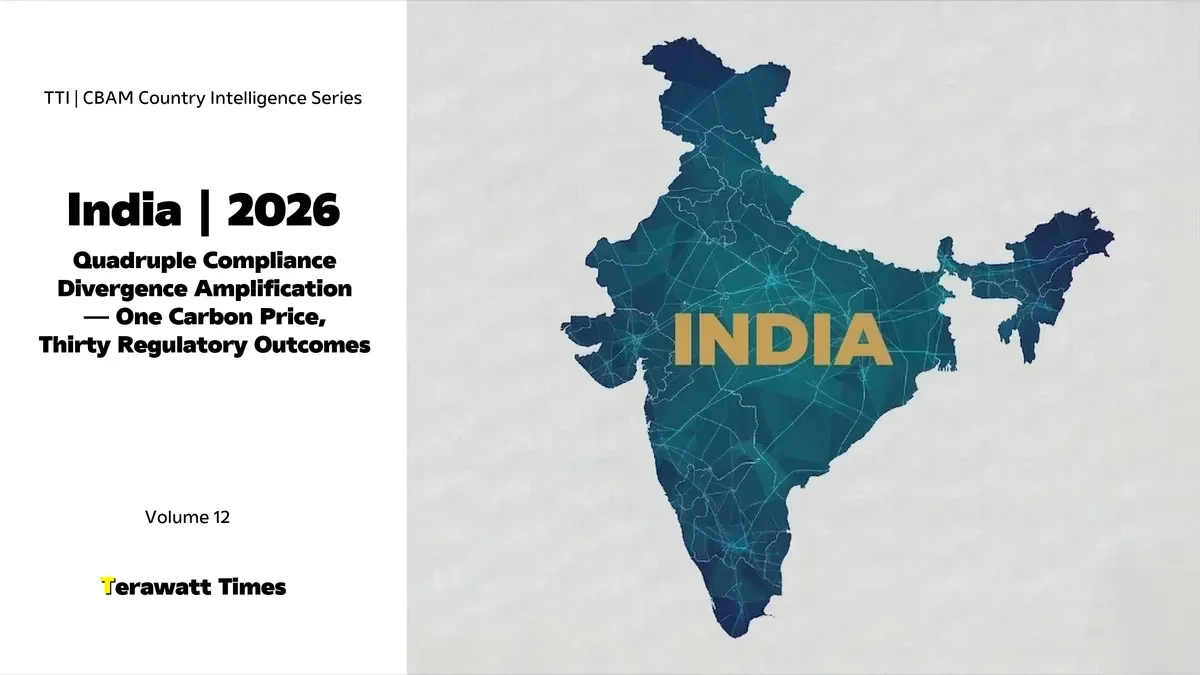
CBAM Country Intelligence India 2026: Quadruple Compliance Divergence Amplification — One Carbon Price, Thirty Regulatory Outcomes
NEW: India faces the widest CBAM cost spread of any exporter—€0 for green hydrogen to €230+/t for MSME steel on defaults. Not emissions but rule architecture. TTI maps the four-dimensional divergence with BFG stoichiometry, enterprise cost ranking, and three testable predictions.

Executive Summary
The European Union's Carbon Border Adjustment Mechanism entered its definitive phase on January 1, 2026. For India, the world's second-largest steel producer and a major exporter of aluminium and hydrogen, CBAM does not impose a single cost. It imposes a distribution of costs spanning from zero to over €230 per tonne of exported product, a thirty-fold spread driven not by how much carbon a facility emits but by where each product falls within CBAM's multi-layered rule architecture.
This report introduces the Quadruple Compliance Divergence Amplification (QCDA) framework to explain why India experiences the widest effective CBAM cost distribution of any major exporting economy. Four independent dimensions drive the spread. Carbon intensity divergence separates low-emission DRI-EAF producers at 0.85 tCO₂ per tonne from high-emission blast furnace operators above 2.00. Installation boundary divergence determines whether a facility's captive power plant inflates or is excluded from its tax base. Data capability divergence creates a binary gate: enterprises with EU-verified monitoring data face a tax base of approximately 1.90 tCO₂ per tonne, while those relying on Commission default values are assigned 4.28 before markup, escalating to 5.56 from 2028 with the 30 percent surcharge. During the CBAM transitional period, 64 percent of Indian steel export volume entered the EU on default values. Scope boundary divergence compresses aluminium's regulatory exposure by a factor of 7.5 relative to its physical carbon footprint and reduces electrolytic hydrogen's CBAM liability to precisely zero.
India is the only economy where all four dimensions activate simultaneously at high variance. The compound effect produces an effective cost ratio exceeding 30 to 1 across the country's CBAM-covered export portfolio.
The analysis rests on a first-principles chemical stoichiometric derivation of blast furnace gas carbon density at approximately 260 tCO₂ per terajoule, compared against the statutory waste gas deduction factor of 37.4 tCO₂ per terajoule. This seven-fold gap adds 0.65 to 0.85 tCO₂ per tonne to every Indian integrated steelmaker's CBAM tax base, a permanent competitive handicap embedded in EU regulation rather than in Indian industrial performance. Enterprise-level CBAM cost rankings, incorporating route-specific benchmarks finalized by the EU Commission CBAM Committee in December 2025 at 1.370 for BF-BOF, 0.481 for DRI-EAF, and 0.072 for scrap-EAF, reveal that even India's lowest-carbon steel facility carries a positive CBAM obligation from the first day of the definitive phase.
The cumulative CBAM-driven cost transfer from Indian steel exporters to the EU treasury over 2026 to 2030 is estimated at €3 to 5 billion. By 2026, blast furnace steelmakers operating above 1.90 tCO₂ per tonne face export margins compressed to breakeven. By 2028, default-value exporters are structurally excluded from the European market.
Three testable predictions are advanced for empirical validation as verified compliance data accumulates from 2027 onward, establishing falsifiability benchmarks for the QCDA framework itself.
1. Quadruple Compliance Divergence Amplification
1.1 One Carbon Price, Thirty Outcomes
Consider a stylized Indian industrial conglomerate that exports four product lines to the European Union in 2030: blast furnace hot-rolled coil from its flagship integrated steelworks, primary aluminium ingots from its coal-powered smelter, electrolytic green hydrogen from a newly commissioned electrolyser, and the same hot-rolled coil specification produced by a cluster of small-scale coal-based direct reduced iron workshops that supply semi-finished feedstock to the group's downstream rolling mills. Each product crosses the same border. Each faces the same nominal carbon price embedded in CBAM certificates, projected at approximately €80–85 per tonne of CO₂ equivalent by 2030 [1].
Yet the financial obligations attached to each tonne of exported product diverge by an order of magnitude. The conglomerate's blast furnace steel, backed by a fully operational monitoring, reporting, and verification system and staffed by engineers capable of executing the EU's waste gas deduction protocols, carries a CBAM-adjusted direct emission intensity of approximately 1.90 tCO₂ per tonne of hot-rolled coil. After subtracting the Specific Embedded Free Allocation credit of roughly 1.370 tCO₂ per tonne at 2030 phase-in levels, the net taxable exposure translates into a carbon levy of approximately €96 per tonne [2][3]. The group's natural gas DRI-EAF facility, assessed against the lower DRI-EAF route benchmark of 0.481 tCO₂ per tonne finalized by the EU Commission CBAM Committee in December 2025 [3], carries a levy of approximately €48 per tonne at the same carbon price. The small-scale DRI workshops, lacking any capacity to furnish EU-compliant verified emission data, are assigned the Commission's punitive default value of approximately 3.55 tCO₂ per tonne for India-origin steel, augmented by a 30 percent markup surcharge applicable from 2028 onward [4]. Their effective CBAM cost exceeds €230 per tonne. The aluminium smelter, despite generating over 15 tonnes of physical CO₂ per tonne of metal when Scope 2 electricity emissions are included, reports a regulatory tax base below 2.0 tCO₂ per tonne because current CBAM rules exclude both indirect emissions and upstream alumina refining from the aluminium system boundary [5][6]. Its CBAM liability amounts to roughly €32 per tonne. The electrolyser, splitting water molecules into hydrogen and oxygen through an electrochemical reaction that produces zero direct CO₂ by the laws of chemistry (2H₂O → 2H₂ + O₂), faces a Scope 1 tax base of precisely zero regardless of the carbon intensity of the electricity it consumes [7]. Its CBAM cost is €0.
The spread from €0 to over €230 per tonne constitutes a force distribution ratio exceeding thirty to one. The distribution does not track physical carbon emissions. The aluminium smelter emits far more CO₂ per unit of output than the blast furnace steelworks, yet pays less than half the carbon levy. The electrolyser may run on coal-fired grid power with an implied carbon footprint exceeding 10 tCO₂ per tonne of hydrogen, yet its CBAM obligation remains zero. The small-scale DRI workshops may operate coal-based rotary kilns with genuine emission intensities of 2.0–2.4 tCO₂ per tonne [8], well below their assigned default value of 4.28 before markup (rising to 5.56 with the 30 percent surcharge from 2028), yet they are taxed as though they were among the dirtiest producers on earth.
What determines where each product lands in this distribution is not how much carbon it releases into the atmosphere. The determining variable is which cell of CBAM's rule matrix the product occupies: which emissions scope the regulation counts, whether the exporter possesses data infrastructure meeting EU verification standards, which route-specific benchmark applies to the product, and at what rate the free allocation baseline erodes over time.
Remaining content is for paid members only.
Please subscribe to any paid plan to unlock this article and more content.
Subscribe Now