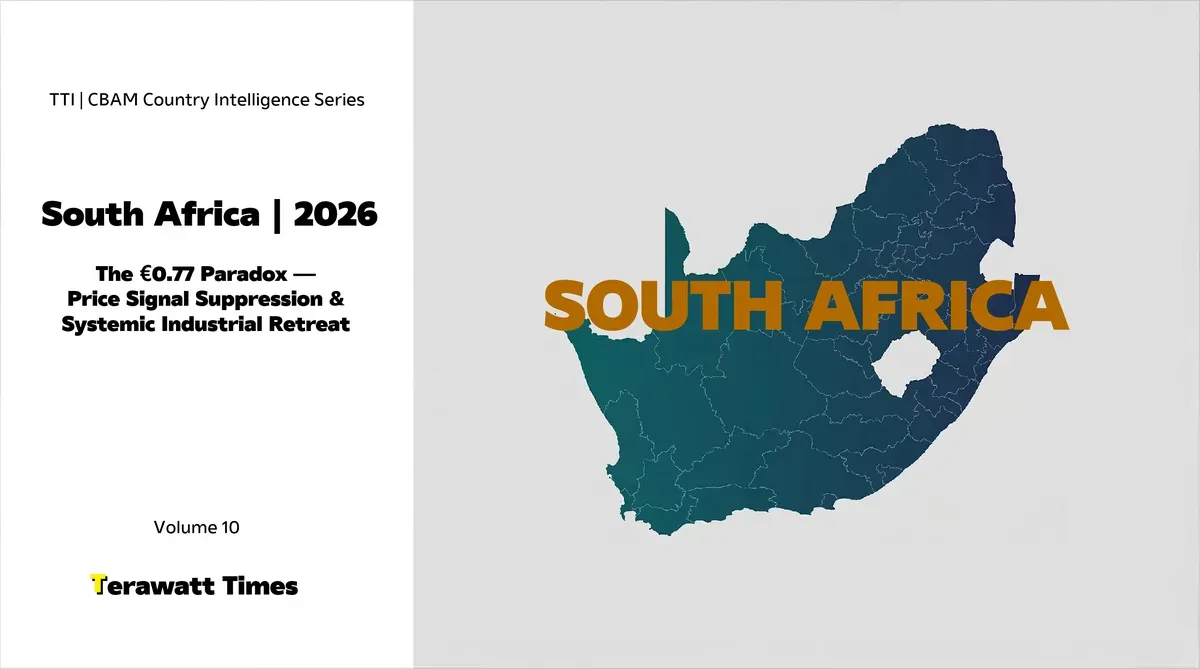
CBAM Country Intelligence South Africa 2026: The €0.77 Paradox — Price Signal Suppression and Systemic Industrial Retreat
South Africa is the CBAM-exposed economy where carbon price signal suppression and grid collapse intersect. A nominal R308/tCO₂ carbon tax delivers €0.77 effective rate. 53 of 62 ferro-alloy furnaces offline. Chrome ore exports at 20.55Mt record. This is retreat, not adaptation.
Executive Summary
Six numbers define South Africa's position under the EU Carbon Border Adjustment Mechanism.
The first is €0.77 per tonne of CO₂ equivalent. This is the effective carbon tax rate that applies uniformly across South Africa's steel, aluminium, ferro-alloy, and fertiliser industries after the statutory allowance architecture compresses a nominal rate of R308 per tonne into fiscal irrelevance [1][2]. The Carbon Tax Act provides multiple categories of tax-free allowance, including a basic allowance of 60 percent, a process emission allowance, a trade exposure allowance, a performance allowance, and a carbon offset allowance [1]. Section 13 of the Act constrains the combined effect of the basic, process, trade exposure, and performance allowances to a maximum of 95 percent of assessed emissions, while the carbon offset allowance under Section 12 operates as a separate mechanism that permits an additional 5 to 10 percent reduction in the taxable base [1]. The practical result, confirmed through both bottom-up legal calculation and top-down verification against South African Revenue Service collection data, is an effective tax rate of approximately R15.40 per tonne, or €0.77 at a reference exchange rate of 20 ZAR per euro [1][2][3]. Against an EU ETS carbon price fluctuating between €65 and €85, this figure represents less than one percent of the price South African exporters will face at Europe's border. Article 9 of the CBAM Regulation permits deduction of carbon prices effectively paid in the country of origin [4]. In South Africa's case, that deduction rounds to zero in practical terms. A further operational complication arises from the fact that South Africa's carbon tax is settled annually with significant lag, meaning that in the early quarters of 2026, enterprises may be unable to present contemporaneous payment evidence matching the specific reporting period required by CBAM's declaration procedures [4][5]. The €0.77 figure represents the institutional design rate; the real-time Article 9 deduction available in any given quarter may be lower still.
The second number is zero out of five. Of the five enterprises most exposed to CBAM across the South African metals sector, not a single one has published a quantified estimate of its annual CBAM cost liability in any annual report or investor presentation [6][7][8][9][10]. Three of the five do not mention the mechanism at all.
The third number captures an incentive reversal that the architects of CBAM did not anticipate. Under the 2026 default-value regime, South Africa's Hillside aluminium smelter may face a CBAM cost approaching zero through the default pathway and approximately €27 to €42 per tonne through precise actual-value reporting [5][11][12]. The mechanism designed to penalise data opacity instead rewards it. This inversion arises because the direct-emission default for unwrought aluminium, set at 0.36 tCO₂ per tonne and rising to 0.396 with the 10 percent mark-up [11], falls below the free-allocation adjustment derived from the EU ETS aluminium benchmark [12][13]. The precise magnitude of the gap depends on a technical question that this report identifies but cannot definitively resolve: whether the EU ETS benchmark of approximately 1.514 tCO₂ per tonne, defined at the "liquid metal" stage of production, requires adjustment when applied to finished aluminium ingot (CN 7601), which incorporates additional process steps including casting [14]. If the benchmark applies without adjustment, the default pathway cost is zero. If a conversion factor is required, the cost may be small but non-zero. Either way, the default pathway is substantially cheaper than actual-value reporting for Hillside in 2026, which constitutes a reversal of CBAM's intended incentive structure.
The fourth number is 53 out of 62. That is the count of submerged-arc furnaces in South Africa's ferro-alloy sector that have ceased operation, entered indefinite care and maintenance, or been permanently decommissioned [15][16][17]. The ferro-alloy industry has not merely contracted. It has collapsed, in measurable and documented terms.
The fifth is 20.55 million tonnes. In 2024, South Africa exported a record volume of unprocessed chrome ore, the vast majority destined for smelters in China [18][19]. This figure is the mirror image of the ferro-alloy collapse. The country has not lost its resource endowment. It has lost the industrial capacity to convert that endowment into value-added products, and CBAM's impending cost structure eliminates the economic rationale for rebuilding that capacity.
The sixth number requires a distinction that matters. Of the $13.73 billion pledged under the Just Energy Transition Partnership, $833 million had been disbursed by early 2026, representing 6 percent of committed capital [20]. An additional amount reported at approximately $3.5 billion had reached the "signed" or "committed" stage of the financing pipeline [20]. The gap between signed agreements and actual disbursement is the gap between contracts in filing cabinets and kilowatts on the grid. The transition pathway that might have allowed South African industry to adapt to carbon border constraints depends on physical infrastructure that money on paper cannot build.
The causal structure connecting these numbers runs along two independent lines that converge at the point of CBAM contact. The first line is institutional. South Africa's carbon tax, through its allowance architecture, suppressed the carbon price signal below the threshold at which enterprises invest in monitoring capacity, evaluate trade-policy risk, or redirect capital expenditure toward decarbonisation. Six years elapsed between the Carbon Tax Act's enactment in 2019 and CBAM's definitive phase in 2026. Those years produced no CBAM-relevant capacity. The second line is physical. Eskom's accelerating grid deterioration raised the carbon intensity of South African production while simultaneously closing every plausible adaptation route. ArcelorMittal South Africa's combined Scope 1 and Scope 2 carbon intensity worsened from 2.77 to 3.35 tCO₂e per tonne of liquid steel between 2023 and 2024 [6]. When these two lines intersect, the result is an enterprise that neither knows the scale of its CBAM exposure nor possesses the physical means to reduce it. The behavioural outcome is retreat: facility closures, workforce retrenchments, and the replacement of processed exports with raw material shipments.
A third mechanism determines which industries retreat first. CBAM's differentiated treatment of indirect emissions (Scope 2), combined with variation in electrical intensity and EU ETS benchmark coverage, sorts South Africa's exposed sectors into a predictable sequence. Ferro-alloys, where electricity accounts for over 60 percent of production cost and no dedicated product benchmark exists, collapsed between 2023 and 2025. Steel, partially shielded by the Hot Metal benchmark and Scope 2 exemption, is bleeding market share at a slower rate. Aluminium, protected in the short term by Scope 2 exemption and a default-value pathway that currently yields minimal cost, appears stable on the surface but faces a decisive inflection when Scope 2 is incorporated into the CBAM calculation or when Hillside's Eskom supply contract expires in 2031.
Remaining content is for paid members only.
Please subscribe to any paid plan to unlock this article and more content.
Subscribe NowAuthors

Hiroto Nakamura is a research fellow focused on climate intelligence, satellite-based MRV, and AI-driven environmental monitoring. He analyzes geospatial data and verification systems to improve global carbon transparency and emissions accountability

U.S. energy strategist focused on the intersection of clean power, AI grid forecasting, and market economics. Ethan K. Marlow analyzes infrastructure stress points and the race toward 2050 decarbonization scenarios at the Terawatt Times Institute.