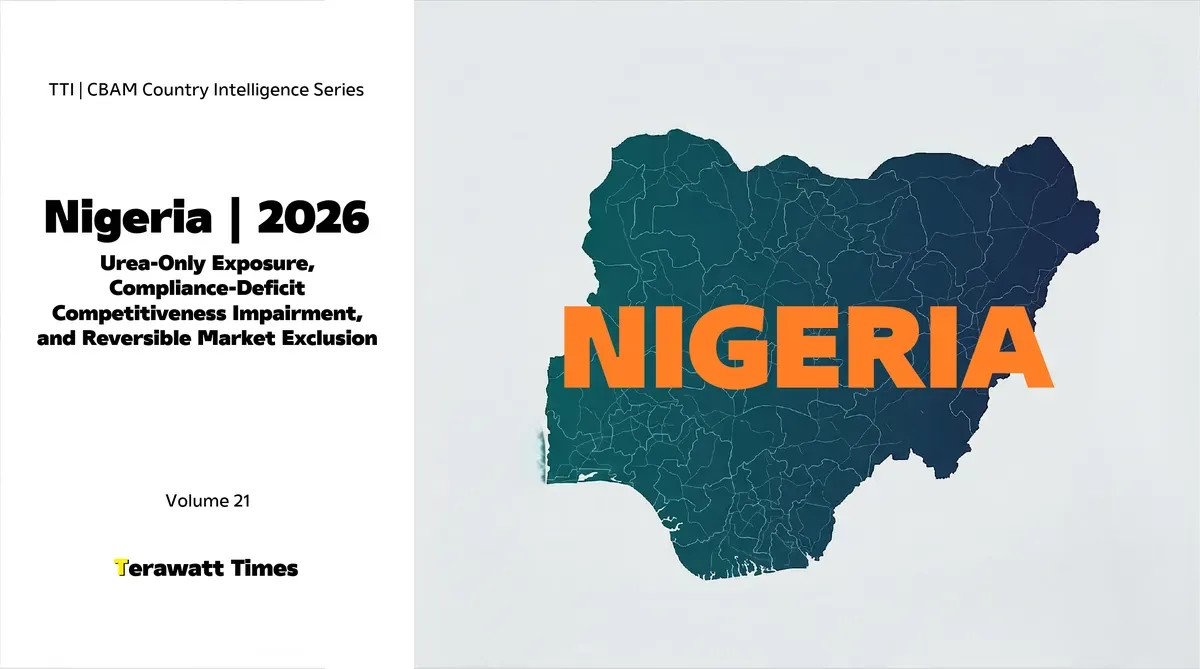
CBAM Country Intelligence Nigeria 2026: Urea-Only Exposure, Compliance-Deficit Competitiveness Impairment, and Reversible Market Exclusion
Nigeria's only CBAM exposure is urea, yet EU exports fell 92% before the carbon levy even began. The cause is not the 1% mark-up but compliance friction. This report introduces Compliance-Deficit Competitiveness Impairment (CDCI), showing the €42/t penalty drops to €12/t.

Executive Summary
Nigeria occupies a singular position among countries affected by the European Union's Carbon Border Adjustment Mechanism. Its entire CBAM exposure is concentrated in a single commodity: granulated urea fertiliser, classified under Combined Nomenclature code 3102 10 19. Between 2022 and 2024, Nigerian fertiliser exports to the EU collapsed by 92 percent, falling from €168 million to approximately €13 million, even though Nigeria's total global urea exports remained above 3 million tonnes throughout the period. This report demonstrates that the collapse was driven by anticipatory supply chain restructuring in response to CBAM, confirmed through a multi-dimensional causal attribution framework that rules out domestic gas supply disruption as the primary cause. A central paradox emerges from the regulatory architecture: CBAM applies a mark-up of only 1 percent to fertiliser default values, against 10 to 30 percent for steel, aluminium, and the other covered industrial goods. The resulting financial penalty amounts to roughly 9 percent of the free-on-board price of urea, a margin too slim to explain the near-total trade extinction observed.
This report identifies a new mechanism, termed Compliance-Deficit Competitiveness Impairment (CDCI), wherein the institutional compliance channel of CBAM operates independently of its financial penalty channel. When the financial channel is politically suppressed, the compliance channel becomes the binding constraint on trade, sorting suppliers by institutional distance from the EU regulatory infrastructure rather than by carbon intensity. Nigeria's Dangote Fertiliser, a plant operating at global best-available-technology efficiency with an estimated carbon intensity of approximately 1.05 tonnes of CO₂ equivalent per tonne of urea, faces a CBAM cost of €42 per tonne under default values but only €12 per tonne under verified actual data. The €30 per tonne differential represents competitiveness that exists in physical reality but remains invisible to EU customs. This is the first case in the TTI CBAM Country Intelligence Series where the institutional compliance channel, rather than the financial penalty channel, constitutes the binding constraint on trade.
Critically, this impairment is reversible: the cost of establishing a CBAM-compliant monitoring, reporting, and verification system is estimated at €0.5 to 1 million, while the annual penalty of remaining on default values exceeds €5 million for a conservative export volume assumption. The findings carry immediate implications for the forthcoming Dangote Fertiliser initial public offering on the Nigerian Exchange, where the quantification of CBAM risk factors is now a mandatory disclosure requirement under the Investments and Securities Act 2025.
Remaining content is for paid members only.
Please subscribe to any paid plan to unlock this article and more content.
Subscribe Now