From Fairness to Evolvability: Rethinking the Legitimacy Basis of Audit-Based Carbon Governance
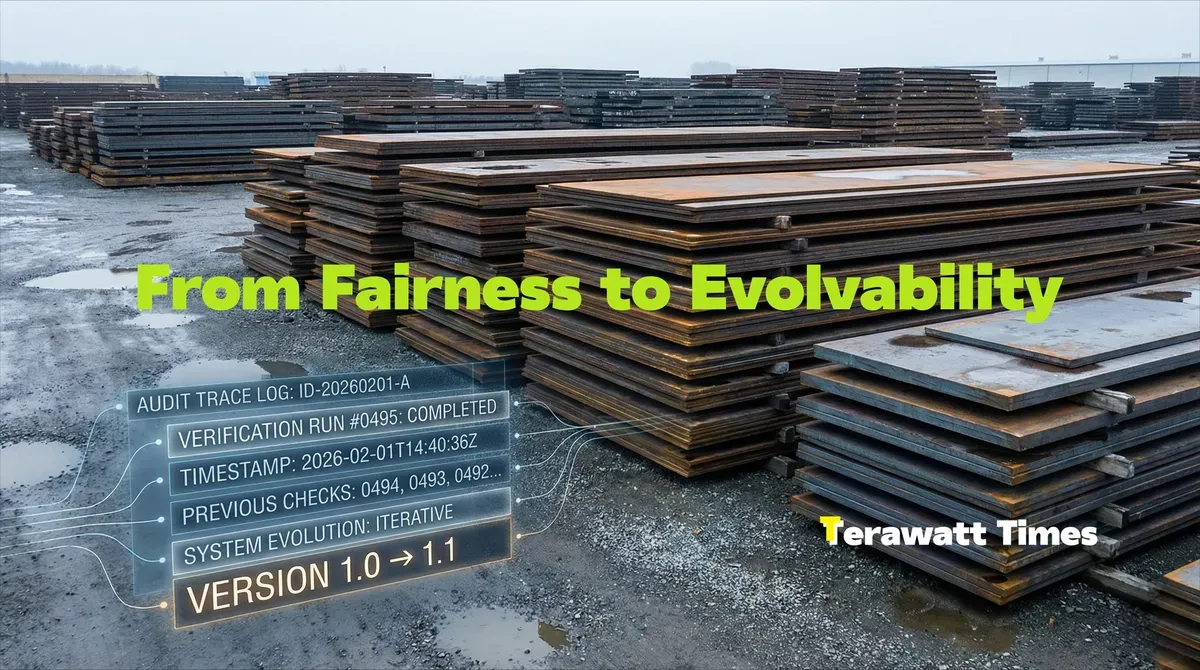
The EU’s CBAM resolves the credibility crisis of climate pledges but creates a new problem: whose measurement rules apply? This paper argues that static fairness is a trap. The true legitimacy of audit-based carbon governance lies in its "evolvability."
Abstract
Audit-based governance mechanisms such as the EU Carbon Border Adjustment Mechanism and the Digital Product Passport resolve the credibility crisis that undermined commitment-based climate policy. They substitute verified measurement for political promise. The resolution creates a new problem that the credibility gain cannot answer on its own. Someone must decide what counts as valid measurement, who may shape the rules, and how compliance costs fall, and those decisions encode the circumstances of whoever makes them. This paper argues that the sustainability of audit-based governance turns on its capacity for institutional evolution. Initial fairness cannot carry the weight, for a structural reason. Every fairness judgment requires a higher-order fairness standard to validate it, and the chain has no natural floor.
Evolvability offers a foundation that the regress of fairness denies. A governance system possesses it when it can revise its standards, expand its participation, and redistribute its burdens through defined processes. The paper develops the concept across three interdependent dimensions. Technical evolvability concerns whether the methodological rules can change. Procedural evolvability concerns whether the channels of participation can widen. Distributive evolvability concerns whether the allocation of cost can shift. The dimensions reinforce one another, and a system strong in one and weak in another fails in characteristic ways that the paper specifies.
Evolvability is necessary for legitimate audit-based governance and not sufficient for it. Without directional safeguards, evolution serves whoever already holds power. The causal path from evolvability to legitimacy runs through iterative trust. Stakeholders who see that their concerns can move future revisions extend cooperation even when present rules disadvantage them. Assessment of current arrangements finds the Carbon Border Adjustment Mechanism and the Digital Product Passport low on all three dimensions. The UNFCCC technology transfer mechanism shows that procedural openness without distributive support produces hollow institutions, and the EU Emissions Trading System's later reforms show that distributive adjustment can be built into a single-center regime. The paper closes with a nested architecture that resolves the meta-regress of evolution through amendment thresholds differentiated by the systemic weight of the rule being changed.
1. Introduction: The Second Problem of Audit-Based Governance
Climate governance has changed its operating principle. For three decades after the 1992 Rio summit, international cooperation ran on voluntary commitment backed by reputation. Nations pledged reductions, reported progress through national communications, and absorbed mild diplomatic cost when targets slipped. This architecture won symbolic victories and missed the trajectories that climate stabilization requires [1]. The gap between pledge and delivery widened across commitment periods, and confidence that voluntary mechanisms could solve the underlying collective-action problem eroded with it.
The European Union's Carbon Border Adjustment Mechanism breaks with that tradition. Rather than request commitments and trust reports, it requires importers to surrender certificates reflecting the verified carbon content of their goods, assessed through standardized monitoring, reporting, and verification [2]. The Digital Product Passport extends the same logic to a wider set of sustainability attributes, requiring products to carry machine-readable records of their environmental characteristics across the lifecycle [3]. Measurement now sits where promises used to be. The two mechanisms convert carbon accounting from a voluntary reporting exercise into a mandatory compliance requirement carrying direct financial consequence.
The shift answers the credibility problem that defeated the earlier approach. When carbon cost attaches automatically to trade flows on the basis of verified data, the incentive structure changes at its root. A firm cannot profit from greenwashing when audited values determine what it pays. A government cannot free-ride on a vague pledge when its exporters meet a concrete price at the border. The verification architecture enforces itself, without relying on diplomatic goodwill.
The credibility gain arrives with a bill attached. Someone must define what counts as valid measurement. Someone must write the methodological rules that auditors apply. Someone must decide how cost distributes across the actors in the trading system. Each decision carries wide discretion, and the actors who make it embed their own circumstances, capabilities, and priorities in the standards that result. When the European Commission specifies the category rules for a carbon footprint calculation, it draws on European industrial practice, European data infrastructure, and European policy priorities [4]. Producers elsewhere then demonstrate compliance against standards built without them. Prior analysis has named this discretion. The architecture exercises evidence-standard power, the unilateral capacity to determine what counts as adequate proof of a contested empirical claim, through control of methodology, accreditation, and infrastructure [5]. The credibility of the mechanism rests on that power. So does its second problem.
The argument of this paper is that audit-based governance survives on its capacity to evolve, and that initial fairness cannot do the work many of its defenders ask of it. Fairness in initial design is a chimera. Every attempt to fix a fair standard raises the further question of whether the process that fixed it was itself fair, and that question regresses without end. Evolvability offers a different footing. A system that can revise its standards, widen its participation, and redistribute its burdens can correct its early imperfections through iteration. The question moves from whether the system began fair to whether it can become fairer, and the second question has answers that institutions can be built to deliver.
The paper develops the argument in five steps. Section 2 sets out the infinite regress of fairness and grounds it in concrete carbon accounting disputes. Section 3 introduces the three-dimensional framework for evolvability, traces the causal path from evolvability to legitimacy, and specifies the safeguards that keep evolution from serving incumbents. Section 4 applies the framework to current arrangements, against comparators that succeeded and failed. Section 5 sets out design principles for evolution infrastructure and the nested architecture that resolves the meta-regress. Section 6 concludes.
Remaining content is for members only.
Please become a free member to unlock this article and more content.
Subscribe NowAuthors

Alex is the founder of the Terawatt Times Institute, developing cognitive-structural frameworks for AI, energy transitions, and societal change. His work examines how emerging technologies reshape political behavior and civilizational stability.

U.S. energy strategist focused on the intersection of clean power, AI grid forecasting, and market economics. Ethan K. Marlow analyzes infrastructure stress points and the race toward 2050 decarbonization scenarios at the Terawatt Times Institute.

Preston studies the policy and social dimensions of the energy transition, focusing on urban electrification, energy equity, and how emerging technologies shape outcomes for middle‑ and working‑class communities.