Productive Autonomy: De-risking and the Restoration of Production Control
Productive Autonomy explains why lower import dependence may not restore control. It identifies four substitution channels and four criteria for judging de-risking, then applies the protocol to European gas, the Japan–Korea materials dispute, RESourceEU, and connected vehicles.

Abstract
De-risking has become the organising word of economic security policy, and the dependence ratio its default metric. A falling import ratio records a change in suppliers. Whether the capacity to operate, maintain and replace a system has returned is a separate question, and this paper answers it with a stated principle: physical capacity is a necessary condition, and productive autonomy resides in the capability to maintain, integrate and control it.
The paper first shows how production control has become legally separable from production location, from software licence keys to connected vehicles, and how artificial intelligence extends that separation into every process that runs on models and inference. It then sets out four channels through which dependence can fall, namely localisation, resourcing, technological substitution and inward investment, each of which leaves a different industrial structure behind. Four criteria judge the result: choice restoration, operational autonomy, absence of equivalent reconcentration, and limited transfer. Crossing channels with criteria yields a four-by-four protocol whose output is a profile.
Applied to Europe's exit from Russian pipeline gas, the protocol records a rapid restoration of choice alongside pressure transferred to other LNG importers and to European industry. Applied to the 2019 Japan-Korea materials dispute, it finds all four channels at work and shows that the channels which moved most differed from the one policy targeted. Prospective applications to the RESourceEU target and the United States connected-vehicle rule complete the paper.
Keywords: de-risking; decoupling; economic security; supply chain diversification; productive autonomy; production control; export controls; energy security; critical raw materials; substitution channels; geoeconomic fragmentation; systemic survival compression
1 Introduction
The European Economic Security Strategy set de-risking inside an open, rules-based economy as its objective [1], and the Union has since given that objective a number. For battery, rare earth and defence-related raw material value chains, the RESourceEU Action Plan expects selected mature projects to reduce dependence on a single country of origin by up to 50 percent by 2029 [2].
The target is clear, measurable and useful, and it counts where inputs come from. A share of imports from one country can fall because a domestic plant came online, because purchases moved to a second foreign supplier, because a different material replaced the original, or because the original supplier built a factory inside the importing economy. All four movements register identically on the metric. They leave very different structures behind and restore very different amounts of capability.
This paper supplies the measurement that sits underneath the dependence ratio. Its governing principle can be stated at the outset:
Physical capacity is a necessary condition; productive autonomy resides in the capability to maintain, integrate, and control it.
Productive autonomy, in this sense, is the ability of a party to keep a production system running, repair it, modify it and replace its components under adverse conditions without the consent of an external controller. The question the paper asks of any de-risking measure follows: which layer of capability did it restore, and through which channel? Policy debate already treats autonomy as a goal of economic security. The contribution here is to decompose it into observable capabilities, maintenance, integration and control, and to read every change in dependence through the channel that produced it.
The analysis uses the concept of systemic survival compression, the degree to which an asymmetric production or control relationship narrows the practical space in which a dependent party can maintain basic functioning, reproduce its own capabilities, obtain realistic alternatives, claim a share of productive output and correct adverse rules through peaceful means. De-risking is a response to compression, and its success is measured by how much of that practical space it restores.
Section 2 sets out when international dependence becomes compressive, and Section 3 analyses the control layer, where production location and production control come apart. Sections 4 and 5 build the assessment protocol of four channels, four criteria and one profile. Sections 6 and 7 apply it to two documented episodes, Section 8 prices decoupling, and Section 9 applies the protocol prospectively to two current instruments. Section 10 concludes.
2 International Industrial Compression
Trade by itself does not produce compression. It lowers prices, enlarges choice, transmits knowledge and permits specialisation, and a highly interdependent relationship can remain stable and mutually beneficial for decades while supply is diversified, contracts are credible, technology is maintainable and domestic recovery capability is preserved.
International compression rises as six conditions accumulate. Critical productive or control capacity sits externally. Local industry, skills and suppliers decline persistently, and replacement costs keep climbing. External supply or access can be changed unilaterally, adjustment costs fall mainly on the dependent state, and international rules offer little practical correction. Each condition corresponds to one variable of compression, respectively concentration, capability reproduction, the cost of substitution, asymmetric control, transfer and peaceful correction.
A thought experiment shows why a dependence ratio cannot separate the cases that matter. Consider two countries importing the same share of a complex system. The first holds inventories, a second qualified supplier, domestic technical competence sufficient to operate and repair the system, and enforceable contractual protection; its measured dependence is high, and its room for action is substantial. The second has lost its engineering workforce, its testing and certification facilities and its maintenance rights, and it can modify the system only with the supplier's cooperation; its measured dependence may be lower, and its practical alternatives are narrower. The import ratio reports one number for both, and the instruments built in the rest of this paper tell them apart.
3 The Control Layer and Its AI-Era Extension
3.1 The Legal Architecture of Production Control
Productive capacity has three layers. Physical capacity covers factories, machinery, energy, materials, logistics and testing. Intelligent and organisational capacity covers design, engineering, software, systems integration, maintenance and quality control. Production-control capacity consists of the rights and technical means to authorise, operate, modify, update, restrict or terminate essential parts of a productive system, and it resides in models, chips, industrial software, cloud accounts, encryption keys, data interfaces, standards, certification and remote maintenance. Different parties in different countries can hold the three layers, and United States export control law now treats the third layer explicitly.
In December 2024 the Bureau of Industry and Security revised the Export Administration Regulations to add a provision on the transfer of access information, under which software keys and software licence keys, meaning keys that let a user operate software or hardware or renew an existing licence to use it, are controlled [3]. A key is classified under the same export control entry as the software or hardware it unlocks, and if a licence requirement is imposed after the initial export, for example because the end user is added to the Entity List, later transfers of the software, the hardware and the associated licence key all become subject to the new requirement [3]. Picture a machine tool that runs only while a licence server keeps answering. The steel sits on the buyer's floor, and the permission sits elsewhere.
The connected-vehicle rule carries the same logic into a mass consumer product. Effective March 2025, it bars the import of vehicle connectivity system hardware designed, developed, manufactured or supplied by parties owned by, controlled by or subject to the jurisdiction of China or Russia. It bars the sale or import of connected vehicles containing covered connectivity or automated-driving software with that nexus. And it bars manufacturers holding such a nexus from selling vehicles that incorporate the covered hardware or software, even where the components have no other link to those countries and even where the vehicle is assembled in the United States [4]. Software prohibitions take effect from model year 2027 and hardware prohibitions from model year 2030 [4]. The third prohibition carries the analytical weight, because it reaches vehicles built domestically.
The two instruments share a structure with three elements: a controlled item, whether software, a key or a component; a continuing permission required for the item to operate, update or be sold; and jurisdiction over the party that issues the permission. When all three are present, control over a product can sit with a party far from the place where the product is made, and it can be exercised long after the sale.
3.2 New Dependencies in the AI Era
Industrial autonomy has usually been assessed through ownership of factories, domestic value added and the location of final assembly. Artificial intelligence adds a layer to that assessment, because dependence can now reside in foundation models, training and inference compute, advanced semiconductors, cloud platforms, industrial software, data access, robot operating systems, technical standards and update permissions. A factory can be physically local while the capacity to operate, maintain or alter it stays external. International Monetary Fund research on technological decoupling estimates its effects separately from those of trade fragmentation for the same reason, since the technology layer moves on its own logic [5].
The consequence is recursive. The capabilities that make substitution feasible are themselves sources of dependence. An economy that replaces external productive capacity by deploying AI and flexible automation acquires, in the process, a dependence on models, advanced chips, industrial software and update permissions. The object of dependence changes while its structure may stay the same, so a measure that exchanges a dependence on capacity for a dependence on a control layer restores choice in the first round and reconcentrates it in the second. The criteria in Section 5 are designed to catch exactly this exchange.
The converse keeps the analysis practical. Resilience does not require national ownership of every technical component. Open standards, interoperable systems, multiple suppliers, domestic integration competence and credible legal commitments can deliver sufficient autonomy at lower cost, and the objective is a workable combination of access, control, substitutability and recovery.
3.3 The Control Layer Extends to Models and Inference
Proprietary model weights and access-controlled inference services can exhibit all three elements of the structure in Section 3.1. The weights or the service are a controlled item; continued access requires a continuing permission, granted through an account, a licence or an API key; and the party issuing that permission sits under a particular jurisdiction. When the same structure is applied to models, the separation of control from production location extends from manufacturing to every process that uses AI.
That extension meets an asymmetric starting position. The incumbent production centre holds strong positions in the physical and organisational layers: in 2024 China accounted for 295,000 of the world's 542,076 industrial robot installations, and its manufacturers outsold foreign suppliers in their own domestic market for the first time [6]. The substituting economies hold stronger positions in the control layer, which is where the export controls of December 2024 apply, covering advanced computing and semiconductor manufacturing items [3]. Their own constraints lie in the physical and organisational layers. Each side is constrained in a different layer and is investing to fill the layer it lacks, and Section 11 states the prediction that follows.
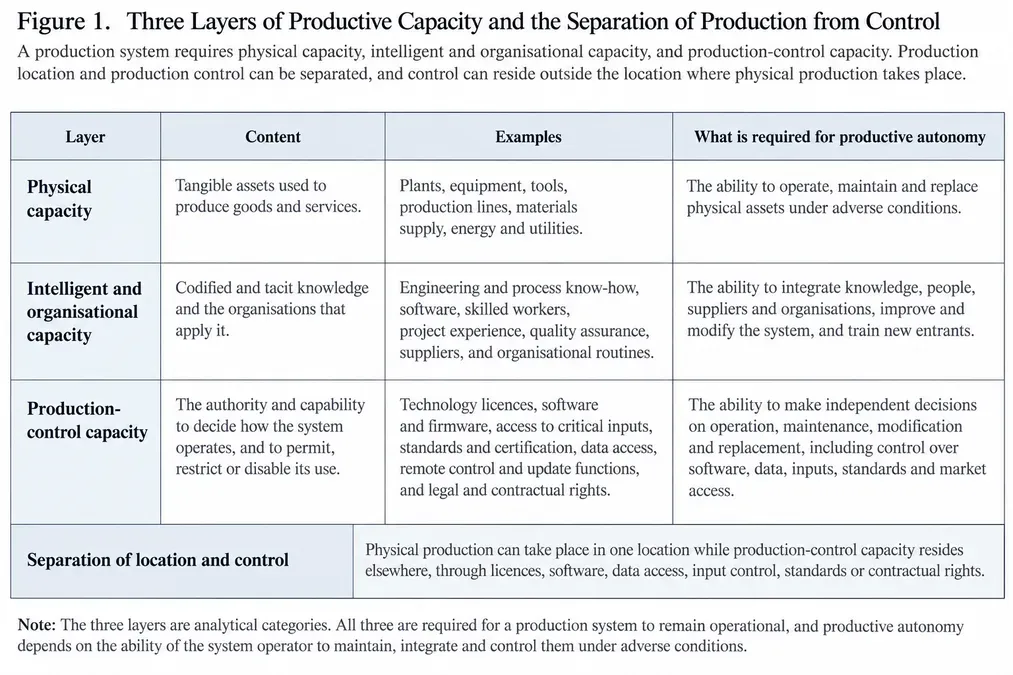
Figure 1. Three Layers of Productive Capacity and the Separation of Production from Control
4 Four Channels of Substitution
Reducing a dependence can proceed through four distinct channels, which differ in cost and speed and in the structure each leaves behind.
Localisation builds the capability domestically. It is the slowest and most expensive channel, because it requires complementary assets to be present in the place doing the building: electricity and grid access, equipment, systems integrators, materials, an existing production base and the skilled trades that install and maintain what is built. Resourcing obtains the same input from a different external supplier. It lowers the buyer's asymmetry of dependence quickly and leaves global concentration where it was; access to the function returns, while the capability to perform it stays with suppliers. Technological substitution replaces the input with a different one and so changes the supply structure itself, which is why its effect on concentration can be the largest of the four. Inward investment by the restricting party places production locally under external ownership, lowering asymmetry at the border while potentially raising concentration over the long run.
Localisation and technological substitution can directly displace incumbent volume. Resourcing mainly reallocates it, and inward investment changes production location while control can stay with the investor.
Which channel is available depends on what was missing. Codified knowledge is capability recorded in drawings, software, manuals and specifications; physical capacity is plant, equipment and infrastructure; control rights are the permissions and technical means described in Section 3; and practised execution is the ability to perform an operation to a required standard and to inspect and adjudicate defects in it, held by the people who do the work and transmitted by doing the work alongside them. The two classifications cross as follows.
Table 1. Substitution Channels by Type of Missing Capability
| Missing element | Localisation | Resourcing | Technological substitution | Inward investment |
|---|---|---|---|---|
| Codified knowledge | Feasible; AI lowers cost where complements exist | Available | Sometimes | Available |
| Physical capacity | Slow and capital-intensive | Available | Rarely | Available |
| Control rights | Requires building the control layer itself | Changes the holder, leaves the structure | Sometimes, through open alternatives | Leaves control with the investor |
| Practised execution | Slowest; requires throughput | Available | Rarely | Transfers the practice with the investor |
Resourcing is available against every category of gap, and it therefore dominates early substitution. A buyer can also reduce its dependence through resourcing while the seller's aggregate volume holds, provided the displaced supply can be redirected to other markets. Measured dependence and trade volume can thus move in opposite directions, with consequences for the producing economy's own utilisation and margins.
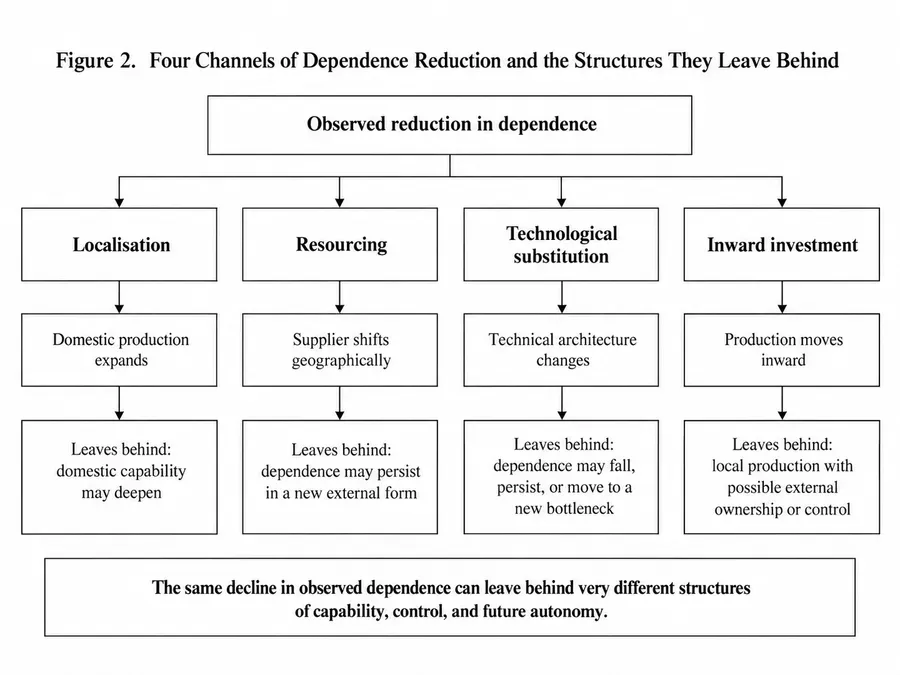
Figure 2. Four Channels of Dependence Reduction and the Structures They Leave Behind
5 Four Criteria and the Four-by-Four Protocol
5.1 Definitions
Decoupling is a state-directed restriction, severance or reorganisation of cross-border production, technology, capital, data or market relationships for reasons of security, power or strategic competition. Its instruments include export controls, investment restrictions, sanctions, procurement exclusions, localisation requirements, limits on technology licensing, alliance-based production and incompatible technical standards. De-risking is the narrower objective of reducing exposure to such relationships while keeping the economy open.
Both can reduce exposure to an external supplier, restore a critical control capability and improve a state's ability to respond to crisis. Both can also raise production and consumption costs, block knowledge diffusion, transfer dependence to an alliance centre, reduce another country's recovery options and impose costs on third parties. Their performance therefore has to be judged by capability, and the volume of cross-border contact is a poor guide to it.
5.2 The Four Criteria
Four criteria apply. Choice restoration asks whether the range of realistic alternatives available to the acting party has expanded, tested against actual time, cost and technical constraints; a list of potential suppliers does not count. Operational autonomy asks whether the acting party can independently run, maintain and repair the replacement system, including its software, updates and integration. No equivalent reconcentration asks whether the former dependence has been replaced by a new one of comparable concentration, whether in another country, an alliance centre or a control layer, and Section 3.2 shows that the means of substitution can themselves fail this test. Limited transfer asks whether adjustment costs have been shifted principally onto vulnerable domestic groups, third countries or future periods.
5.3 The Protocol
The protocol crosses the four channels of Section 4 with the four criteria in three steps. The change in dependence is first decomposed by channel, identifying how much of the reduction came from localisation, resourcing, technological substitution and inward investment; because the effective channel and the targeted channel can differ, this step works from outcomes, whatever the policy's stated aim. Each channel's contribution is then scored against each criterion. Finally, the result is reported as a profile. A measure that satisfies all four criteria reduces compression, and one that satisfies them only in part has reorganised compression in part. Most policies satisfy some criteria and fail others, so the assessment yields a profile in place of a single score or a yes-or-no verdict. A measure that redirects purchases without building integration and maintenance capacity, for instance, scores on the first criterion and fails the second, which describes a change in the identity of the supplier with the structure of dependence intact.
5.4 A Reference Profile by Channel
The definitions in Section 4 imply a typical performance for each channel on each criterion. The table below records that reference profile, which serves as a starting hypothesis; the actual profile of an episode is established from evidence.
Table 2. Reference Productive Autonomy Profile by Substitution Channel
| Channel | Choice restoration | Operational autonomy | No equivalent reconcentration | Limited transfer |
|---|---|---|---|---|
| Localisation | Strong once capacity is commissioned, and slow to arrive | Strong where the complementary assets exist | Strong, since supply moves inside the acting economy | Build-up costs fall on domestic budgets and consumers |
| Resourcing | Strong and fast | Weak, since capability stays with suppliers | Depends on how concentrated the new supplier set is | Can move pressure onto other buyers of the same supply |
| Technological substitution | Strong once the substitute qualifies | Depends on who controls the substitute | Strongest of the four, since the supply structure itself changes | Transition and requalification costs fall on adopters |
| Inward investment | Moderate: local plant, same owner | Strong on local operation, weak on the control layer | Weak, since ownership concentration is unchanged | Low at the border; longer-run effects depend on ownership |
Two regularities stand out. No single channel scores well on all four criteria, so a strong profile almost always involves a combination. And the two fastest channels, resourcing and inward investment, are the two weakest on operational autonomy. The speed a government can buy in the first year is paid for in autonomy unless slower channels follow.
5.5 Coding Rules and Scope
Each criterion is coded from observable items. Every item is phrased so that "present" means the criterion is met, and each is recorded as present, partial or absent together with its evidence. Items marked critical act as vetoes.
- Choice restoration: an alternative source is qualified for use (critical); a stated share of supply can be switched within a tolerable time; the alternatives can cover a stated share of demand; switching requires no approval from the incumbent (critical).
- Operational autonomy: the acting party holds maintenance and repair rights (critical); it can integrate the replacement without outside engineering; it holds, or can replace, software, update and licence authority (critical); spare parts and certification are available from more than one source.
- No equivalent reconcentration: the new supplier set is diversified by country and by owner; the new source has no common owner with the old one (critical); no control-layer dependence has replaced the capacity dependence.
- Limited transfer: adjustment costs are spread across groups, countries and periods, with none bearing them principally (critical); price effects on other buyers of the same supply stay bounded; the fiscal cost of redundancy stays bounded.
A criterion is coded strong when all its critical items and most of its other items are present, partial when the critical items are present and others are missing, and weak when any critical item is absent. The profile reports every item, so each coding can be checked.
The governing principle has a scope condition. It bites where production depends on software, updates, certification or integration controlled by identifiable parties. For standardised commodity inputs with many qualified suppliers, physical access largely settles autonomy, and resourcing alone can restore it. The reverse case also exists: a party can hold all the physical capacity it needs and still lack autonomy, when a single licence server or update channel sits outside its jurisdiction.
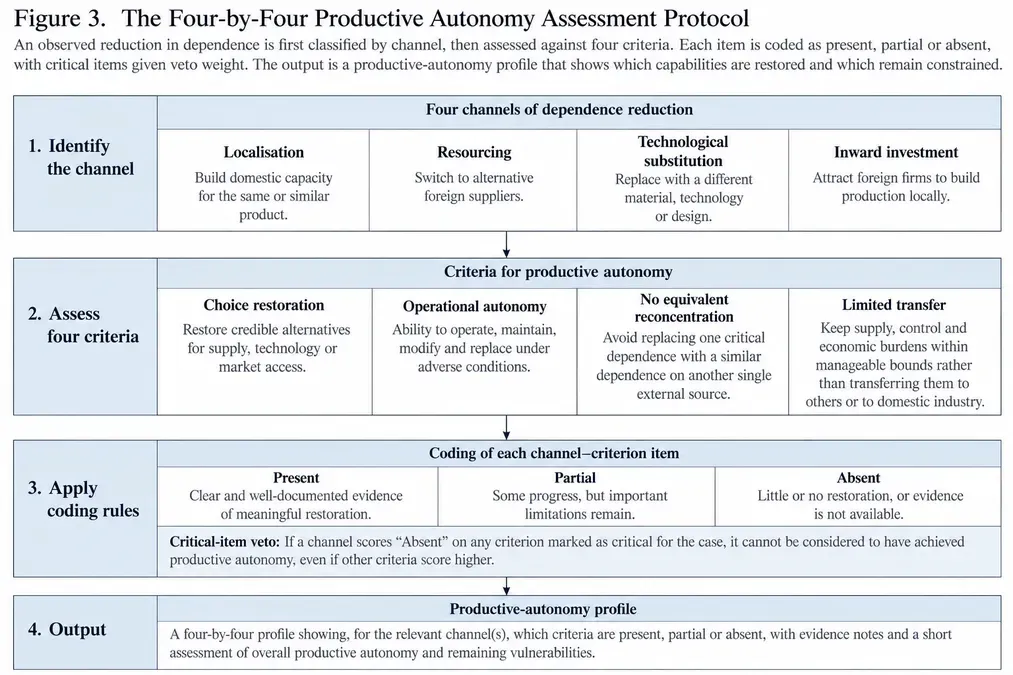
Figure 3. The Four-by-Four Productive Autonomy Assessment Protocol
6 Applying the Protocol I: European Pipeline Gas
6.1 Latent Compression and Its Visibility
A compressive relationship can stay politically quiet for a long time while it delivers low prices, stable supply, accessible credit or concentrated benefits. Latent compression names that condition, in which the relationship narrows realistic alternatives while its costs remain invisible. Capability erosion is gradual and dispersed, and a closed supplier, a discontinued apprenticeship or a lost certification facility attracts little attention until rapid replacement becomes necessary.
A visibility event converts latent dependence into a recognised political issue. Wars, sanctions, export restrictions, financial crises, large employment shocks and critical business closures all perform this role. The process runs from the objective relationship through the visibility event, social perception, political interpretation, collective mobilisation and policy response to eventual change in capability. Social perception can be incomplete or politically shaped, so the underlying productive relationship requires independent measurement. When mobilisation moves while the deeper capability indicators stay unchanged or improve, the mobilisation is tracking something other than the relationship.
6.2 The Episode
Europe's dependence on Russian pipeline gas is the clearest documented case of a latent vulnerability becoming visible, and the importing party's own institutions supply the record. In 2021 the European Union imported more than 150 billion cubic metres of Russian gas, and Russia supplied around 40 percent of its pipeline gas imports [7]. The arrangement rested on pipelines, long-term contracts, and a production and heating system built around continuing delivery.
When Russian pipeline deliveries fell sharply in 2022, European LNG imports grew by 64 billion cubic metres, more than 60 percent above the previous year [8]. The commercial adjustment was rapid. The physical supply of additional LNG was far more limited, since global incremental LNG supply that year totalled only 25 billion cubic metres, and cargoes had to be redirected from other importing markets [8]. By the end of 2022, Asian LNG imports had fallen by nearly 30 billion cubic metres, or 8 percent, and Latin American imports by 9 billion cubic metres, or 38 percent [8].
Policy moved faster than infrastructure. European governments introduced demand-reduction measures, storage requirements, fiscal support, new supply contracts and additional import capacity, while pipelines, terminals, power systems, industrial equipment and building heating systems changed on their own slower clocks. By 2025 imports of Russian gas had fallen to 36 billion cubic metres. Russia's share of EU pipeline imports had dropped to around 6 percent, and its share of total gas imports to around 12 percent [7]. A regulation adopted in January 2026 prohibits LNG and pipeline gas imports from Russia from 18 March 2026, with transition periods for existing contracts, and bans all Russian gas imports by the end of 2027 [7][9].
The adjustment cost shows in industrial energy prices. In 2024 industrial electricity cost about 0.199 euros per kilowatt hour in the European Union, against 0.075 in the United States and 0.082 in China [10].
6.3 Political Response as Recorded Decisions
The political response in this episode can be assessed without attributing motives, because it consists of recorded decisions. Survival politics, as the term is used here, begins where actors show a willingness to accept measurable and previously rejected costs in exchange for greater security, control or substitutability. Four observable forms qualify: acceptance of a significant price premium over an available cheaper source, construction of standby capacity at low expected utilisation, fiscal expenditure on redundancy, and acceptance of lower short-run output in exchange for recovery capability. The European response displays the first three in documented form, through premium-priced LNG, new import capacity and fiscal support.
6.4 The Protocol Profile
Table 3. Productive Autonomy Profile: European Pipeline Gas
| Criterion | Assessment |
|---|---|
| Choice restoration | Strongly met. Realistic alternatives widened within four years, with Russian gas imports falling from more than 150 to 36 billion cubic metres and Russia's share of total imports to around 12 percent [7]. |
| Operational autonomy | Largely met for the infrastructure Europe operates itself, including terminals, storage and networks. The replacement supply is bought on a global market. |
| No equivalent reconcentration | Improved. Dependence on one pipeline supplier gave way to dependence on global LNG markets, import infrastructure and international price competition. |
| Limited transfer | Partly failed. Pressure moved to other importing markets through redirected cargoes, with Asian and Latin American imports falling sharply [8], and to European industry through electricity prices well above those of its competitors [10]. |
Resourcing dominated, supported by rapid construction of import capacity. The episode shows that stable supply and favourable prices delay the political visibility of a dependence, that a crisis changes policy far faster than it changes physical capacity, that replacing one source transfers pressure to other countries, and that diversification reduces compression while creating new forms of dependency. A reduction in one party's compression is therefore no evidence of a reduction in the total.
7 Applying the Protocol II: The 2019 Materials Dispute
7.1 The Objective of State Resilience
The second case turns on what a dependent state needs to rebuild. For states, resilience requires diversified sources of chips, models, equipment, materials and energy; open and interoperable standards; domestic maintenance and integration capability; strategic inventories and emergency production; and the ability to reconstruct critical functions through a new technical paradigm. Full national ownership of every technology would be expensive and often inefficient. The objective is sufficient control to operate, repair, replace and negotiate. A country with multiple suppliers and no ability to integrate them remains vulnerable, while a country with domestic integration competence can use global production and retain strategic choice.
7.2 The Episode
In July 2019 Japan moved three semiconductor and display materials to case-by-case export licensing, and in August it removed Korea from its list of trusted trading partners [11]. The items carried modest export volumes and held deep positions in Korean high-technology production. Japan held 70 to 90 percent of the world market for the three items, and in 2019 Korea imported its fluorinated polyimide entirely from a single Japanese supplier [11].
Within three years the structure had changed, and all four channels of Section 4 appear in the record [11]. Localisation shows in hydrogen fluoride, where domestic production of the high-purity grade roughly doubled and the government reported that reliance on Japanese supply fell by 30 percent. Resourcing shows in photoresist, where dependence on Japan fell from 100 percent to below 50 percent as buyers turned to a supplier in Belgium. Technological substitution shows in fluorinated polyimide, where imports from Japan fell effectively to zero after ultra-thin glass replaced it. Inward investment shows in the Japanese subsidiaries that expanded their investment in Korea or formed joint ventures with Korean firms [11]. Ex-post trade analysis confirms the pattern. The controls sharply reduced Japanese exports of hydrogen fluoride to Korea while exports of photoresist and fluorinated polyimide showed no comparable fall, Japanese hydrogen fluoride exports to the United States rose, and Korean sourcing shifted toward Belgium, the United States and Taiwan [12].
7.3 Two Findings Reconciled
The Korean government answered with a materials, parts and equipment localisation policy. Koo's assessment finds that the policy met very few of the criteria proposed in the new industrial-policy literature: its goals and tools were driven by ideology more than by science, and the implementing ministry, while competent, was politically captured, with the presidential office in the leading role [11]. Koo also shows how much of the reported success rested on Japanese capital. The Belgian photoresist supplier was a subsidiary of the Japanese firm JSR, whose shipments to Korea rose more than tenfold. Domestic hydrogen fluoride producers still depended on joint ventures with Japanese chemical companies. And while Japan's share of Korean imports of materials, parts and equipment fell between 2019 and 2021, their value rose from 32.9 billion to 39.3 billion dollars [11]. Separating the channels reconciles these findings with the fact that substitution occurred. The largest movements came from resourcing and material substitution, localisation contributed most clearly in hydrogen fluoride, and a good part of the resourcing ran to plants owned by the same Japanese firms.
7.4 The Protocol Profile
Table 4. Productive Autonomy Profile: The 2019 Japan–Korea Materials Dispute
| Criterion | Assessment |
|---|---|
| Choice restoration | Met for supply security. Realistic alternatives widened through four channels within three years [11]. |
| Operational autonomy | Improved in hydrogen fluoride, where domestic production doubled, with producers still tied to Japanese joint-venture partners. Resourced photoresist restored access while production capability stayed with the supplier [11]. |
| No equivalent reconcentration | Weak under the coding rules of Section 5.5, since a critical item fails. Technological substitution changed the supply structure for fluorinated polyimide, while the Belgian photoresist source belonged to the same Japanese firm, leaving ownership concentration where it was [11]. |
| Limited transfer | Largely met. Japanese producers redirected hydrogen fluoride toward the United States and Korean buyers sourced from Belgium, the United States and Taiwan, spreading the adjustment across supply routes [12]. |
Any assessment of restored choice must therefore state which channel did the work, and the answer can differ from what the policy intended. The Korean case adds a sharper point: resourcing can move a purchase to another country while leaving it with the same owner. The distinction matters because the channels leave different structures behind, and because only localisation and technological substitution displace the incumbent's volume.
8 Decoupling: Costs and Implications
The International Monetary Fund defines geoeconomic fragmentation as a policy-driven reversal of economic and financial integration guided by strategic considerations, and it explicitly excludes reversal caused by autonomous shifts in preferences or technology [13]. That boundary matches the one used here. Decoupling is a political choice about cross-border production relationships, distinct from an ordinary firm's decision to change suppliers. Firms lobby for, comply with, evade or bear the cost of these policies, and governments set their legal boundaries.
This paper adds a single extension to the Fund's framing, concerning direction. The same instrument can restore one party's choice space or narrow another party's capability reproduction, and the two effects require separate assessment, independent of the instrument's stated purpose.
Fragmentation carries real costs. It interrupts specialisation, scale, investment and knowledge diffusion, and Fund estimates put long-run global output losses between 0.2 percent and nearly 7 percent depending on the depth of fragmentation, reaching 8 to 12 percent for some countries where technology decouples as well [13][14].
These costs price the redundancy being purchased; the four criteria of Section 5 determine which share of that price buys reduced exposure. A decoupling measure that scores well on choice restoration and operational autonomy has bought insurance. One that changes the object of dependence while leaving the structure intact has paid the premium without acquiring the cover.
9 Applying the Protocol Prospectively
The protocol can also be applied to instruments whose outcomes are still unfolding, as two current instruments illustrate.
9.1 The RESourceEU Target
The RESourceEU Action Plan supports projects expected to reduce dependence on a single third country by up to 50 percent by 2029 for the battery, rare earth and defence raw material value chains [2]. The Commission's accompanying factsheet sets out projected dependence on a single third country in 2030, with implemented projects, against 2025 levels [15].
Table 5. RESourceEU Projected Dependence on a Single Third Country, 2025 and 2030
| Value chain stage | 2025 | Projected 2030 |
|---|---|---|
| Rare earth extraction | 95% | 42% |
| Rare earth processing and recycling | 100% | 60% |
| Permanent magnets | 90% | 80% |
| Gallium | 71% | 17% |
| Germanium | 45% | 0% |
| Lithium | 89% | 64% |
| Cobalt | 63% | 44% |
| Graphite | 41% | 25% |
| Manganese | 41% | 30% |
| Tungsten | 31% | 26% |
| Nickel | 29% | 26% |
The plan's instruments map onto all four channels [15]. Strategic Projects to preserve and expand EU production of primary and secondary critical raw materials, backed by a financing hub expected to mobilise close to 3 billion euros over twelve months, are localisation. Fifteen existing Strategic Partnerships with third countries, support for projects abroad and new partnership negotiations are resourcing. Research and innovation support for substitution and measures to raise circularity are technological substitution. Stronger controls and conditions on foreign direct investment govern the fourth channel, inward investment. A Critical Raw Materials Centre, a stockpiling pilot and a mechanism for aggregating demand provide buffers and joint purchasing, protecting against interruption while substitution proceeds.
Read through the protocol, the projections show a clear pattern. The largest reductions are expected upstream, in germanium, gallium and rare earth extraction. The smallest is in permanent magnets, a manufacturing stage governed by physical capacity and practised execution, where dependence falls only from 90 to 80 percent. The dependence metric will register every reduction identically, and the protocol asks which channel produced each. A reduction achieved through partnership projects abroad restores choice and leaves operational autonomy with the supplying partner, whereas one achieved in processing and magnet manufacturing inside the Union raises autonomy at the stage where the projected gain is smallest. Two leading indicators follow directly: the share of each projected reduction attributable to projects sited in the Union as against partnership projects abroad, and commissioned magnet and processing capacity, counted separately from capacity announced.
9.2 The Connected-Vehicle Rule
The connected-vehicle rule acts on the control layer directly [4], and its profile differs from that of a supply-diversification plan. On choice restoration, the rule narrows manufacturers' supplier options in the short run by excluding covered hardware and software, and it restores choice at the control layer only as qualified replacement systems become available. Operational autonomy is the rule's target, and the criterion is met to the extent that replacement connectivity and automated-driving software can be updated, maintained and modified without a covered foreign party. Reconcentration depends on how many qualified suppliers of replacement systems emerge and can be tracked through the supplier base of compliant vehicles. Compliance costs fall on manufacturers and, through prices, on buyers.
The phasing is informative. Software prohibitions take effect from model year 2027 and hardware prohibitions from model year 2030 [4]. The longer lead time for hardware matches the channel logic of Section 4: replacing software is largely a matter of codified knowledge and control rights, while replacing hardware also requires physical capacity and qualified production. The schedule itself acknowledges that substitution capacity has to be built before the restriction can bind without cost.
10 Conclusion
A dependence ratio records where inputs come from. Productive autonomy depends on whether a party can maintain, integrate and control the systems those inputs feed. Physical capacity is the necessary condition, and the control layer, now legally explicit and extending into AI, decides how much that capacity is worth under pressure.
The four-by-four protocol makes the difference measurable by asking of any de-risking measure through which channel dependence fell, and how each channel performed on choice restoration, operational autonomy, reconcentration and transfer. Europe's exit from Russian pipeline gas restored choice quickly through resourcing and new import capacity, and it transferred part of the cost to other LNG buyers and to European industry. Korea's response to the 2019 materials restrictions widened choice through all four channels, and the channels that moved most were resourcing and technological substitution, which the policy never targeted, with part of the resourcing running to plants owned by the same Japanese firms. Both profiles say more than the single number either episode would report on a dependence metric.
The sequencing result carries a consequence beyond the dependent party. Because resourcing comes first and restrictions typically arrive before substitute capacity exists, a buyer's measured dependence can fall while trade volume holds, and the producer's market window begins to narrow before replacement is complete. A de-risking measure designed with that sequence in view builds the slower channels early, localisation where complements exist and technological substitution where the supply structure allows it, so that the choice restored in the first year is followed by autonomy in the years after.
References
[1] European Commission and High Representative of the Union for Foreign Affairs and Security Policy. "Joint Communication on a European Economic Security Strategy." JOIN(2023) 20 final. Brussels, 20 June 2023.
[2] European Commission. RESourceEU Action Plan: Accelerating Our CRM Strategy to Adapt to a New Reality. COM(2025) 945 final. Brussels, 3 December 2025. https://single-market-economy.ec.europa.eu/publications/resourceeu-action-plan-accelerating-our-crm-strategy-adapt-new-reality_en.
[3] U.S. Department of Commerce, Bureau of Industry and Security. Foreign-Produced Direct Product Rule Additions, and Refinements to Controls for Advanced Computing and Semiconductor Manufacturing Items. Interim final rule. 89 Federal Register 96790, 5 December 2024; effective 2 December 2024. Revising 15 C.F.R. § 734.19, "Transfer of access information and export, reexport, and transfer (in-country) of software keys," 89 Federal Register 96812.
[4] U.S. Department of Commerce, Bureau of Industry and Security. Securing the Information and Communications Technology and Services Supply Chain: Connected Vehicles. Final rule. 90 Federal Register 5360–5424, 16 January 2025; effective 17 March 2025. 15 C.F.R. Part 791.
[5] Cerdeiro, Diego A., Johannes Eugster, Dirk Muir, and Shanaka J. Peiris. Sizing Up the Effects of Technological Decoupling. IMF Working Paper No. 2021/069. Washington, DC: International Monetary Fund, 2021.
[6] International Federation of Robotics. World Robotics 2025: Industrial Robots. Frankfurt: IFR, 2025. Press release: "Global Robot Demand in Factories Doubles Over 10 Years," Frankfurt, 25 September 2025. https://ifr.org/news/global-robot-demand-in-factories-doubles-over-10-years/.
[7] Council of the European Union. "Where Does the EU's Gas Come From?" Infographic, with data from European Commission calculations based on LSEG and ENTSOG. Last reviewed 2026. https://www.consilium.europa.eu/en/infographics/eu-gas-supply/.
[8] International Energy Agency. Gas Market Lessons from the 2022–2023 Energy Crisis. Paris: IEA, 2025. https://www.iea.org/reports/gas-market-lessons-from-the-2022-2023-energy-crisis.
[9] Regulation (EU) 2026/261 of the European Parliament and of the Council of 26 January 2026 on phasing out imports of Russian natural gas and improving monitoring of potential energy dependencies. OJ L, 2026/261. https://eur-lex.europa.eu/eli/reg/2026/261/oj/eng.
[10] BusinessEurope. "High Cost of Energy." Data Hub, based on Eurostat data. Brussels, 2025. https://www.businesseurope.eu/media-room/data-hub/high-cost-of-energy/.
[11] Koo, Min Gyo. "Securitizing High-Technology Industries: South Korea–Japan Dispute over Materials–Parts–Equipment Products." Business and Politics 27, no. 4 (2025): 504–520. Published online 11 March 2024. https://doi.org/10.1017/bap.2024.3.
[12] Makioka, Ryo, and Hongyong Zhang. "The Impact of Export Controls on International Trade: Evidence from the Japan–Korea Trade Dispute in the Semiconductor Industry." RIETI Discussion Paper 23-E-017. Tokyo: Research Institute of Economy, Trade and Industry, March 2023. https://www.rieti.go.jp/jp/publications/summary/23030011.html.
[13] Aiyar, Shekhar, Jiaqian Chen, Christian Ebeke, Roberto Garcia-Saltos, Tryggvi Gudmundsson, Anna Ilyina, Alvar Kangur, Tansaya Kunaratskul, Sergio Rodriguez, Michele Ruta, Tatjana Schulze, Gabriel Soderberg, and Juan Pedro Trevino. Geoeconomic Fragmentation and the Future of Multilateralism. IMF Staff Discussion Note 2023/001. Washington, DC: International Monetary Fund, 2023. https://doi.org/10.5089/9798400229046.006.
[14] International Monetary Fund. "Geoeconomic Fragmentation and Foreign Direct Investment." In World Economic Outlook: A Rocky Recovery, chapter 4. Washington, DC: IMF, April 2023.
[15] European Commission. RESourceEU: Accelerating Our CRM Strategy to Adapt to a New Reality. Factsheet. Luxembourg: Publications Office of the European Union, 3 December 2025. https://single-market-economy.ec.europa.eu/document/download/e9ac2181-0dc7-4e61-a964-ba0a39c2aea8_en?filename=ResourceEU_Factsheet.pdf.
Authors

Alex is the founder of the Terawatt Times Institute, developing cognitive-structural frameworks for AI, energy transitions, and societal change. His work examines how emerging technologies reshape political behavior and civilizational stability.

Hiroto Nakamura is a research fellow focused on climate intelligence, satellite-based MRV, and AI-driven environmental monitoring. He analyzes geospatial data and verification systems to improve global carbon transparency and emissions accountability