Systemic Survival Compression: Asymmetric Dependence and the Narrowing of Realistic Choice
Systemic Survival Compression explains why similar forms of dependence can produce sharply different outcomes. It links concentrated production and control to capability erosion, rising recovery costs, output claims, and peaceful correction across two scales.
Abstract
Economic security policy has moved its attention from the price of supply to the survival of capability. Governments now accept measurable losses of efficiency to preserve productive capability, keep realistic alternatives within reach and recover control over strategic systems, yet the patterns behind this shift are usually explained one literature at a time. This article introduces systemic survival compression, defined as the degree to which an asymmetric production or control relationship narrows the practical space in which a dependent party can maintain basic functioning, reproduce its own capabilities, obtain realistic alternatives, claim a share of productive output and correct adverse rules through peaceful institutions.
Concentration, trade dependence, technological leadership and intelligent substitution set the structural conditions. Compression itself rises where concentrated capacity meets asymmetric dependence, where the dependent party's capability reproduction deteriorates, and where claims on output and peaceful correction are weak. The framework specifies five observable dimensions, a causal architecture that runs from structural drivers through transmission and moderation to outcome and feedback, two linked scales of analysis and three classes of capability-security risk. Seven recurring patterns in the global economy, from a latent dependence on pipeline gas to reshoring that leaves control abroad, follow from one set of variables, and each is explained together with its opposite. A minimum application protocol completes the article.
Keywords: systemic survival compression; economic security; economic dependence; de-risking; decoupling; capability reproduction; production control; supply chain resilience; geoeconomic fragmentation; artificial intelligence; industrial policy; shared-output governance
1 Introduction
1.1 From Cost to Capability
For three decades cost organised international production. Firms distributed extraction, manufacturing, engineering, software, logistics and final assembly across countries according to comparative advantage, scale, specialisation, market access and available skills. The resulting networks lowered prices, enlarged output and made it possible to build complex products through long, highly specialised chains. They also gathered particular technologies, manufacturing ecologies, processing facilities and control nodes into the hands of a small number of countries and firms.
The political evaluation of those arrangements has since changed, and the change carries a measurable price. Governments now ask whether essential capabilities can be maintained, replaced or restored under adverse conditions. Current price now sits beside the time needed to establish an alternative, the technical knowledge required to operate an imported system, the location of software and update authority, the resilience of energy and communications infrastructure, and the chance that access could be restricted for strategic reasons.
The European Economic Security Strategy names four categories of risk (supply chain resilience, the physical and cyber security of critical infrastructure, technology security and leakage, and the coercive use of economic dependencies) and sets de-risking inside an open, rules-based economy as its objective [1]. For battery, rare earth and defence-related raw materials, the RESourceEU Action Plan expects selected mature projects to cut dependence on a single country of origin by up to 50 percent by 2029 [2]. In the United States the same logic has reached the technical layers of production. Since December 2024 the Bureau of Industry and Security has treated software keys, which let a user operate software or hardware or renew a licence to use it, as controlled items [3]. The connected-vehicle rule of January 2025 applies to vehicles assembled inside the United States when their connectivity or automated-driving technologies have a defined nexus to China or Russia [4]. Both instruments follow the control architecture of a product, wherever the product is built.
The International Monetary Fund calls the wider process geoeconomic fragmentation, a policy-driven reversal of economic and financial integration guided by strategic considerations, and traces its consequences through trade, investment, capital flows, migration, technology diffusion and global public goods [5]. Fund research also finds foreign direct investment increasingly redirected along geopolitical lines [6]. These developments raise a question that production shares, import ratios and concentration indices cannot settle on their own:
Why are governments increasingly willing to sacrifice part of their current efficiency in order to preserve productive capability, secure realistic alternatives, and recover control over strategic systems?
Security competition and domestic coalitions explain much about which policies are adopted. The harder questions concern timing and form. Some concentrated relationships stay acceptable for decades while others become intolerable within months. Some vulnerabilities yield to inventories, while others push governments to rebuild whole systems of technology, equipment, skills and control. And a measure that reduces one party's dependence can close the market another party relied on. Each question concerns the relationship between parties, which is where this article places its central variable.
1.2 Six Relational Paradoxes and One Macroeconomic Feedback Puzzle
Explanations for these patterns exist in abundance, scattered across separate literatures, and cases in which similar surface conditions produce opposite outcomes tend to be filed as exceptions. Seven such patterns recur. Six concern relationships between parties; the seventh operates inside a single economy.
Table 1. Seven Patterns, One Set of Variables
| Observed paradox | What conventional indicators see | Which variables decide the outcome |
|---|---|---|
| High import dependence persists safely; a smaller dependence triggers crisis | The same dependence ratio | Substitution, maintenance and recovery capability; whether the imported component controls the system |
| Reshoring completes; autonomy does not follow | Rising domestic value added and local assembly | Whether all three layers of capacity returned, or only the physical layer |
| Heavy automation with expanded freedom; light automation with acute insecurity | The same exposure rate | New-task formation, personal capability rebuilding, output claims, institutional adjustment |
| An industry is strong now and losing future capability | Output, orders, market share, labour productivity | Capability reproduction: suppliers, apprenticeship, engineering succession, certification, new entry |
| Low prices and reliable supply coexist with strategic exposure | Price, contract stability, delivery performance | Latent erosion of alternatives; the timing of a visibility event |
| Decoupling restores autonomy in one case and relocates dependence in another | Reduced volume of cross-border contact | Whether maintenance, integration and replacement capability improved, and where costs landed |
| Macroeconomic feedback: productive capability rises while profit, household gains and fiscal foundations fall | Capacity, technology, output | Growth of output claims relative to growth of effective capacity |
Two features of the table matter more than any single row. The same small set of variables recurs throughout it, namely concentration of capability or control, asymmetry of dependence, capability reproduction, realistic substitution, output claims and peaceful correction. And every row explains an outcome together with its opposite. That second property is the standard this article sets for itself. A framework that explains only adverse results is a label; one that identifies the variable producing divergence under similar surface conditions is a theory.
The seventh row stands apart by design. The first six describe relationships between two parties and form the relational core of the framework, while the seventh describes the internal state of one economy. It belongs in the same framework because compression between parties feeds back into market realisation, the conversion of productive capacity into revenue through buyers who hold valid claims on its output. An economy whose domestic claims fall short turns to external absorption. Its partners then experience rising compression, and their responses close the market it turned to. Section 10 gives this loop its empirical anchor.
1.3 Contribution
The principal contribution is the concept of systemic survival compression itself: a relational state distinct from concentration, dependence and technological exposure, with specified boundaries, whose variables account for all seven patterns in the table together with their opposites. Its irreducibility rests on three increments, set out in Section 9.
Sections 2 to 9 build the concept and place it among existing theories, Section 10 resolves the seven patterns with the same variables, Section 11 sets out an application protocol, and Section 12 concludes.
2 Definition
This article defines systemic survival compression as:
the degree to which an asymmetric production or control relationship narrows the practical space available to a dependent party to maintain basic survival, reproduce its capabilities, obtain realistic alternatives, claim a share of productive output, and alter governing rules through peaceful means.
Compression refers to a narrowing of feasible options, and the word feasible carries most of the weight. An alternative counts only if the dependent party can reach it within the time, cost, technical and legal constraints it actually faces. A supply source listed in a contingency plan offers little if reaching it takes ten years of construction during an immediate crisis, and a training entitlement offers little mobility to a worker with no income while retraining. Picture an emergency exit drawn on a building's floor plan and bricked shut in the building itself. On paper there are two ways out. In a fire there is one. The distinction between nominal and realistic substitution is therefore built into the concept, and every assessment under this framework tests alternatives against real constraints.
Intent plays no part in the definition. A firm may simply be pursuing efficiency, a state developing an industry, an owner of capital installing better machines. Where the resulting relationship persistently narrows the dependent party's capability, choices, claims and room for correction, compression is high whatever anyone wanted; hostility combined with ample substitution and effective correction yields low compression. The analysis rests on observable actions and measurable consequences, with one evidentiary standard for every actor.
Survival is specified at two scales. For an individual it includes access to basic goods and services, stable or replaceable income, social participation, occupational identity, opportunities for development and political agency. For a state or industrial system it includes essential production, continuity of supply, technical learning, employment and fiscal foundations, policy autonomy and the capacity to respond to crisis. Both lists describe the minimum an actor requires in order to keep acting. Sen's capability approach evaluates development through the substantive freedoms people can actually exercise [7]. The concern here is analogous and narrower, confined to the relationships through which production is organised and controlled.
3 Where Capability and Control Reside
Productive capacity has three layers, and each can be held separately. Physical productive capacity covers factories, machinery, electricity, materials, logistics, construction, testing facilities and the ability to deliver at the required scale and quality. Intelligent and organisational capacity covers design, process engineering, software development, simulation, production management, systems integration, maintenance, quality control, exception handling and supply chain coordination. Production-control capacity consists of the rights and technical means to authorise, operate, modify, update, restrict or terminate essential parts of a productive system. It resides in models, advanced chips, industrial software, cloud accounts, encryption keys, data interfaces, technical standards, certification, remote maintenance and platform rules.
Different firms and different countries can hold the three layers. One country may own factories, employ local labour and host part of a supplier network while relying on external design software, cloud infrastructure, chips, robot operating systems or permission to update its equipment. Another may control software, standards and system architecture while outsourcing most physical production. Owning a house and holding its keys are separate facts, and whoever can change the locks has a say in how the house is used.
Production location and control location are therefore independent variables, and the law already registers the difference. The United States connected-vehicle rule bars manufacturers owned by, controlled by or subject to the jurisdiction of China or Russia from selling vehicles that incorporate covered connectivity hardware or automated-driving software. The bar applies even where those components have no other link to either country and even where the vehicle is assembled in the United States, with software prohibitions taking effect from model year 2027 and hardware prohibitions from model year 2030 [4]. A vehicle can roll off a domestic assembly line and remain, in the regulator's view, inside a foreign control relationship.
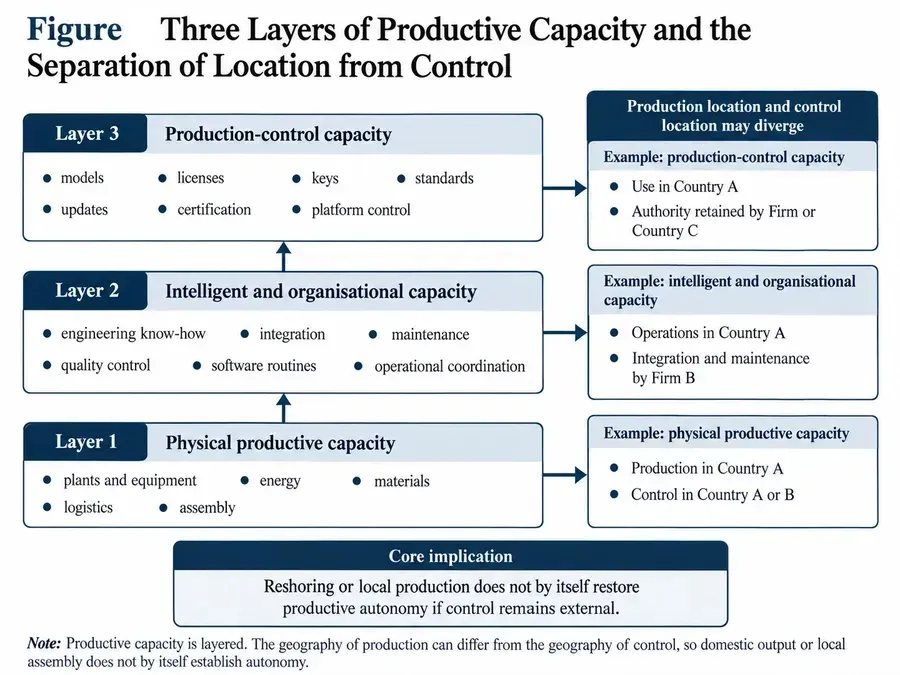
Figure 1. Three Layers of Productive Capacity and Control
Reshoring and local assembly can strengthen employment and some forms of capability, while productive autonomy rests on the ability to maintain, redesign, substitute suppliers, reach software and documentation, integrate systems and recover within a tolerable time.
4 Five Observable Dimensions
Compression acts on five dimensions of practical choice, each observable on its own terms.
Basic survival space concerns whether individuals can obtain food, housing, health care, energy, income and public services, and whether states can maintain essential supplies, infrastructure, administration and fiscal capacity. It contracts when access to these becomes conditional on a relationship the dependent party can neither realistically leave nor influence.
Capability-reproduction space concerns the process through which productive, occupational, technical and institutional abilities are maintained over time. For a worker it includes education, practice, access to entry-level tasks, occupational progression and chances to use existing skills. For an industry it includes investment, equipment renewal, supplier continuity, apprenticeship, engineering experience, research, testing, certification and the entry of new firms. An orchestra can play superbly tonight and still be in decline if it has stopped training the players who will fill its chairs in ten years. Capability reproduction measures that second condition.
Substitution, exit and recovery space holds three distinct questions. Substitution asks whether an income source, supplier, platform, technology or production route can be replaced. Exit asks whether the actor can leave the original relationship without losing basic functioning, and recovery asks whether lost capability can be rebuilt afterwards. The answers can diverge. A country may stop importing a product while remaining unable to reproduce its function, and a worker may leave an employer with no viable route into another occupation.
Claim on productive output concerns the institutionally recognised routes through which a share of current production reaches those who depend on the system. For a person or household the routes are wages, self-employment income, profits, ownership returns, pensions, public services, social insurance, cash transfers and social dividends, together with time, where productivity gains turn into shorter hours or paid leave. For a state the corresponding concept is the retained and socially effective output claim. It has four layers: domestic value creation, meaning value added arising within the economy; domestic fiscal capture, the share of that value the public sector obtains; domestic reinvestment, the share retained and committed to future capacity; and household and public claims, the share that reaches residents and public provision as purchasing power.
Only the first layer is measured on an internationally comparable basis. The OECD's Trade in Value Added database estimates the domestic value added content of gross exports from its Inter-Country Input-Output tables, and its origin-of-value-added indicators decompose gross exports by source country and industry, so the measure can be taken for a specific bilateral relationship [8]. That indicator shows where value arises. The other three layers require national tax, investment and household data, and a full assessment of a state's output claim is currently made case by case. A country that hosts factories and retains little at layers two to four occupies a physical position in production without an effective claim on what it produces.
Peaceful correction space measures whether adverse relationships can be altered through law, negotiation, collective bargaining, elections, regulation, public participation, industrial policy or international dispute settlement. A relationship can stay unequal for a long time at modest compression while credible correction remains available.
Table 2. Five Dimensions of SSC and Their Observable Indicators
| SSC dimension | Core question | Representative observables |
|---|---|---|
| Basic survival | Can basic functioning continue? | essential supply, income continuity, fiscal capacity |
| Capability reproduction | Can capability reproduce itself? | investment, suppliers, apprenticeships, certification |
| Substitution / exit / recovery | Is an alternative realistically reachable? | time, cost, qualification, recovery duration |
| Claim on output | How much output is effectively retained/shared? | wages, fiscal capture, reinvestment, household claims |
| Peaceful correction | Can adverse rules be changed institutionally? | bargaining, appeal, regulation, dispute settlement |
The five dimensions can move independently, so compression may be severe on one while another holds. What separates compression from ordinary inadequacy of income or provision is persistence combined with reach: the contraction touches capability reproduction or realistic choice, and it continues. A low income with a working route out of it is a different relational state from the same income with no such route.
Three of the dimensions also reappear as causes. Substitution capability, output claims and correction capacity are compressed by a relationship, and they also govern how far compression proceeds in the other dimensions, which makes compression cumulative: a worker whose claims have narrowed absorbs the next shock less easily, and a state that has lost its engineering base finds the next substitution dearer than the last.
5 Causal Architecture
The five dimensions describe outcomes. Explaining why they contract requires variables at several distinct analytical levels.
Two structural drivers come first. Productive or control capacity becomes concentrated, so that a large share of a capability sits with a few firms or countries, and dependence becomes asymmetric, so that one party values the relationship more highly or holds fewer alternatives. The second condition is the relational core of Emerson's account of power as rooted in the value of a relationship and the scarcity of alternatives [9]. Trade theory, the economics of scale and industrial organisation already explain how both conditions form, and the framework takes them as given in order to ask when they convert into compression. Together they establish the possibility of compression and nothing further.
Transmission turns a structural position into a trajectory. The dependent party's capability reproduction erodes, and the time and cost required for substitution and recovery rise.
Moderation governs how far the trajectory runs, through the breadth of output claims and the effectiveness of peaceful correction. At the individual scale the mechanism is direct. A worker with income from other sources loses less by leaving a relationship, and one who can change its terms may have no need to leave at all. At the state scale it runs through fiscal and political capacity. A state that retains much of the value a dependent relationship generates, across the four layers set out in Section 4, can fund the substitution the relationship makes necessary. A state whose institutions can revise the terms of participation can renegotiate a relationship it would otherwise have to accept or sever. Where claims are narrow and correction weak, compression deepens under conditions that look mild by conventional measures.
The outcome is a contraction of realistic choice across the five dimensions, and feedback carries that outcome back into the relationship through market realisation and political response.
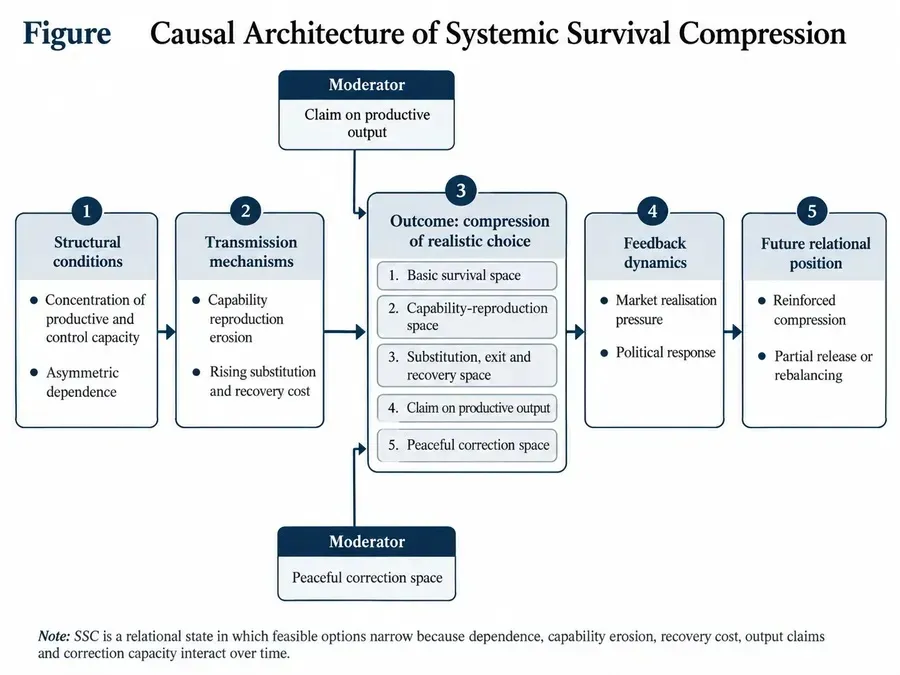
Figure 2. The causal architecture of systemic survival compression
Two countries can occupy the same structural position, with the same dependence ratio, and still diverge sharply because transmission and moderation differ between them. Every divergence recorded in the table of Section 1.2 has this source.
6 Two Scales and Their Linkage
The mechanism operates at two scales. Internationally, control over production, technology, infrastructure or market access can reduce the ability of other states to maintain, replace or restore critical capabilities. Domestically, intelligent substitution can narrow citizens' income, occupational development, social participation and influence over the rules that govern technological change. Intelligent substitution is the process through which AI systems, software platforms, robots and automated equipment replace, compress or recombine tasks previously performed by people, whether those tasks are cognitive, communicative, coordinative, decision-making or physical.
Both scales can display the same sequence, in which productive control concentrates, dependence becomes asymmetric, independent capability weakens, substitution grows costly, output claims stay inadequate and correction loses effectiveness. The institutional positions differ, and the difference bears directly on policy. States hold taxation, regulation, industrial policy, public finance, strategic reserves and diplomacy. Individuals rely on labour law, social insurance, collective organisation, savings, family resources, political rights and public services. A state can build an inventory or subsidise a domestic supplier, whereas a worker facing the loss of an occupation depends on collective institutions able to pool risk and finance adjustment.
The two scales connect in four ways. They reinforce each other. Weak household claims constrain domestic demand and push firms toward exports; trading partners experiencing industrial erosion answer with subsidies, local-content rules, tariffs, technology controls and diversification; external markets grow less secure; and producers respond with further automation and cost reduction, which presses again on domestic labour income. Analysts of global imbalances have described the same pairing, in which suppressed domestic claims and external surpluses turn out to be two aspects of one distributional arrangement [10].
The scales can also stand in for each other. Closing excess capacity eases trade conflict abroad while raising unemployment and local fiscal stress at home; higher wages strengthen domestic demand while altering short-term costs; reshoring improves national control while raising consumer prices. Pressure can be transferred as well, onto workers, consumers, migrants, weaker trading partners, peripheral regions, public budgets, the environment and future generations.
The fourth connection is the most revealing. One technical change can act in opposite directions at the two ends of a relationship. A fall in the cost of substitution and rebuilding lowers the dependent party's compression and, at the same moment, narrows the production centre's market window. A development that relieves one end while tightening the other shows plainly that compression belongs to relationships and to no single actor.
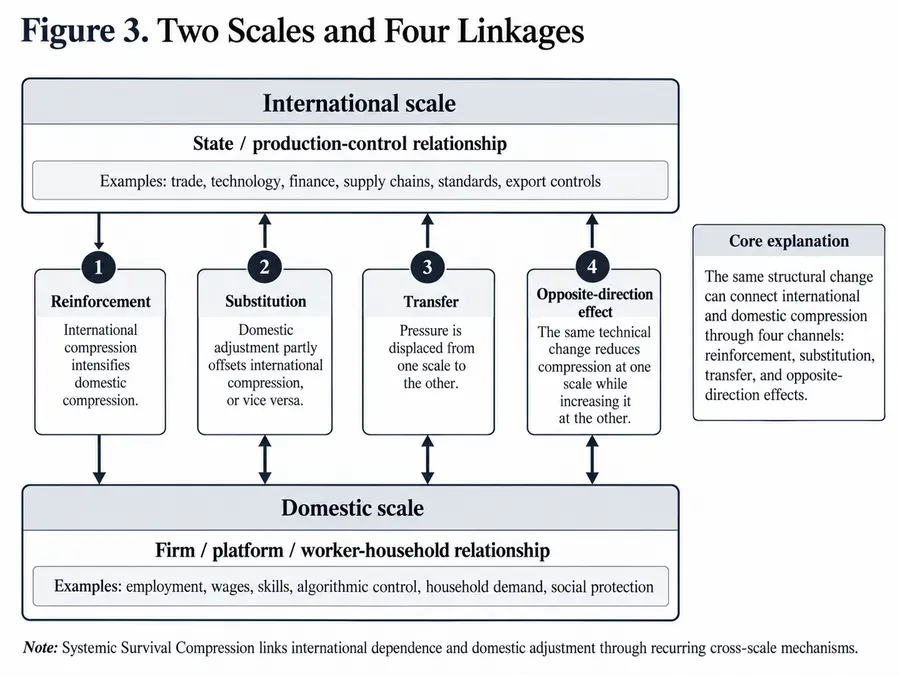
Figure 3. Two Scales and Four Linkages
Artificial intelligence speeds up the search for suppliers, the learning of technologies and political organisation, while factories, grids, skills and institutions are built at their established pace, and the gap between fast response and slow physical substitution is itself a source of conflict.
7 Conceptual Boundaries
Seven neighbouring ideas need precise placement.
Strength describes an actor. Technological leadership, scale and market share measure a party's capability, and compression describes the relationship in which that capability sits. Concentration can coexist with low compression wherever substitutes exist, supply is assured, benefits are reciprocal, constraints are credible and disputes are correctable. Competition moves prices, profits and rankings all the time; compression begins where the space for the next round of investment, learning and entry closes.
Intelligent substitution lowers compression when productivity gains are shared, public services expand, hours shorten, new tasks appear and individual capability strengthens, and under those conditions substitution and compression move in opposite directions. Dependence that is reciprocal, substitutable, rule-bound and correctable can last for decades at low compression. Accidents, natural disasters and scarcity are hazards. They enter the analysis where an asymmetric control relationship amplifies them or shifts their cost in one direction.
Geographic dispersion of production and dispersion of control are separate measurements, as Section 3 showed, and so are market share and capability, since an industry can hold its share while its suppliers, apprentices and engineers disappear.
8 Three Classes of Capability-Security Risk
Governments duplicate capability for several reasons, and inference goes astray when the reasons are merged. Three classes of risk require separation, because each calls for its own remedies.
Relational coercion risk arises from control capacity inside a dependence and from its observable unilateral use: supply cut-offs, revoked access, export restrictions, terminated income channels and unilateral changes to technical rules. Credible constraint, dispute settlement, counter-capability, alternative sources and autonomous capability answer it.
Operational interruption risk arises from accidents, natural disaster, epidemic, logistics failure and ordinary commercial breakdown. Its source may carry no controlling intent at all, and the practical case for inventories and diversification remains substantial.
Capability-carrier destruction risk arises when the physical or organisational carriers of a capability disappear: a unique supplier is liquidated, an engineering team disperses, a specialised laboratory closes for good. The only remedy is to reproduce the capability somewhere it will survive, and inventory offers no protection, because what is at stake is the existence of the capability itself.
The same instrument can address any of the three classes, or serve proximity to market, subsidy capture or logistics cost, so the existence of a reshoring programme leaves open which risk motivated it.
9 Relation to Existing Accounts
Existing theories explain the individual links of the mechanism. Systemic survival compression explains how those links combine into a deeper relational state, and why identical concentration, dependence and technological shocks generate different results. The adjacent literatures can be placed link by link.
Classical trade theory and product-cycle analysis explain why production moves toward locations with lower relative costs or stronger specialisation, and why mature production leaves its original centre of innovation [11]. The framework adds the question of whether a lost share also removes future recovery capability. Task-based models of automation explain how technology changes the demand for occupations, skills and work activities, and they identify which workers are exposed [12]. Compression asks why similar exposure produces very different outcomes under different systems of capability reconstruction, output distribution and correction.
Securitisation theory and coalition analysis explain how dependencies become politicised and which interests support protective policy [13]. Here the framework concentrates on the productive relationship that makes politicisation plausible, and on why some dependencies stay latent until a disruption reveals alternatives already lost. Dependency theory organises unequal economic relations around the structural positions of core and peripheral economies [14], and it shares the framework's attention to asymmetric position. Compression treats the direction of strength as variable, since a historically dominant economy can lose capability in one industry and a producer winning on every competitive metric can be compressed on a single dimension.
The literature on power, dependence and networks supplies the link between control and dependence. Hirschman showed how asymmetric trade dependence generates political influence at the expense of a partner's security [15], and Emerson located power in the value of a relationship and the scarcity of alternatives [9]. Hirschman's later pairing of exit and voice as the two general responses of a dissatisfied party [16] maps onto the substitution and correction dimensions of this framework. Farrell and Newman showed how jurisdiction over central network nodes generates information and chokepoint advantages [17]. To these the framework adds a temporal claim: even a control node that is never used coercively can, if held outside long enough, leave the dependent party unable to maintain, upgrade, replace or redirect its own production.
Pisano and Shih showed that losing manufacturing can carry away the shared operational capabilities on which later innovation depends [18]. Their argument anchors the capability-reproduction link, which the framework generalises beyond manufacturing and connects to substitution, output claims and correction. Galtung drew attention to social arrangements that restrict the realisation of human potential without any single act of direct violence [19], a concern that compression shares and narrows to productive and control relationships observed through five dimensions.
Ruggie's account of embedded liberalism supplies the historical form of the moderating link. The postwar international economic order stayed politically viable because external openness was embedded within domestic institutions capable of supporting social stability and adjustment [20]. In the vocabulary of this article that settlement was a historical configuration of output claims and peaceful correction, and it allowed openness to coexist with tolerable compression.
The concept's irreducibility rests on three increments that none of these accounts supplies on its own. The first is temporal. Accounts of dependence and power describe a relationship at a point in time, while capability reproduction describes how today's dependence alters tomorrow's feasible options, so a relationship with stable prices and volumes can still be narrowing the future. The second is dimensional. Compression is observed on five separate dimensions, so one party can be strong on one and compressed on another at the same moment, which a single balance of power cannot represent. The third is scalar. The same sequence of concentration, erosion, weak claims and weak correction runs between states and inside them, so a shock at one scale can be absorbed, displaced or amplified at the other.
10 The Seven Patterns Resolved
Section 1.2 set a test: each pattern must be explained together with its opposite, using the variables of Sections 4 and 5. The seven cases below provide the empirical anchors, and each is brief by design.
The first pattern is a small dependence that triggers a crisis. In July 2019 Japan moved three semiconductor and display materials to case-by-case export licensing, and in August it removed Korea from its list of trusted trading partners [21]. The items carried modest export volumes and held deep positions in Korean high-technology production. Japan held 70 to 90 percent of the world market for the three items, and in 2019 Korea imported its fluorinated polyimide entirely from a single Japanese supplier [21]. A dependence that looked minor in trade statistics prompted a national localisation programme. Two variables decided the outcome: the controlling position of the imported inputs within the production system, and the thinness of domestic substitution capability. The same variables explain the opposite case, where inventories, a second qualified supplier and domestic repair competence let a much larger dependence be carried safely for years.
In the second pattern, reshoring completes while control stays abroad. The connected-vehicle rule examined in Section 3 treats a vehicle assembled on a domestic line as part of a foreign control relationship when its connectivity or automated-driving software carries a defined foreign nexus [4]. Rising local value added measures the physical layer. Autonomy depends on whether the intelligent and control layers came back as well.
The third pattern pairs similar exposure with divergent social outcomes. Two national datasets, covering overlapping periods and similar occupations, reach different results on the early labour-market effects of generative AI. United States payroll data show a notable relative decline in employment for early-career workers in the most AI-exposed occupations after the wide rollout of generative AI [22]. Danish administrative data, linking adoption surveys to employment records across eleven exposed occupations, estimate precise null effects on earnings and recorded hours and rule out effects larger than 2 percent two years on [23]. Exposure and effect are separate quantities, and the institutions standing between them vary enormously: effective social protection coverage reaches 85.9 percent of the population in high-income countries and 9.7 percent in low-income countries [24]. New-task formation, the speed of personal capability rebuilding, the breadth of output claims and the pace of institutional adjustment decide the social outcome of automation.
The fourth pattern is an industry that is strong today and losing future capability. Korean shipbuilding took 21 percent of global new orders in 2025 [25], measured in compensated gross tonnage, a unit designed to approximate construction workload [26]. By competitive measures the industry performs well, specialising in technically complex vessels and carrying a large order book [25]. Its capability reproduction is under sustained pressure all the same. Korean industrial research identifies skill transmission as a central constraint [27]; the age group declining fastest over eight years is men aged 28 to 35, workers aged 60 and over now outnumber those under 27, apprenticeship under a foreman has become rare, and relative wages have stagnated [27][28]. Output, orders and market share describe the present. Suppliers, apprenticeship, engineering succession and new entry describe the future.
Low prices and stable supply conceal exposure in the fifth pattern. In 2021 the European Union imported more than 150 billion cubic metres of Russian gas, and Russia supplied around 40 percent of its pipeline gas imports [29]. Low prices and reliable delivery kept the dependence politically quiet. The sharp fall in Russian pipeline deliveries in 2022 [30] acted as a visibility event, a disruption that converts a latent dependence into a recognised political issue. By 2025 imports of Russian gas had fallen to 36 billion cubic metres, and Russia's share of total EU gas imports to around 12 percent [29]. The latent erosion of alternatives and the timing of the visibility event decide this pattern.
The sixth pattern, decoupling that restores choice in one case and relocates dependence in another, emerges when the two preceding cases are read against each other. In the materials dispute, choice widened through several channels at once. Domestic production of high-purity hydrogen fluoride roughly doubled, dependence on Japan for photoresist fell from 100 percent to below 50 percent as buyers turned to a supplier in Belgium, and imports of fluorinated polyimide from Japan fell effectively to zero after ultra-thin glass replaced it [21]. Part of that choice was nominal. The Belgian supplier was a subsidiary of the Japanese firm JSR, domestic hydrogen fluoride producers still depended on joint ventures with Japanese chemical companies, and Japanese subsidiaries expanded their investment in Korea [21]. In gas, European LNG imports grew by 64 billion cubic metres in 2022, more than 60 percent above the previous year, while global incremental LNG supply that year totalled only 25 billion cubic metres, so cargoes had to be redirected from other importing markets [30]. Dependence on one supplier gave way to dependence on global LNG markets, and part of the pressure moved to other buyers. Whether maintenance, integration and replacement capability improved, and where the costs landed, separates the two outcomes.
The seventh pattern is productive capability rising while realisation weakens. In China, manufacturing capacity utilisation fell from 75.2 percent in the fourth quarter of 2025 to 73.9 percent in the first quarter of 2026 and 73.5 percent in the second, while industrial value added grew by 5.4 percent over the first half of 2026 [31]. In an ordinary cyclical downturn output and utilisation generally move together. Here they move apart, the first observable sign of a gap between effective capacity and the claims available to absorb it. A stronger reading requires the pattern to persist, and compositional, statistical, inventory-cycle and price explanations to be excluded.
Across the seven cases the same variables carry the explanation, and each pattern's opposite follows from a different value of the same variable. The test unit of the framework is exactly this: a row of the paradox table, explained in both directions.
11 Minimum Application Protocol
The framework applies to any relationship through nine steps. Each assessment is a profile across the five dimensions, reported separately, because the dimensions move independently and a weighted total would hide the divergence the framework explains.
- Define the relationship and the scale. Identify the actor controlling the relevant capability and the actor depending on it, and specify whether the unit of analysis is an individual, firm, industry, region or state.
- Separate the three layers of productive capacity. Examine physical, intelligent and organisational, and production-control capacity independently. Counts of factories and output cover the first layer only.
- Identify the type of risk. Determine whether the primary risk arises from relational coercion, operational interruption, capability-carrier destruction or ordinary commercial competition. Similar policies address different risks, so the existence of redundancy or reshoring leaves the cause to be established.
- Demonstrate changes in capability reproduction. Use evidence on investment against depreciation, supplier entry and exit, intergenerational transmission of skills, engineering and integration capacity, certification, continuity of throughput and expected recovery time. Single-year profit, price, market share and import figures describe current conditions and are inadmissible as evidence of erosion, since reproduction can weaken while position holds.
- Locate the gap. Identify whether the missing element is codified knowledge (recorded in drawings, software and manuals), physical capacity, control rights, or practised execution (the ability to perform and inspect an operation to standard, held by people who do the work). Establish also whether the complementary assets for rebuilding are present: electricity and grid access, equipment, systems integrators, materials, an industrial base and the skilled trades. Artificial intelligence lowers recovery costs most where the gap is codified knowledge and those complements are present.
- Assess the space for self-repair. Evaluate realistic substitution, exit and recovery, claims on output and their conversion into expenditure, and peaceful correction, testing each alternative against actual time, cost, technical and institutional constraints.
- Separate the objective relationship from political visibility. Reconstruct the sequence: objective relationship, visibility event, social perception, political mobilisation, policy response, subsequent capability change.
- Assess any response against four criteria. Ask whether realistic alternatives widened, whether the acting party can run and repair the replacement system itself, whether the old dependence was replaced by a comparably concentrated new one, and whether adjustment costs were shifted onto vulnerable groups, third countries or future periods. Report the result as a profile, and identify which channel produced any substitution: localisation, resourcing from another supplier, technological substitution or inward investment. The effective channel and the targeted channel can differ.
- Separate findings from inferences. Keep observed findings, theoretical inferences and forward assessments distinct, and give each forward assessment its conditions and direction.
12 Conclusion
Systemic survival compression names a relational state that economic security policy has been circling. Governments that trade efficiency for capability respond to it, and so do firms that keep idle plants and workers who resist automation when their health care would leave with their job.
Concentration and asymmetric dependence make it possible, and erosion of capability reproduction together with rising recovery costs turns possibility into trajectory. Output claims and peaceful correction set how far the trajectory runs. Realistic choice then contracts across five observable dimensions, and market realisation and political response carry the result back into the relationship.
Because compression belongs to relationships, strength and weakness are positions within them, and positions change. A leading producer can be compressed on a single dimension. A dependent party can widen its choices through substitution channels its own policy never targeted, and a single fall in rebuilding costs can relieve one end of a relationship while tightening the other. One set of variables explains the seven patterns of Section 1.2 in both directions, and that is the evidence that the concept does work of its own.
The framework also shows where measurement should concentrate. Transmission, the link through which a structural position becomes a trajectory, can be observed before compression becomes politically visible: in the renewal of equipment, the entry of suppliers and apprentices, the continuity of throughput and the expected time to recover. A government, a firm or a worker that tracks those carriers of capability can see compression forming while there is still time to act.
References
[1] European Commission and High Representative of the Union for Foreign Affairs and Security Policy. "Joint Communication on a European Economic Security Strategy." JOIN(2023) 20 final. Brussels, 20 June 2023.
[2] European Commission. RESourceEU Action Plan: Accelerating Our CRM Strategy to Adapt to a New Reality. COM(2025) 945 final. Brussels, 3 December 2025. https://single-market-economy.ec.europa.eu/publications/resourceeu-action-plan-accelerating-our-crm-strategy-adapt-new-reality_en.
[3] U.S. Department of Commerce, Bureau of Industry and Security. Foreign-Produced Direct Product Rule Additions, and Refinements to Controls for Advanced Computing and Semiconductor Manufacturing Items. Interim final rule. 89 Federal Register 96790, 5 December 2024; effective 2 December 2024. Revising 15 C.F.R. § 734.19, "Transfer of access information and export, reexport, and transfer (in-country) of software keys," 89 Federal Register 96812.
[4] U.S. Department of Commerce, Bureau of Industry and Security. Securing the Information and Communications Technology and Services Supply Chain: Connected Vehicles. Final rule. 90 Federal Register 5360–5424, 16 January 2025; effective 17 March 2025. 15 C.F.R. Part 791.
[5] Aiyar, Shekhar, Jiaqian Chen, Christian Ebeke, Roberto Garcia-Saltos, Tryggvi Gudmundsson, Anna Ilyina, Alvar Kangur, Tansaya Kunaratskul, Sergio Rodriguez, Michele Ruta, Tatjana Schulze, Gabriel Soderberg, and Juan Pedro Trevino. Geoeconomic Fragmentation and the Future of Multilateralism. IMF Staff Discussion Note 2023/001. Washington, DC: International Monetary Fund, 2023. https://doi.org/10.5089/9798400229046.006.
[6] International Monetary Fund. "Geoeconomic Fragmentation and Foreign Direct Investment." In World Economic Outlook: A Rocky Recovery, chapter 4. Washington, DC: IMF, April 2023.
[7] Sen, Amartya. Development as Freedom. New York: Alfred A. Knopf, 1999.
[8] Organisation for Economic Co-operation and Development. Trade in Value Added (TiVA), 2025 Edition, including the indicators for domestic value added content of gross exports and the origin of value added in gross exports, derived from the OECD Inter-Country Input-Output tables. Paris: OECD, 2025; database revised October 2025.
[9] Emerson, Richard M. "Power-Dependence Relations." American Sociological Review 27, no. 1 (1962): 31–41. https://doi.org/10.2307/2089716.
[10] Klein, Matthew C., and Michael Pettis. Trade Wars Are Class Wars: How Rising Inequality Distorts the Global Economy and Threatens International Peace. New Haven, CT: Yale University Press, 2020.
[11] Vernon, Raymond. "International Investment and International Trade in the Product Cycle." Quarterly Journal of Economics 80, no. 2 (1966): 190–207.
[12] Acemoglu, Daron, and Pascual Restrepo. "The Race between Man and Machine: Implications of Technology for Growth, Factor Shares, and Employment." American Economic Review 108, no. 6 (2018): 1488–1542.
[13] Buzan, Barry, Ole Wæver, and Jaap de Wilde. Security: A New Framework for Analysis. Boulder, CO: Lynne Rienner, 1998.
[14] Cardoso, Fernando Henrique, and Enzo Faletto. Dependency and Development in Latin America. Berkeley: University of California Press, 1979.
[15] Hirschman, Albert O. National Power and the Structure of Foreign Trade. Berkeley: University of California Press, 1945.
[16] Hirschman, Albert O. Exit, Voice, and Loyalty: Responses to Decline in Firms, Organizations, and States. Cambridge, MA: Harvard University Press, 1970.
[17] Farrell, Henry, and Abraham L. Newman. "Weaponized Interdependence: How Global Economic Networks Shape State Coercion." International Security 44, no. 1 (2019): 42–79. https://doi.org/10.1162/isec_a_00351.
[18] Pisano, Gary P., and Willy C. Shih. "Restoring American Competitiveness." Harvard Business Review 87, nos. 7–8 (2009): 114–125.
[19] Galtung, Johan. "Violence, Peace, and Peace Research." Journal of Peace Research 6, no. 3 (1969): 167–191. https://doi.org/10.1177/002234336900600301.
[20] Ruggie, John Gerard. "International Regimes, Transactions, and Change: Embedded Liberalism in the Postwar Economic Order." International Organization 36, no. 2 (1982): 379–415.
[21] Koo, Min Gyo. "Securitizing High-Technology Industries: South Korea–Japan Dispute over Materials–Parts–Equipment Products." Business and Politics 27, no. 4 (2025): 504–520. Published online 11 March 2024. https://doi.org/10.1017/bap.2024.3.
[22] Brynjolfsson, Erik, Bharat Chandar, and Ruyu Chen. Canaries in the Coal Mine? Six Facts about the Recent Employment Effects of Artificial Intelligence. Stanford Digital Economy Lab Working Paper, November 2025. https://digitaleconomy.stanford.edu/publication/canaries-in-the-coal-mine-six-facts-about-the-recent-employment-effects-of-artificial-intelligence/.
[23] Humlum, Anders, and Emilie Vestergaard. Large Language Models, Small Labor Market Effects. NBER Working Paper No. 33777. Cambridge, MA: National Bureau of Economic Research, 2025; also University of Chicago Becker Friedman Institute Working Paper No. 2025-56.
[24] International Labour Organization. World Social Protection Report 2024–26: Universal Social Protection for Climate Action and a Just Transition. Geneva: ILO, 2024. https://doi.org/10.54394/ZMDK5543.
[25] Oh, Jieun. "Korean Shipbuilders Secure 18% of Orders Last Month… Annual Chinese Volume Drops Sharply." Asia Business Daily, 7 January 2026, reporting Clarksons Research data. https://www.asiae.co.kr/en/article/2026010709203304033.
[26] Organisation for Economic Co-operation and Development, Council Working Party on Shipbuilding. A New Compensated Gross Ton (CGT) System. C/WP6(2006)7. Paris: OECD.
[27] Lee, Eun-chang, and Eun-seon Gil. Workforce Impacts on the Shipbuilding Industry from Demographic Change and the Digital and AI Transition, and Response Measures [in Korean]. KIET Policy Materials. Sejong: Korea Institute for Industrial Economics and Trade, 31 December 2025. https://www.kiet.re.kr/research/podataView?podata_no=379.
[28] Seo, Mid-eum. "Hourly Pay Still Around 20,000 Won after 18 Years: 'Who Would Work Here?' Plenty of Orders, but No Workers" [in Korean], in K-Shipbuilding: The Disappearing Skilled Workforce, part 1. Asia Business Daily, 10 June 2026; updated 11 June 2026. https://www.asiae.co.kr/article/2026060915251603914.
[29] Council of the European Union. "Where Does the EU's Gas Come From?" Infographic, with data from European Commission calculations based on LSEG and ENTSOG. Last reviewed 2026. https://www.consilium.europa.eu/en/infographics/eu-gas-supply/.
[30] International Energy Agency. Gas Market Lessons from the 2022–2023 Energy Crisis. Paris: IEA, 2025. https://www.iea.org/reports/gas-market-lessons-from-the-2022-2023-energy-crisis.
[31] National Bureau of Statistics of China. "Industrial Capacity Utilisation Rate in the Fourth Quarter of 2025," 19 January 2026; "Industrial Capacity Utilisation Rate in the First Quarter of 2026," 16 April 2026; "Industrial Capacity Utilisation Rate in the Second Quarter of 2026," 15 July 2026; and "Industrial Value Added in June 2026," 15 July 2026. Beijing. https://www.stats.gov.cn/sj/zxfbhjd/202601/t20260119_1962320.html; https://www.stats.gov.cn/sj/zxfb/202604/t20260416_1963322.html; https://www.stats.gov.cn/sj/zxfbhjd/202607/t20260715_1964130.html; https://www.stats.gov.cn/sj/zxfb/202607/t20260715_1964123.html.
Authors

Alex is the founder of the Terawatt Times Institute, developing cognitive-structural frameworks for AI, energy transitions, and societal change. His work examines how emerging technologies reshape political behavior and civilizational stability.

Preston studies the policy and social dimensions of the energy transition, focusing on urban electrification, energy equity, and how emerging technologies shape outcomes for middle‑ and working‑class communities.

U.S. energy strategist focused on the intersection of clean power, AI grid forecasting, and market economics. Ethan K. Marlow analyzes infrastructure stress points and the race toward 2050 decarbonization scenarios at the Terawatt Times Institute.

Hiroto Nakamura is a research fellow focused on climate intelligence, satellite-based MRV, and AI-driven environmental monitoring. He analyzes geospatial data and verification systems to improve global carbon transparency and emissions accountability